Backed by market attractiveness analysis, total addressable market sizing, company benchmarking matrices, interactive Excel dashboards, wider supply chain intelligence, emerging startup coverage, and detailed product-level insights, The Business Research Company’s 2026 market reports are designed to offer research that is more actionable and strategically valuable than ever.
Industrial Connectivity Market Forecast: What Value Will The Market Reach By 2030?
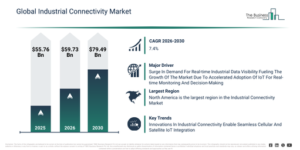
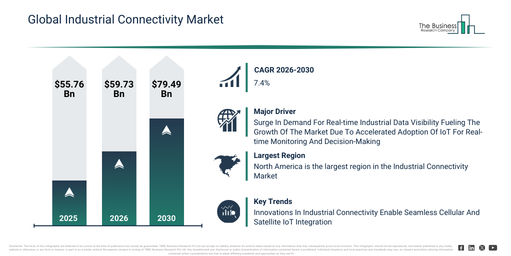
The industrial connectivity market size has experienced significant growth over recent years. It is projected to expand from $55.76 billion in 2025 to $59.73 billion in 2026, achieving a compound annual growth rate (CAGR) of 7.1%. The expansion observed historically is attributable to the advancement of smart manufacturing initiatives, increased adoption of industrial automation, growing demand for low-latency connectivity, the broadening of wired and wireless industrial networks, and the initial integration of industrial Ethernet and fieldbus systems.
The industrial connectivity market size is anticipated to undergo significant expansion over the next few years. It is forecast to increase to $79.49 billion in 2030, achieving a compound annual growth rate (CAGR) of 7.4%. This projected growth during the forecast period stems from the integration of AI and predictive analytics within connectivity, the growing deployment of industrial 5G networks, the expansion of cloud-based industrial network management solutions, an increasing demand for cybersecurity in industrial networks, and the broadening of managed connectivity and optimization services. Noteworthy trends identified for this period include real-time data transmission and monitoring, secure remote connectivity, comprehensive industrial network management, machine-to-machine communication services, and specialized network design and integration services.
Get A Free Sample Report With In-Depth Market Insights:
Industrial Connectivity Market Expansion Drivers: What’s Shaping Future Growth?
The future expansion of the industrial connectivity market is anticipated to be driven by the escalating need for real-time industrial data visibility. This visibility involves the constant acquisition, oversight, and analysis of data produced by industrial processes as it occurs, facilitating quicker decisions and proactive control throughout industrial and supply chain functions. The surge in the need for real-time industrial data visibility stems from the increasing requirement for more rapid, precise, and data-informed decision-making within industrial settings. Industrial connectivity facilitates real-time industrial data visibility by ensuring uninterrupted data flow and communication among machinery, sensors, and software systems. An illustrative example comes from Tive, Inc., a US-based supply chain visibility and logistics technology platform, which reported in March 2024 that 53% of survey participants utilized IoT devices for real-time shipment monitoring, a significant increase from 25% in 2023. Consequently, the rising requirement for real-time industrial data visibility is fueling the expansion of the industrial connectivity market.
Industrial Connectivity Market Segment Landscape: Which Areas Lead Development?
The industrial connectivity market covered in this report is segmented –
1) By Component: Hardware, Software, Services
2) By Technology: Industrial Ethernet, Fieldbus Communication, Cellular Connectivity, Low Power Wide Area Networks, Industrial Wireless Local Area Networks
3) By Network Connectivity: Wired, Wireless
4) By Deployment: On-Premise, Cloud-Based
5) By End Use: Aerospace And Defense, Automotive, Chemical, Energy And Utilities, Food And Beverage, Healthcare, Manufacturing, Mining And Metal, Oil And Gas, Transportation, Other Industrial Connectivity End Users
Subsegments:
1) By Hardware: Industrial Routers, Industrial Switches, Industrial Gateways, Connectivity Modules, Industrial Cables And Connectors, Network Interface Devices
2) By Software: Network Management Software, Industrial Communication Software, Connectivity Middleware, Device Management Software, Data Integration Platforms, Network Security Software
3) By Services: Installation And Configuration Services, Network Design And Engineering Services, Maintenance And Support Services, Managed Connectivity Services, System Integration Services, Network Optimization And Monitoring Services
Industrial Connectivity Market Strategic Trends: What Defines The Next Growth Phase?
Prominent companies in the industrial connectivity sector are concentrating on offering integrated IoT connectivity solutions to assure dependable, always-on communication across various industrial environments, including those that are remote and difficult to reach. Such unified IoT connectivity solutions merge terrestrial and non-terrestrial networks, thereby enabling industrial devices to sustain continuous data transmission for uses such as tracking assets, monitoring remotely, and automating industrial processes. For example, in October 2025, Semtech Corporation, a US-based semiconductor and Internet of Things (IoT) solutions provider, collaborated with Skylo Technologies, Inc., a US-based satellite connectivity provider, to unveil a single-vendor device-to-cloud cellular and satellite IoT solution. This particular solution provides a comprehensive industrial connectivity system from one provider, allowing devices to automatically transition between cellular and satellite networks to guarantee uninterrupted data transmission. It also features a centralized management platform and a smart SIM solution, empowering industrial enterprises to observe, administer, and bill connected devices from a single dashboard, thereby boosting operational efficiency and connectivity reliability across a range of industrial applications.
Industrial Connectivity Market Key Participants And Competitive Landscape
Major companies operating in the industrial connectivity market are Google LLC, Microsoft Corporation, Verizon Business Network Services Inc, Siemens Aktiengesellschaft, International Business Machines Corporation, Cisco Systems Inc, Intel Corporation, Orange SA, Telefonica SA, Schneider Electric SE, Qualcomm Technologies Inc, Honeywell International Inc, ABB Ltd, Rockwell Automation Inc, Belden Inc., PTC Inc., Advantech Co Ltd, Digi International Inc, Moxa Inc, and Inductive Automation LLC
View The Full Industrial Connectivity Market Report:
Industrial Connectivity Market Geographic Analysis: Where Is Demand Accelerating Fastest?
North America was the largest region in the industrial connectivity market in 2025. Asia-Pacific is expected to be the fastest-growing region in the forecast period. The regions covered in the industrial connectivity market report are Asia-Pacific, South East Asia, Western Europe, Eastern Europe, North America, South America, Middle East, Africa.
Reach Out To Our Team:
The Business Research Company: https://www.thebusinessresearchcompany.com/
Americas: +1 310-496-7795
Asia: +44 7882 955267 & +91 8897263534
Europe: +44 7882 955267
Email us at: marketing@tbrc.info
Follow us on:
LinkedIn: https://in.linkedin.com/company/the-business-research-company
YouTube: https://www.youtube.com/channel/UC24_fI0rV8cR5DxlCpgmyFQ
Global Market Model: https://www.thebusinessresearchcompany.com/global-market-model

Wasay has over a decade of experience in market research, data modelling, and analytics, with prior experience at GlobalData and Decision Tree Consulting Services. At The Business Research Company , he leads research operations across syndicated studies, customized consulting engagements, and the Global Market Model platform. His professional experience includes supporting organizations such as Boston Consulting Group, KPMG, and Ernst & Young. Wasay holds a degree in Electronics and Communications Engineering, postgraduate management qualifications from International Management Institute Belgium and Indian School of Business and Entrepreneurship, and completed the Integrated Program in Business Analytics from Indian Institute of Management Indore.