Featuring market attractiveness scoring, total addressable market sizing, company benchmarking matrices, interactive Excel dashboards, deeper supply chain intelligence, emerging startup tracking, and granular product-level insights, The Business Research Company’s 2026 market reports are built to deliver research that is both more actionable and more strategically valuable.
Sparse Models Serving Market Set To Climb From $2.6 Billion In 2026 To $8.34 Billion By 2030
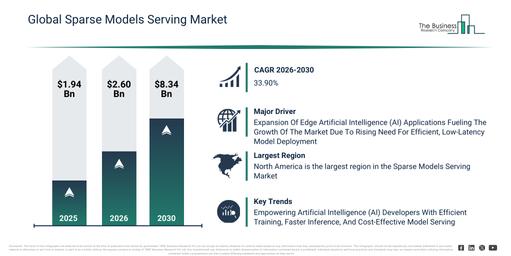
The sparse models serving market size has witnessed substantial exponential growth in recent years. The market’s size is projected to expand from $1.94 billion in 2025 to $2.60 billion in 2026, achieving a compound annual growth rate (CAGR) of 34.2%. This historical expansion can be attributed to the increasing uptake of pruned neural networks, a surging demand for efficient AI inference, the growing implementation of MoE architectures, the widening reach of cloud-based model serving, and an intensified focus on latency reduction.
The sparse models serving market size is anticipated to experience substantial growth in the upcoming years. It is projected to reach $8.34 billion in 2030, demonstrating a compound annual growth rate (CAGR) of 33.9%. This projected growth throughout the forecast period stems from the increasing integration of sparse inference in edge devices, the expanding use of sparsity-aware hardware accelerators, a growing need for energy-efficient AI workloads, the development of cloud-native AI infrastructure, and rising enterprise expenditures on advanced AI optimization tools. Noteworthy trends during this period include improvements in sparsity-optimized AI hardware, novelties in mixture-of-experts routing algorithms, the creation of unified sparse model serving platforms, augmented research and development in pruning and compression methods, and the expansion of cloud-native sparse inference frameworks.
Get A Free Sample Report With In-Depth Market Insights:
Sparse Models Serving Market Demand Drivers Opening New Revenue Streams
The growing deployment of edge artificial intelligence (AI) applications is anticipated to propel the expansion of the sparse models serving market in the future. Edge artificial intelligence (AI) refers to the implementation of AI algorithms directly on local devices, allowing data to be processed near its source rather than solely relying on centralized cloud servers. The surge in edge artificial intelligence (AI) applications stems from the escalating requirement for low-latency processing and instantaneous decision-making across various industries, including automotive, healthcare, retail, and manufacturing. Sparse models support edge artificial intelligence (AI) applications by enabling AI systems to operate efficiently on hardware with limited resources, as they demand fewer parameters, less memory, and reduced computational power while maintaining high accuracy. For instance, in July 2025, the UK’s Department of Science, Innovation and Technology projected that global expenditure on edge computing would rise by 13.8 percent, reaching $380 billion by 2028, thereby encouraging investment in tinyML and energy-efficient chips. Thus, the expansion of edge artificial intelligence (AI) applications is a key driver for the growth of the sparse models serving market.
Sparse Models Serving Market Segment Performance And Emerging Opportunities
The sparse models serving market covered in this report is segmented –
1) By Component: Software, Hardware, Services
2) By Deployment Mod: On-Premises, Cloud
3) By Model Type: Pruned Neural Networks, Mixture-of-Experts (MoE) Models, Quantized Sparse Models, Structured Sparse Models, Unstructured Sparse Models
4) By Application: Natural Language Processing, Computer Vision, Recommendation Systems, Speech Recognition, Other Applications
5) By End-User: Banking, Financial Services, And Insurance (BFSI), Healthcare, Retail And E-Commerce, Information Technology (IT) And Telecommunications, Automotive, Other End-Users
Subsegments:
1) By Software: Sparse Model Inference Engines, Sparse Model Optimization Tools, Model Routing And Orchestration Platforms, Sparse Model Monitoring Software, Sparse Model Deployment Frameworks
2) By Hardware: Sparse Model Optimized Processors, High-Performance Computing Servers, Edge Computing Devices, Memory Efficient Accelerators, Data Center Inference Appliances
3) By Services: Model Optimization Services, Deployment And Integration Services, Consulting And Implementation Services, Managed Inference Services, Maintenance And Support Services
Sparse Models Serving Market Trends Powering Strategic Industry Growth
Companies within the sparse models serving market are concentrating on developing advanced solutions, such as deepseek sparse attention, to enhance the efficiency, speed, and affordability of hosting and delivering large artificial intelligence (AI) models. DeepSeek sparse attention refers to a model architecture’s ability to focus computational resources exclusively on the most relevant segments of input data during both training and inference, leading to faster processing, reduced memory consumption, and significant cost reductions. For example, in September 2025, Hangzhou DeepSeek Artificial Intelligence Co. Ltd., an artificial intelligence (AI) infrastructure provider based in China, launched DeepSeek V3.2 EXP, which introduced DeepSeek Sparse Attention (DSA) to accelerate model training and inference while lowering application programming interface (API) costs by up to 50 percent. This innovation empowers artificial intelligence (AI) developers to train and serve models more rapidly and economically, facilitating the efficient operation of large language models and other compute-intensive architectures in production environments. The update improves performance across various use cases by reducing latency and resource consumption without compromising accuracy or scalability.
Sparse Models Serving Market Competitive Landscape: Who Leads The Industry?
Major companies operating in the sparse models serving market are Google LLC, Microsoft Corporation, NVIDIA Corporation, Amazon Web Services Inc., Oracle Corporation, Qualcomm Technologies Inc., cloudera ai, Cerebras Systems, OpenXcell Technolabs Pvt. Ltd., Cohere Inc., Hugging Face Inc., Mistral AI SAS, Anysphere Inc., SoluLab Inc., InData Labs Inc., World Labs Inc., AlgoScale Technologies Pvt. Ltd., Thinking Machines Lab Inc., DeepSeek AI Co. Ltd.
View The Full Sparse Models Serving Market Report:
Sparse Models Serving Market Geographic Landscape: Which Region Leads Industry Growth?
North America was the largest region in the sparse models serving market in 2025. Asia-Pacific is expected to be the fastest-growing region in the forecast period. The regions covered in the sparse models serving market report are Asia-Pacific, South East Asia, Western Europe, Eastern Europe, North America, South America, Middle East, Africa.
Reach Out To Our Team:
The Business Research Company: https://www.thebusinessresearchcompany.com/
Americas: +1 310-496-7795
Asia: +44 7882 955267 & +91 8897263534
Europe: +44 7882 955267
Email us at: marketing@tbrc.info
Follow us on:
LinkedIn: https://in.linkedin.com/company/the-business-research-company
YouTube: https://www.youtube.com/channel/UC24_fI0rV8cR5DxlCpgmyFQ
Global Market Model: https://www.thebusinessresearchcompany.com/global-market-model

Wasay has over a decade of experience in market research, data modelling, and analytics, with prior experience at GlobalData and Decision Tree Consulting Services. At The Business Research Company , he leads research operations across syndicated studies, customized consulting engagements, and the Global Market Model platform. His professional experience includes supporting organizations such as Boston Consulting Group, KPMG, and Ernst & Young. Wasay holds a degree in Electronics and Communications Engineering, postgraduate management qualifications from International Management Institute Belgium and Indian School of Business and Entrepreneurship, and completed the Integrated Program in Business Analytics from Indian Institute of Management Indore.