Backed by market attractiveness analysis, total addressable market sizing, company benchmarking matrices, interactive Excel dashboards, wider supply chain intelligence, emerging startup coverage, and detailed product-level insights, The Business Research Company’s 2026 market reports are designed to offer research that is more actionable and strategically valuable than ever.
SRv6 Service Chaining Market Size Forecast: How Big Could The Market Get By 2030?
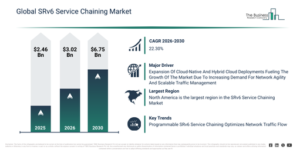
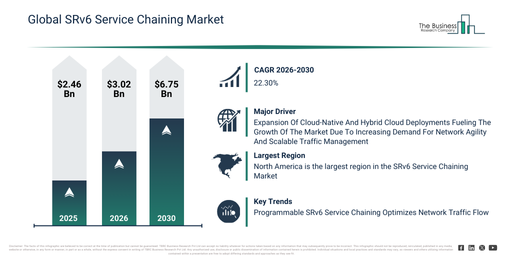
The SRv6 service chaining market has recently demonstrated substantial growth in its overall size. It is projected to expand from $2.46 billion in 2025 to $3.02 billion in 2026, achieving a compound annual growth rate (CAGR) of 22.6%. This historical development is primarily due to several factors, such as an escalating demand for programmable networking, the increasing embrace of network function virtualization, a heightened need for scalable service architectures, the ongoing transition towards IPv6 infrastructure, and the broader expansion of cloud and telecom network deployments.
The SRv6 service chaining market size is projected to undergo substantial growth over the next few years. It is forecast to reach $6.75 billion in 2030, demonstrating a compound annual growth rate (CAGR) of 22.3%. This anticipated growth throughout the forecast period stems from the increasing need for automated service chaining, the expanding adoption of 5G and edge computing, a rising demand for low-latency network services, a heightened focus on network simplification and modernization, and the growing requirement for efficient multi-cloud connectivity. Prominent trends expected during this period encompass technological advancements in micro-segment identifiers, innovation in stateless service function chaining, the development of high-performance SRv6 data planes, progress in automated orchestration utilizing artificial intelligence (AI) and machine learning (ML), and ongoing research and development concerning SRv6 interoperability and standardization.
Get A Free Sample Report With In-Depth Market Insights:
SRv6 Service Chaining Market Expansion Drivers: What’s Shaping Future Growth?
The burgeoning presence of cloud-native and hybrid cloud setups is projected to fuel the expansion of the SRv6 service chaining market moving ahead. These deployments involve operating applications that are either entirely optimized for cloud infrastructure or spread across a mix of on-premises and cloud settings (known as hybrid cloud), aiming for enhanced scalability, adaptability, and operational performance. The increasing adoption of cloud-native and hybrid cloud models is motivated by a rising demand for instantaneous, high-throughput data processing and scalable application solutions. SRv6 service chaining facilitates cloud-native and hybrid cloud environments by allowing adaptable, programmable management of traffic flow across various distributed network functions. This technology enhances network agility and scalability through streamlined service integration, optimized performance, and its capacity to support dynamic, software-defined infrastructures. As an illustration, in October 2025, the Cloud Native Computing Foundation, a US-based cloud native organization, reported that 56% of backend developers were categorized as cloud native in the third quarter of 2025, an increase from 49% in the first quarter of 2025, indicating a notable surge over the past five years. Consequently, the proliferation of cloud-native and hybrid cloud deployments serves as a key impetus for the expansion of the SRv6 service chaining market.
SRv6 Service Chaining Market Segment Landscape: Which Areas Lead Development?
The srv6 service chaining market covered in this report is segmented –
1) By Component: Hardware, Software, Services
2) By Deployment Mode: On-Premises, Cloud-Based
3) By Application: Telecommunications, Data Centers, Cloud Service Providers, Enterprises, Other Applications
4) By End-User: Service Providers, Enterprises, Government, Other End-Users
Subsegments:
1) By Hardware: Network Routers, Switches, Gateways, Network Interface Cards, Traffic Controllers
2) By Software: Orchestration Platforms, Traffic Management Software, Analytics and Monitoring Tools, Security and Policy Software, Network Automation Software
3) By Services: Consulting Services, Implementation Services, Managed Services, Support and Maintenance Services
SRv6 Service Chaining Market Strategic Trends: What Defines The Next Growth Phase?
Key players in the SRv6 service chaining market are concentrating on developing sophisticated network routing solutions, specifically programmable service chaining platforms, with the goal of optimizing traffic flow, reducing network delay, and improving operational effectiveness. Programmable service chaining platforms are innovative technologies that facilitate the routing of network traffic through an ordered series of virtual or physical network functions, such as firewalls, load balancers, and deep packet inspection systems, using instructions based on IPv6. As an illustration, in May 2024, Time dotCom, a telecommunications operator from Malaysia, unveiled its segment routing IPv6 (SRv6) service chaining platform. This solution features built-in IPv6 service direction, dynamic traffic management to ensure stable bandwidth, and customizable service paths that uphold service-level agreements (SLAs) for both enterprise and critical applications. The launch signifies a notable advancement in automating network functions by integrating flexible, IPv6-native routing and service chaining, which empowers operators to efficiently manage complex traffic patterns and support scalable enterprise and carrier-grade deployments. It offers a robust, expandable, and programmable framework for governing modern IP networks and orchestrating services.
SRv6 Service Chaining Market Leading Companies And Competitive Benchmarking
Major companies operating in the srv6 service chaining market are Samsung Electronics Co. Ltd., Huawei Technologies Co. Ltd., Dell Technologies Inc., Telefonaktiebolaget LM Ericsson, Cisco Systems Inc., Intel Corporation, Broadcom Inc., Fujitsu Limited, NEC Corporation, ZTE Corporation, Arista Networks Inc., Marvell Technology Inc., Ciena Corporation, Mavenir Inc., Ribbon Communications Inc., ADVA Optical Networking SE, Ekinops S.A., IP Infusion Inc., H3C Technologies Co. Ltd., Nokia Corporation
View The Full SRv6 Service Chaining Market Report:
SRv6 Service Chaining Market Largest Region By Revenue And Market Share
North America was the largest region in the SRv6 service chaining market in 2025. Asia-Pacific is expected to be the fastest-growing region in the forecast period. The regions covered in the srv6 service chaining market report are Asia-Pacific, South East Asia, Western Europe, Eastern Europe, North America, South America, Middle East, Africa.
Reach Out To Our Team:
The Business Research Company: https://www.thebusinessresearchcompany.com/
Americas: +1 310-496-7795
Asia: +44 7882 955267 & +91 8897263534
Europe: +44 7882 955267
Email us at: marketing@tbrc.info
Follow us on:
LinkedIn: https://in.linkedin.com/company/the-business-research-company
YouTube: https://www.youtube.com/channel/UC24_fI0rV8cR5DxlCpgmyFQ
Global Market Model: https://www.thebusinessresearchcompany.com/global-market-model

Wasay has over a decade of experience in market research, data modelling, and analytics, with prior experience at GlobalData and Decision Tree Consulting Services. At The Business Research Company , he leads research operations across syndicated studies, customized consulting engagements, and the Global Market Model platform. His professional experience includes supporting organizations such as Boston Consulting Group, KPMG, and Ernst & Young. Wasay holds a degree in Electronics and Communications Engineering, postgraduate management qualifications from International Management Institute Belgium and Indian School of Business and Entrepreneurship, and completed the Integrated Program in Business Analytics from Indian Institute of Management Indore.