Backed by market attractiveness analysis, total addressable market sizing, company benchmarking matrices, interactive Excel dashboards, wider supply chain intelligence, emerging startup coverage, and detailed product-level insights, The Business Research Company’s 2026 market reports are designed to offer research that is more actionable and strategically valuable than ever.
Synthetic Application Programming Interface (API) Testing Market Growth Analysis: How Will Revenue Trend Over The Forecast Period?
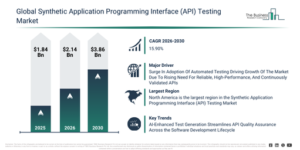
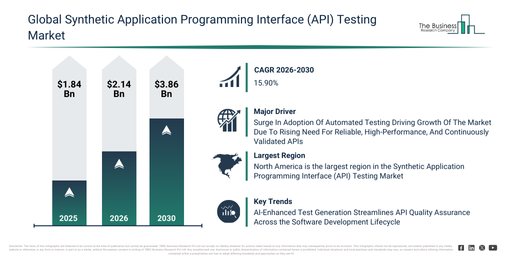
The synthetic application programming interface (API) testing market size has witnessed significant expansion in recent years. It is anticipated to increase from $1.84 billion in 2025 to $2.14 billion in 2026, achieving a compound annual growth rate (CAGR) of 16.2%. Historically, this growth can be ascribed to a wider adoption of application programming interface based architectures, an escalating requirement for proactive application reliability monitoring, more frequent failures in distributed applications leading to synthetic validation, the proliferation of automated software testing practices, and a rising trend towards microservices deployments.
The market for synthetic application programming interface (API) testing is anticipated to experience substantial expansion over the upcoming years. This market is projected to reach $3.86 billion by 2030, exhibiting a compound annual growth rate (CAGR) of 15.9%. Several factors will contribute to this growth during the forecast period, including the increasing incorporation of synthetic testing into continuous delivery processes, the rising need for highly available digital services, the expanding use of artificial intelligence-powered testing automation, the development of Internet of Things ecosystems necessitating API reliability, and a greater emphasis on mobile-first applications. Key trends expected in this period encompass technological progress in autonomous test generation, advancements in artificial intelligence-driven synthetic monitoring, the evolution of integrated functional and performance testing platforms, ongoing research and development in API virtualization, and novel approaches in cloud-native synthetic testing frameworks.
Get A Free Sample Report With In-Depth Market Insights:
Synthetic Application Programming Interface (API) Testing Market Growth Catalysts And Demand Drivers
The expanding use of automated testing is anticipated to boost the synthetic application programming interface (API) testing market’s expansion in the future. Automated testing involves software tools that autonomously run pre-established test scripts to verify API functionality, reliability, and performance, eliminating the need for human intervention. The uptake of automated testing is growing because businesses require quicker, more dependable software releases, incorporating ongoing testing into agile and DevOps workflows, thereby cutting down manual work and production flaws. Synthetic API testing complements automated testing by allowing engineering teams to perform continuous, simulated API requests, which helps identify problems before end-users encounter them and guarantees uniform behavior across different environments. For example, data from PractiTest Ltd., an Israel-based software testing platform, in November 2025, indicated that the percentage of organizations where automation took over 75% or more of manual testing increased from 18% in 2023 to 19% in 2024 and further to 20% in 2025. Consequently, the rising acceptance of automated testing is propelling the expansion of the synthetic application programming interface (API) testing market.
Synthetic Application Programming Interface (API) Testing Market Segmentation And Category Overview
The synthetic application programming interface (api) testing market covered in this report is segmented –
1) By Component: Software, Services
2) By Deployment Mode: Cloud based, On premise
3) By Testing Type: Functional testing, Performance testing, Load testing, Regression testing, End to end synthetic monitoring
4) By Application: Web Services, Mobile Applications, Microservices, IoT Devices, Cloud Application Programming Interfaces
5) By End Use Vertical: Banking Financial Services and Insurance, Information Technology and Telecommunication, Retail and E-commerce, Government, Manufacturing and Automotive, Healthcare, Media and Entertainment, Other End Use Verticals
Subsegments:
1) By Software: Automated Application Programming Interface Testing Tools, Synthetic Monitoring Platforms, Application Programming Interface Virtualization Software, Performance And Load Testing Suites, Continuous Quality Engineering Tools
2) By Services: Implementation Services, Managed Synthetic Testing Services, Consulting And Advisory Services, Training And Support Services, Performance Monitoring Services
Synthetic Application Programming Interface (API) Testing Market Trends Shaping Long-Term Demand
Leading companies within the synthetic API testing market are concentrating on developing advanced technological solutions, notably AI-enhanced test impact analysis, which allows for accurate identification of impacted code sections and the automatic generation of specific test cases. This AI-enhanced test impact analysis involves using machine learning algorithms to scrutinize code modifications, foresee potential errors, and prioritize test execution for optimal effectiveness and precision. For example, in December 2025, Parasoft Inc., a US-based AI-powered software testing solutions company, rolled out its newest Agentic AI functionalities integrated into SOAtest and the Continuous Testing Platform (CTP). This enhancement brings AI-assisted API test scenario generation, empowering testers to develop automated test cases using natural language and service definition files. Moreover, the platform now extends code coverage collection and AI-enhanced test impact analysis to include manual tests for Java and NET applications, helping teams pinpoint exactly which tests require re-execution, thereby shortening retesting periods and enhancing cooperation between development and quality assurance teams.
Synthetic Application Programming Interface (API) Testing Market Competitive Landscape: Who Leads The Industry?
Major companies operating in the synthetic application programming interface (api) testing market are Apidog Inc., OpenText Corporation, Datadog Inc., Dynatrace GmbH, New Relic Inc., Postman Inc., AppDynamics LLC, ThousandEyes Inc., Parasoft Corporation, Katalon Inc., Catchpoint Systems Inc., Sematext Group Inc., Site24x7, Testsigma Technologies Inc., Dotcom-Monitor Inc., Checkly Inc., Uptime.com Inc., Uptrends Monitoring B.V., UptimeRobot Ltd., APImetrics Ltd.
View The Full Synthetic Application Programming Interface (API) Testing Market Report:
Synthetic Application Programming Interface (API) Testing Market Geographic Landscape: Which Region Leads Industry Growth?
North America was the largest region in the synthetic application programming interface (API) testing market in 2025. Asia-Pacific is expected to be the fastest-growing region in the forecast period. The regions covered in the synthetic application programming interface (api) testing market report are Asia-Pacific, South East Asia, Western Europe, Eastern Europe, North America, South America, Middle East, Africa.
Reach Out To Our Team:
The Business Research Company: https://www.thebusinessresearchcompany.com/
Americas: +1 310-496-7795
Asia: +44 7882 955267 & +91 8897263534
Europe: +44 7882 955267
Email us at: marketing@tbrc.info
Follow us on:
LinkedIn: https://in.linkedin.com/company/the-business-research-company
YouTube: https://www.youtube.com/channel/UC24_fI0rV8cR5DxlCpgmyFQ
Global Market Model: https://www.thebusinessresearchcompany.com/global-market-model

Wasay has over a decade of experience in market research, data modelling, and analytics, with prior experience at GlobalData and Decision Tree Consulting Services. At The Business Research Company , he leads research operations across syndicated studies, customized consulting engagements, and the Global Market Model platform. His professional experience includes supporting organizations such as Boston Consulting Group, KPMG, and Ernst & Young. Wasay holds a degree in Electronics and Communications Engineering, postgraduate management qualifications from International Management Institute Belgium and Indian School of Business and Entrepreneurship, and completed the Integrated Program in Business Analytics from Indian Institute of Management Indore.