Built to provide research that’s more actionable and strategically valuable, The Business Research Company’s 2026 market reports include market attractiveness analysis, total addressable market sizing, company benchmarking matrices, interactive Excel dashboards, broader supply chain intelligence, emerging startup tracking, and in-depth product insights.
Synthetic Data Generation For Natural Language Processing (NLP) Market Growth Potential: How Will Market Size Shift Through 2030?
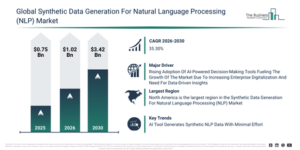
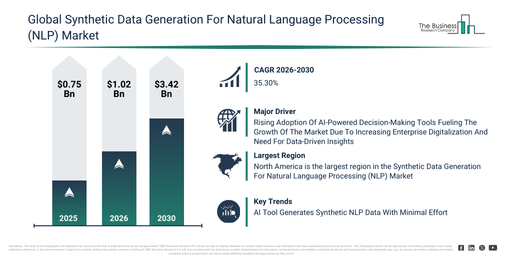
The synthetic data generation for nlp market size has experienced substantial growth in recent years. It is anticipated to expand from $0.75 billion in 2025 to $1.02 billion in 2026, exhibiting a compound annual growth rate (CAGR) of 35.6%. This historical expansion can be attributed to factors such as increasing demand for natural language processing, a growing need for data privacy, the rising adoption of artificial intelligence, the expansion of machine learning applications, and an increasing focus on data augmentation.
The synthetic data generation for nlp market size is projected to experience rapid expansion over the coming years. This market is predicted to reach $3.42 billion by 2030, exhibiting a compound annual growth rate (CAGR) of 35.3%. Factors driving this expansion during the forecast period include increasing investments in AI research, wider adoption of cloud-based solutions, a growing need for multilingual NLP models, the broadening scope of enterprise automation, and a heightened emphasis on using synthetic data for model training. Key trends anticipated for the forecast period encompass technological advancements in deep learning, novel innovations in generative models, progress in NLP algorithms, ongoing research and development in data simulation, and a stronger integration of AI with business intelligence systems.
Get A Free Sample Report With In-Depth Market Insights:
Synthetic Data Generation For Natural Language Processing (NLP) Market Growth Drivers: What’s Behind The Acceleration?
The synthetic data generation for natural language processing (NLP) market is projected to expand moving forward, driven by the increasing integration of AI-powered decision-making tools. These tools are defined as software systems leveraging artificial intelligence, including machine learning and predictive analytics, to automate and improve business decisions and generate insights. This surge in adoption stems from escalating enterprise digitalization and the demand for strategically sound, data-driven decisions. By providing rich, scalable text datasets, synthetic data generation for NLP reinforces AI-powered decision-making tools, thereby boosting model accuracy and refining decision efficiency. An illustrative example from January 2025 reveals that, as per Eurostat, a Luxembourg-based statistical office of the European Union, the year 2024 saw 13.5% of enterprises employing 10 or more staff utilize AI technologies, which is an increase from 8.0% in 2023, representing a 5.5 percentage-point rise. Consequently, the growing uptake of AI-powered decision-making tools is serving as a catalyst for the expansion of the synthetic data generation for natural language processing (NLP) market.
Synthetic Data Generation For Natural Language Processing (NLP) Market Segment Performance And Emerging Opportunities
The synthetic data generation for natural language processing (nlp) market covered in this report is segmented –
1) By Component: Software, Services
2) By Deployment Mode: On-Premises, Cloud
3) By Technology: Large Language Model (LLM) -Based Generation, Rule-based And Template-driven Generation, Data Augmentation And Perturbation Techniques
4) By Application: Text Classification, Sentiment Analysis, Machine Translation, Named Entity Recognition, Question Answering, Other Applications
5) By End-User: Banking, Financial Services, And Insurance, Healthcare, Retail And E-Commerce, Information Technology (IT) And Telecommunications, Media And Entertainment, Other End-Users
Subsegments:
1) By Software: Data Synthesis Tools, Language Model Training Software, Natural Language Processing Algorithms, Data Augmentation Platforms, Text Generation Frameworks
2) By Services: Data Annotation Services, Model Training Services, Consulting And Integration Services, Technical Support Services, Custom Synthetic Data Development Services
Synthetic Data Generation For Natural Language Processing (NLP) Market Trends: What’s Defining The Industry’s Next Phase?
Key players in the synthetic data generation for natural language processing (NLP) market are prioritizing the development of sophisticated platforms, including AI-driven synthetic data generators, to increase efficiency, bolster data privacy, and reduce the time and expense involved in creating datasets. An AI-powered synthetic data generator refers to a tool that leverages Large Language Models (LLMs) to autonomously produce artificial text datasets, designed to imitate real-world information based on natural language descriptions. For instance, in December 2024, Hugging Face, a US-based open-source AI platform company, introduced its Synthetic Data Generator. This particular tool is an accessible, web-based solution facilitating dataset creation for applications such as text classification and conversational AI through a straightforward three-step process, which significantly lowers technical hurdles and minimizes manual input. Key features include automatic system prompt generation and configuration refinement, allowing for the easy development of customized datasets without extensive technical involvement. Furthermore, it offers direct integration with platforms like Argilla for dataset review and Hugging Face AutoTrain for instant model training, thereby broadening the applicability of the generated data and establishing an efficient workflow from initial prompt to final model deployment.
Synthetic Data Generation For Natural Language Processing (NLP) Market Top Companies Driving Competitive Growth
Major companies operating in the synthetic data generation for natural language processing (nlp) market are Amazon Web Services Inc., Microsoft Corporation, OpenAI Inc., Writer Inc., Google DeepMind, Cohere Inc., Anthropic PBC, AI21 Labs Ltd., Hugging Face Inc., Gretel Labs Inc., Tonic.ai Inc., Synthesis AI Inc., Mostly AI GmbH, Hazy Ltd., DataGenie Inc., DataCebo Inc., Statice GmbH, Snorkel AI Inc., Synthesized Ltd., YData Ltd.
View The Full Synthetic Data Generation For Natural Language Processing (NLP) Market Report:
Synthetic Data Generation For Natural Language Processing (NLP) Market Global Footprint: Which Region Leads The Industry?
North America was the largest region in the synthetic data generation for nlp market in 2025. Asia-Pacific is expected to be the fastest-growing region in the forecast period. The regions covered in the synthetic data generation for natural language processing (nlp) market report are Asia-Pacific, South East Asia, Western Europe, Eastern Europe, North America, South America, Middle East, Africa.
Reach Out To Our Team:
The Business Research Company: https://www.thebusinessresearchcompany.com/
Americas: +1 310-496-7795
Asia: +44 7882 955267 & +91 8897263534
Europe: +44 7882 955267
Email us at: marketing@tbrc.info
Follow us on:
LinkedIn: https://in.linkedin.com/company/the-business-research-company
YouTube: https://www.youtube.com/channel/UC24_fI0rV8cR5DxlCpgmyFQ
Global Market Model: https://www.thebusinessresearchcompany.com/global-market-model

Wasay has over a decade of experience in market research, data modelling, and analytics, with prior experience at GlobalData and Decision Tree Consulting Services. At The Business Research Company , he leads research operations across syndicated studies, customized consulting engagements, and the Global Market Model platform. His professional experience includes supporting organizations such as Boston Consulting Group, KPMG, and Ernst & Young. Wasay holds a degree in Electronics and Communications Engineering, postgraduate management qualifications from International Management Institute Belgium and Indian School of Business and Entrepreneurship, and completed the Integrated Program in Business Analytics from Indian Institute of Management Indore.