Featuring market attractiveness scoring, total addressable market sizing, company benchmarking matrices, interactive Excel dashboards, deeper supply chain intelligence, emerging startup tracking, and granular product-level insights, The Business Research Company’s 2026 market reports are built to deliver research that is both more actionable and more strategically valuable.
Voicebot Market Growth Potential: How Will Market Size Shift Through 2030?
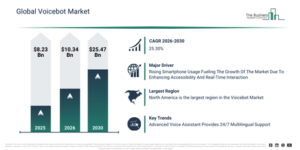
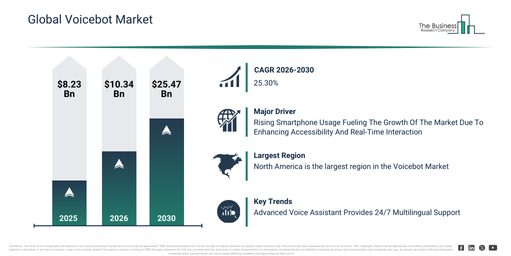
The voicebot market has witnessed substantial expansion in recent years. It will grow from $8.23 billion in 2025 to $10.34 billion in 2026 at a Compound Annual Growth Rate (CAGR) of 25.6%. This historic increase can be attributed to various factors, such as the increasing embrace of smart speakers and voice assistants, a heightened need for contact center automation and the replacement of Interactive Voice Response (IVR) systems, the expanding use of smartphone voice search and mobile voice applications, larger enterprise budgets for digital transformation aimed at enhancing customer experience (CX), and notable improvements in the accuracy of automatic speech recognition (ASR) and natural language understanding (NLU).
The voicebot market is anticipated to experience substantial growth in the upcoming years. It is forecast to grow to $25.47 billion in 2030, showing a Compound Annual Growth Rate (CAGR) of 25.3%. This expansion during the forecast period can be attributed to the increasing integration of generative artificial intelligence (AI) into voice agents, the growing adoption of on-device and edge voice processing, rising enterprise investments in artificial intelligence (AI)-driven customer experience (CX), expanding multilingual and localization support worldwide, and accelerating regulatory clarity and enterprise data governance. Noteworthy trends expected in this period include innovation in generative artificial intelligence-powered conversational voice, technological advancements in contextual natural language understanding (NLU) and dialogue management, the development of multimodal voice and visual interaction systems, research and development in voice biometrics and security, and innovation in real-time voice analytics and personalization.
Get A Free Sample Report With In-Depth Market Insights:
Voicebot Market Industry Drivers: What’s Behind The Revenue Growth?
The expanding adoption of smartphones is anticipated to fuel the expansion of the voicebot market in the coming years. Smartphones are defined as sophisticated mobile gadgets that offer internet access, application functionality, and live communication capabilities. The use of smartphones is increasing, driven by the swift growth of mobile internet connections, which allows users to engage with online services and conduct global shopping at their convenience. Smartphone utilization improves voicebot performance by facilitating widespread availability, immediate interaction, and seamless connection with mobile applications and sensors. This leads to better user engagement, enhanced personalization, and more effective voice-powered assistance. For example, data from November 2024, released by Eurostat, the European Union’s (EU) official statistical office located in Luxembourg, revealed that approximately 89% of EU residents between 16 and 74 years old residing in cities used their smartphones for internet access in 2023. This figure was 86% for those in towns and suburbs, and 82% in rural regions. Consequently, the growing adoption of smartphones is propelling the expansion of the voicebot market.
Voicebot Market Segment Landscape And Growth Outlook
The voicebot market covered in this report is segmented –
1) By Type: Rule-based Voice Bots, Artificial Intelligence-Assisted Voice Bots, Conversational Voice Bots
2) By Technology: Natural Language Understanding, Natural Language Processing, Machine Learning, Automatic Speech Recognition, Text To Speech, Other Technologies
3) By Deployment Model: Cloud-Based, On-Premises, Hybrid
4) By Application: Customer Service, Task Automation, Data Analytics, Knowledge Management, Voice-Enabled Services
5) By End-User: Banking, Financial Services, And Insurance (Bfsi), Retail And E-commerce, Healthcare, Travel And Hospitality
Subsegments:
1) By Rule-based Voice Bots: Voice Command Response Systems, Scripted Interaction Engines, Decision Tree Automation Bots, Keyword Triggered Voice Systems
2) By Artificial Intelligence-Assisted Voice Bots: Natural Language Understanding Voice Systems, Machine Learning Enhanced Voice Agents, Context Aware Voice Interaction Bots, Predictive Response Voice Platforms
3) By Conversational Voice Bots: Human Like Conversational Assistants, Real Time Dialogue Management Bots, Emotion Adaptive Voice Systems, Multilingual Conversational Voice Agents
#Voicebot Market Growth Trends: What’s Shaping The Future Outlook?
Leading companies in the voicebot market are concentrating on developing advanced offerings, such as AI-driven voicebots, to improve efficiency, upgrade customer service, and reduce manual tasks. These AI-powered voicebots represent sophisticated conversational AI platforms that utilize natural language processing to comprehend and respond to spoken inquiries, providing immediate, continuous support. For instance, in April 2025, BLS International, an India-based firm specializing in visa processing and consular services, launched an industry-first AI-powered voicebot for visa applicants in Canada. This fully automated, voice-based assistant incorporates a phased rollout strategy, beginning with English support and expanding to more than 22 languages, thereby significantly boosting accessibility for a global user base. It includes smart query handling and automatic response features, facilitating seamless guidance on visa documentation and procedures without human intervention. The system also plans for an AI-enhanced email system and a comprehensive quality management framework, ensuring service consistency and developing the next generation of citizen-facing technologies.
Voicebot Market Competitive Landscape: Who Leads The Industry?
Major companies operating in the voicebot market are Amazon.com Inc., Google LLC, Microsoft Corporation, International Business Machines Corporation, OpenAI L.L.C., Twilio Inc., Genesys Telecommunications Laboratories Inc., LivePerson Inc., Kore.ai Inc., Veritone Inc., Observe.AI, Boost AI AS, SoundHound Inc., Inbenta Holdings Inc., AssemblyAI Inc., Cerence Inc., Cognigy GmbH, Rasa Technologies Inc., Speechmatics Ltd., Deepgram Inc., Kasisto Inc., VoiceBase Inc., Clinc Inc., Speechly Oy
View The Full Voicebot Market Report:
Voicebot Market Geographic Landscape: Which Region Dominates Industry Growth?
North America was the largest region in the voicebot market in 2025. Asia-Pacific is expected to be the fastest-growing region in the forecast period. The regions covered in the voicebot market report are Asia-Pacific, South East Asia, Western Europe, Eastern Europe, North America, South America, Middle East, Africa.
Reach Out To Our Team:
The Business Research Company: https://www.thebusinessresearchcompany.com/
Americas: +1 310-496-7795
Asia: +44 7882 955267 & +91 8897263534
Europe: +44 7882 955267
Email us at: marketing@tbrc.info
Follow us on:
LinkedIn: https://in.linkedin.com/company/the-business-research-company
YouTube: https://www.youtube.com/channel/UC24_fI0rV8cR5DxlCpgmyFQ
Global Market Model: https://www.thebusinessresearchcompany.com/global-market-model

Wasay has over a decade of experience in market research, data modelling, and analytics, with prior experience at GlobalData and Decision Tree Consulting Services. At The Business Research Company , he leads research operations across syndicated studies, customized consulting engagements, and the Global Market Model platform. His professional experience includes supporting organizations such as Boston Consulting Group, KPMG, and Ernst & Young. Wasay holds a degree in Electronics and Communications Engineering, postgraduate management qualifications from International Management Institute Belgium and Indian School of Business and Entrepreneurship, and completed the Integrated Program in Business Analytics from Indian Institute of Management Indore.