Enhanced with market attractiveness analysis, total addressable market evaluation, company benchmarking matrices, interactive Excel dashboards, expanded supply chain intelligence, emerging startup coverage, and detailed product insights, The Business Research Company’s 2026 market reports deliver more actionable and strategically valuable research.
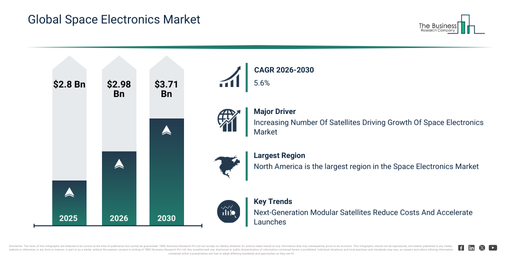
Space Electronics Market Growth From $2.98 Billion In 2026 To $3.71 Billion By 2030 At A CAGR Of 5.63%
The space electronics market size is projected to experience substantial expansion over the coming years, reaching $3.71 billion by 2030, driven by a compound annual growth rate (CAGR) of 5.6%. This projected growth is primarily due to increased investment in compact, high-performance electronics for small satellite constellations, a surging need for advanced radiation-tolerant components for deep space missions, the creation of versatile sensor systems that improve spacecraft autonomy, the wider use of modular electronic designs to cut down on integration time and expenses, and the expansion of commercial space ventures which fuels the demand for scalable space electronics solutions. Key trends anticipated during this period include a heightened need for radiation-hardened electronics tailored for deep-space missions, the increasing deployment of miniature sensors in small satellites, a greater integration of multi-functional electronic components within spacecraft, continuous improvements in thermal and radiation shielding materials, and the ongoing growth of commercial satellite constellations that necessitate rugged electronic systems.
The growing count of satellites is anticipated to fuel the expansion of the space electronics market in the foreseeable future. A satellite is defined as any object orbiting a celestial body like a planet, star, or moon. This surge in satellite numbers stems from the escalating need for worldwide communication and connectivity. Due to their susceptibility to charging and discharging, satellites necessitate specialized space components, including space electronics, that are free of floating metal. As an illustration, in January 2024, a report from the Space Foundation, a US-based non-profit organization, indicated that global launch activity reached unprecedented levels for the third year in a row, recording 223 launch attempts and 212 successes. Commercial launches alone saw a 50% increase compared to 2022. More than 2,800 satellites were deployed into orbit, representing a 23% rise from the preceding year. Consequently, the expanding number of satellites is a key factor propelling the growth of the space electronics market.
Download A Free Sample Report For Comprehensive Market Insights:
Space Electronics Market Growth Momentum: Which Factors Are Influencing Demand?
Leading companies in the space electronics market are prioritizing the development of innovative solutions, such as modular satellite platforms, to accelerate satellite deployment and decrease mission expenses. These modular platforms are spacecraft constructed from standardized, interchangeable modules that can be rapidly assembled or reconfigured, thereby shortening development times, lowering costs, and enabling quicker, more flexible satellite missions. For instance, in July 2025, the National Aeronautics and Space Administration (NASA), a U.S.-based government space agency, launched the Athena EPIC satellite aboard a SpaceX Falcon 9 rocket as part of a rideshare mission. This mission evaluated a groundbreaking scalable satellite architecture designed to allow multiple payloads to share onboard electronics and resources, which reduces costs and facilitates faster deployment of instruments for Earth observation and scientific research. Athena EPIC employs Hyper-Integrated Satlets (HISats), modular building-block components that can be combined into larger structures called SensorCraft. This allows the satellite to manage routine functions like heating, power, and control through the HISats, rather than relying on separate systems for each payload. The sensor payload integrated into Athena EPIC was built using spare parts from previous NASA missions, showcasing an economical approach to reusing proven technology.
Space Electronics Market Segments: Where Are The Largest Growth Opportunities?
The space electronics market covered in this report is segmented –
1) By Type: Radiation Hardened, Radiation Tolerant
2) By Component: Microprocessors And Controllers, Sensors, Application Specific Integrated Circuits, Memory Chips, Power Source Cables, Discrete Semiconductors, Other Components
3) By Platform: Satellite, Launch Vehicles, Deep Space Probes
4) By Application: Communication, Earth Observation, Navigation, Global Positioning System (GPS), Technology Development And Education, Other Applications
Subsegments:
1) By Radiation Hardened: Analog Components, Digital Components, Power Management ICs, Mixed-Signal Components
2) By Radiation Tolerant: Microprocessors, FPGAs (Field Programmable Gate Arrays), Memory Devices, Logic Devices
Space Electronics Market Growth Trends Influencing Competitive Dynamics
Leading companies in the space electronics market are prioritizing the development of innovative solutions, such as modular satellite platforms, to accelerate satellite deployment and decrease mission expenses. These modular platforms are spacecraft constructed from standardized, interchangeable modules that can be rapidly assembled or reconfigured, thereby shortening development times, lowering costs, and enabling quicker, more flexible satellite missions. For instance, in July 2025, the National Aeronautics and Space Administration (NASA), a U.S.-based government space agency, launched the Athena EPIC satellite aboard a SpaceX Falcon 9 rocket as part of a rideshare mission. This mission evaluated a groundbreaking scalable satellite architecture designed to allow multiple payloads to share onboard electronics and resources, which reduces costs and facilitates faster deployment of instruments for Earth observation and scientific research. Athena EPIC employs Hyper-Integrated Satlets (HISats), modular building-block components that can be combined into larger structures called SensorCraft. This allows the satellite to manage routine functions like heating, power, and control through the HISats, rather than relying on separate systems for each payload. The sensor payload integrated into Athena EPIC was built using spare parts from previous NASA missions, showcasing an economical approach to reusing proven technology.
Space Electronics Market Major Participants And Competitive Dynamics
Major companies operating in the space electronics market are BAE Systems PLC, Texas Instruments, Inc., Cobham PLC, Honeywell International Inc., STMicroelectronics, Teledyne e2v (UK) Ltd., TT Electronics, Ruag Group, Infineon Technologies, Onsemi, Renesas Electronics Corporation, Analog Devices Inc., Microchip Technology Inc., NXP Semiconductors, Vishay Intertechnology Inc., Silicon Laboratories Inc., L3Harris Technologies Inc., Lockheed Martin Corporation, Northrop Grumman Corporation, Raytheon Technologies Corporation, Thales Group, Airbus Defence and Space
Access The Complete Space Electronics Market Report:
Space Electronics Market Largest Region By Revenue And Market Share
North America was the largest region in the space electronics market in 2025. Asia-Pacific is expected to be the fastest-growing region in the space electronics market report during the forecast period. The regions covered in the space electronics market report are Asia-Pacific, South East Asia, Western Europe, Eastern Europe, North America, South America, Middle East, Africa.
Access a Customized Space Electronics Market Report for Deeper Competitive Insights
https://www.thebusinessresearchcompany.com/customise?id=8041&type=smp
The Business Research Company: https://www.thebusinessresearchcompany.com/
Americas: +1 310-496-7795
Asia: +44 7882 955267 & +91 8897263534
Europe: +44 7882 955267
Email us at: marketing@tbrc.info
Follow us on:
LinkedIn: https://in.linkedin.com/company/the-business-research-company
YouTube: https://www.youtube.com/channel/UC24_fI0rV8cR5DxlCpgmyFQ
Global Market Model: https://www.thebusinessresearchcompany.com/global-market-model

Wasay has over a decade of experience in market research, data modelling, and analytics, with prior experience at GlobalData and Decision Tree Consulting Services. At The Business Research Company , he leads research operations across syndicated studies, customized consulting engagements, and the Global Market Model platform. His professional experience includes supporting organizations such as Boston Consulting Group, KPMG, and Ernst & Young. Wasay holds a degree in Electronics and Communications Engineering, postgraduate management qualifications from International Management Institute Belgium and Indian School of Business and Entrepreneurship, and completed the Integrated Program in Business Analytics from Indian Institute of Management Indore.