Built to provide research that’s more actionable and strategically valuable, The Business Research Company’s 2026 market reports include market attractiveness analysis, total addressable market sizing, company benchmarking matrices, interactive Excel dashboards, broader supply chain intelligence, emerging startup tracking, and in-depth product insights.
#Demand Respnse (DR) Market Revenue Outlook: What CAGR Lies Ahead Through 2030?#_x000D_
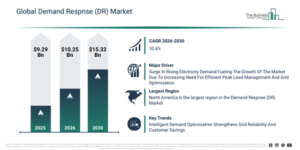
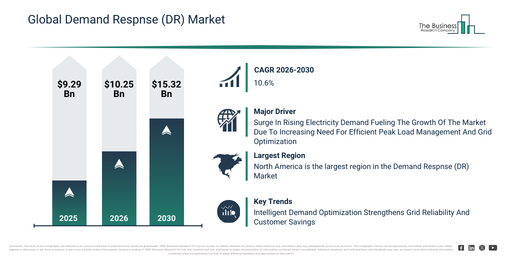
The demand response (dr) market has seen swift expansion in recent years. It is projected to grow from $9.29 billion in 2025 to $10.25 billion in 2026, achieving a compound annual growth rate (CAGR) of 10.3%. The market’s historical growth can be attributed to several factors: rising peak electricity demand, grid congestion and reliability challenges, the emergence of early utility-led demand response programs, increasing electricity price volatility, and the widespread deployment of smart meters and advanced metering infrastructure._x000D_
_x000D_
The demand respnse (dr) market size is set for significant expansion in the coming years. It is forecast to grow to $15.32 billion in 2030 at a compound annual growth rate (CAGR) of 10.6%. This growth during the forecast period is propelled by factors such as a higher uptake of renewable energy sources, the expansion of electric vehicle charging requirements, more stringent grid reliability and flexibility demands, the increasing adoption of cloud-based DR platforms, and enhanced incentives for demand-side energy management. Notable trends for the forecast period encompass the rising implementation of automated demand response programs, greater engagement in capacity and ancillary service markets, an increase in real-time energy consumption monitoring and analytics, the growing utilization of load aggregation platforms for commercial users, and the integration of demand response with distributed energy resources._x000D_
_x000D_
#Get A Free Sample Report With In-Depth Market Insights:#_x000D_
_x000D_
#Demand Respnse (DR) Market Industry Drivers: What’s Behind The Revenue Growth?#_x000D_
An anticipated increase in electricity demand is set to drive the expansion of the demand response (DR) market moving ahead. Electricity demand signifies the overall quantity of electrical power utilized or needed by consumers during a particular timeframe. This surge in electricity demand stems from swift urbanization and industrialization, given that growing urban areas and industries necessitate more power for infrastructure, production, and everyday energy use. Demand response offers advantages to the electricity sector by regulating peak electricity consumption, enhancing grid stability, and lessening the reliance on costly power generation facilities and system enhancements. For example, in July 2025, the International Energy Agency (IEA), an intergovernmental body based in France, forecasts electricity consumption will rise by 3.3% in 2025 and by 3.7% in 2026. Consequently, the escalating electricity demand serves as a key driver for the demand response (DR) market’s growth._x000D_
_x000D_
#Demand Respnse (DR) Market Segmentation: How Does The Market Break Down By Category?#_x000D_
The demand respnse (dr) market covered in this report is segmented – _x000D_
_x000D_
1) By Type: Automated Demand Response (Adr); Manual Demand Response; Price-Based Demand Response; Incentive-Based Demand Response_x000D_
2) By Deployment Type: On-Premise; Cloud Or Remote_x000D_
3) By Solution: System; Services_x000D_
4) By Application Area: Load Shifting; Peak Load Management; Frequency Regulation; Capacity Market Participation_x000D_
5) By End User: Manufacturing; Agriculture; Government Buildings; Colleges And Universities; Commercial Buildings; Hospitals; Data Centers; Other End Users_x000D_
_x000D_
Subsegments:_x000D_
1) By Automated Demand Response: Direct Load Control; Temperature Setback Control; Lighting Control; Equipment Cycling Control; Demand Response Scheduling And Dispatch_x000D_
2) By Manual Demand Response: Customer-Initiated Load Reduction; Manual Equipment Shutdown; Manual Lighting Adjustment; On-Demand Load Curtailment_x000D_
3) By Price-Based Demand Response: Time Of Use Pricing; Critical Peak Pricing; Real-Time Pricing; Peak Time Rebate Programs) _x000D_
4) By Incentive-Based Demand Response: Capacity Bidding Programs; Ancillary Services Participation; Emergency Demand Response Programs; Load Aggregation Incentive Programs_x000D_
_x000D_
#Demand Respnse (DR) Market Growth Trends: What’s Shaping The Future Outlook?_x000D_
Leading firms within the demand response (DR) sector are concentrating their efforts on creating AI-driven solutions for demand response and optimizing loads, aiming to boost grid adaptability, elevate system dependability, and lower power expenses for business and industrial clients. Such sophisticated solutions utilize AI and live grid information to automatically modify electricity usage during high-demand times, assisting in balancing supply with demand and simultaneously maximizing monetary rewards for those involved. As an illustration, during July 2025, Constellation Energy, an energy enterprise based in the US, introduced an AI-enabled demand response initiative within the PJM Interconnection market, working together with GridBeyond, an energy technology company from Ireland. This initiative employs GridBeyond’s AI-powered optimization platform to autonomously handle customer loads, reacting to prevailing grid conditions and market pricing signals. Its purpose is to enhance grid adaptability, strengthen resilience during periods of elevated demand, and provide substantial cost reductions for participating customers, all while contributing to PJM’s overarching goals for grid reliability._x000D_
_x000D_
#Demand Respnse (DR) Market Leading Players And Competitive Positioning#_x000D_
Major companies operating in the demand respnse (dr) market are Siemens AG, International Business Machines Corporation, Cisco Systems Incorporated, Oracle Corporation, Schneider Electric SE, Honeywell International Incorporated, Eaton Corporation Plc, Nexant Incorporated, Itron Incorporated, Landis+Gyr Group AG, Open Systems International Inc., Aclara Technologies LLC, Enel X Italia Srl, Open Access Technology International, Opus One Solutions Energy Corporation, Sympower B.V., GridBeyond Limited, CPower Energy Management LLC, OhmConnect Incorporated, Virtual Peaker Incorporated, Bidgely Incorporated, and Leap Energy Incorporated. _x000D_
_x000D_
#View The Full Demand Respnse (DR) Market Report:#_x000D_
_x000D_
#Demand Respnse (DR) Market Regional Distribution: Which Areas Power Market Growth?#_x000D_
North America was the largest region in the demand response (DR) market in 2025. Asia-Pacific is expected to be the fastest-growing region in the forecast period. The regions covered in the demand respnse (dr) market report are Asia-Pacific, South East Asia, Western Europe, Eastern Europe, North America, South America, Middle East, Africa._x000D_
_x000D_
#Reach Out To Our Team:#_x000D_
_x000D_
The Business Research Company: https://www.thebusinessresearchcompany.com/_x000D_
Americas: +1 310-496-7795_x000D_
Asia: +44 7882 955267 & +91 8897263534_x000D_
Europe: +44 7882 955267_x000D_
Email us at: marketing@tbrc.info_x000D_
_x000D_
#Follow us on:#_x000D_
_x000D_
LinkedIn: https://in.linkedin.com/company/the-business-research-company_x000D_
YouTube: https://www.youtube.com/channel/UC24_fI0rV8cR5DxlCpgmyFQ_x000D_
Global Market Model: https://www.thebusinessresearchcompany.com/global-market-model

Wasay has over a decade of experience in market research, data modelling, and analytics, with prior experience at GlobalData and Decision Tree Consulting Services. At The Business Research Company , he leads research operations across syndicated studies, customized consulting engagements, and the Global Market Model platform. His professional experience includes supporting organizations such as Boston Consulting Group, KPMG, and Ernst & Young. Wasay holds a degree in Electronics and Communications Engineering, postgraduate management qualifications from International Management Institute Belgium and Indian School of Business and Entrepreneurship, and completed the Integrated Program in Business Analytics from Indian Institute of Management Indore.