
Featuring market attractiveness scoring, total addressable market sizing, company benchmarking matrices, interactive Excel dashboards, deeper supply chain intelligence, emerging startup tracking, and granular product-level insights, The Business Research Company’s 2026 market reports are built to deliver research that is both more actionable and more strategically valuable.
Lifecycle Service Orchestration Market Poised To Hit $4.63 Billion By 2030 With A 13% CAGR
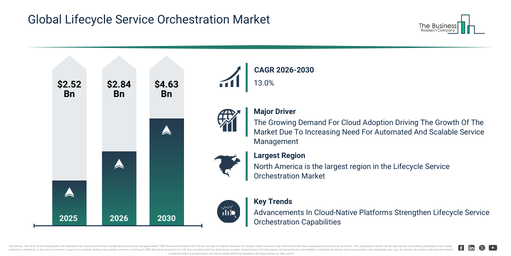
The market size for lifecycle service orchestration has experienced swift expansion recently. This market is projected to grow from $2.52 billion in 2025 to $2.84 billion in 2026, demonstrating a compound annual growth rate (CAGR) of 12.7%. Historically, this expansion has been driven by factors such as the increasing intricacy of enterprise IT landscapes, the heightened embrace of cloud services, the imperative for enhanced operational efficiency, the initial implementation of orchestration solutions, and a burgeoning requirement for dependable service delivery.
The lifecycle service orchestration market is projected to expand significantly over the coming years. Its valuation is anticipated to reach $4.63 billion by 2030, exhibiting a compound annual growth rate (CAGR) of 13.0%. This projected expansion during the forecast period stems from factors such as the broadening of hybrid and multi-cloud infrastructures, the integration of AI-powered service management, a rising need for automated incident resolution, an increase in IT service management integration, and a heightened emphasis on compliance and regulatory adherence. Key developments expected during this period involve lifecycle automation and orchestration, service monitoring and performance enhancement, configuration and change oversight, incident and fault resolution, and ensuring service assurance and compliance.
Get A Free Sample Report With In-Depth Market Insights:
Lifecycle Service Orchestration Market Opportunity Drivers: What’s Unlocking New Revenue Potential?
The increasing demand for cloud adoption is expected to propel the growth of the lifecycle service orchestration market going forward. Cloud adoption signifies the shift from conventional on-premises IT infrastructure to cloud-based computing platforms, which offer scalable resources, adaptable service delivery, and real-time management across digital environments. The surge in cloud adoption is motivated by organizations seeking agile, cost-efficient platforms to support digital transformation efforts and scalable service delivery models. Lifecycle service orchestration facilitates cloud adoption by enabling automated deployment, coordination, and optimization of services across complex cloud environments, assisting organizations in reducing operational complexity and enhancing efficiency. For instance, in March 2025, according to the Office for National Statistics, a UK-based government department, in 2023, artificial intelligence (AI) was adopted by 9% of firms, while cloud-based computing systems and applications were adopted by 69% of firms in the UK. Therefore, the growing demand for cloud adoption is driving the growth of the lifecycle service orchestration market. The rising demand for 5G networks is anticipated to propel the growth of the lifecycle service orchestration market going forward. 5G networks are fifth-generation wireless cellular networks that deliver faster data speeds, lower latency, and enhanced connectivity capacity compared to earlier generations. The escalating demand for 5G networks is fueled by the need for improved mobile broadband services, as increased smartphone usage and the digitalization of industries necessitate higher data capacity and quicker connectivity infrastructure. The demand for 5G networks stimulates lifecycle service orchestration growth by creating a need for automated service orchestration platforms that can effectively manage and coordinate the complex lifecycle of diverse network services across virtualized 5G infrastructure. For instance, in March 2024, according to 5G Americas, a US-based wireless industry trade association, by the end of 2023, there were 1.76 billion 5G connections worldwide, reflecting an addition of 700 million connections during the year, a 66% growth compared to 2022. Additionally, global 5G connections are projected to reach 7.9 billion by 2028. Therefore, the rising demand for 5G networks is driving the growth of the lifecycle service orchestration market.
Lifecycle Service Orchestration Market Segment Landscape: Which Areas Lead Development?
The lifecycle service orchestration market covered in this report is segmented –
1) By Service Type: Managed Services, Professional Services, Consulting Services
2) By Deployment Model: On-Premises, Cloud-Based, Hybrid
3) By Organization Size: Large Enterprises, Small And Medium Enterprises
4) By Application: Network Orchestration, Service Orchestration, Cloud Resource Orchestration
5) By End-User Industry: Telecommunications, Information Technology Services, Banking, Financial Services, And Insurance (BFSI), Healthcare, Retail
Subsegments:
1) By Managed Services: Remote Monitoring, Incident Management, Patch Management, Backup And Recovery, Security Management
2) By Professional Services: Implementation Services, Integration Services, Migration Services, Training Services, Support Services
3) By Consulting Services: Strategy Consulting, Process Optimization, Risk Assessment, Compliance Consulting, Technology Advisory
Lifecycle Service Orchestration Market Innovation Trends Shaping Future Development
Key companies engaged in the lifecycle service orchestration market are concentrating on developing an advanced cloud-native, enterprise-grade Kubernetes platform aimed at streamlining the deployment, administration, and optimization of distributed services throughout their entire lifecycle. This type of platform is a production-ready system engineered to operate and manage containerized applications using cloud-native architectures across hybrid and multi-cloud environments, thereby enabling scalability, reliability, and agility. It also furnishes enterprise capabilities such as automation, security, governance, and lifecycle management for critical workloads. For example, in November 2024, Mirantis, a US-based cloud infrastructure company, introduced Mirantis Kubernetes Engine 4, an enterprise-grade Kubernetes platform created to boost orchestration efficiency and service lifecycle management. This solution offers scalable cluster automation, automated configuration drift correction, and simplified management of distributed workloads, allowing enterprises to lessen manual errors, sustain service consistency, and ensure reliable lifecycle orchestration across hybrid and multi-cloud environments.
Lifecycle Service Orchestration Market Key Players Shaping Industry Direction
Major companies operating in the lifecycle service orchestration market are Samsung Electronics Co. Ltd., Huawei Technologies Co. Ltd., International Business Machines Corporation, Cisco Systems Inc., Oracle Corporation, Broadcom Inc., Hewlett Packard Enterprise Company, Fujitsu Limited, NEC Corporation, Nokia Corporation, Ericsson AB, Infosys Limited, ZTE Corporation, Wipro Limited, Juniper Networks Inc., Amdocs Limited, Ciena Corporation, Infinera Corporation, Mavenir Systems Inc., Ribbon Communications Inc., Comarch SA, Infovista SA, Anuta Networks Inc., Amartus GmbH
View The Full Lifecycle Service Orchestration Market Report:
Lifecycle Service Orchestration Market Regional Analysis: Which Region Leads By Revenue?
North America was the largest region in the lifecycle service orchestration market in 2025. Asia-Pacific is expected to be the fastest-growing region in the forecast period. The regions covered in the lifecycle service orchestration market report are Asia-Pacific, South East Asia, Western Europe, Eastern Europe, North America, South America, Middle East, Africa.
Reach Out To Our Team:
The Business Research Company: https://www.thebusinessresearchcompany.com/
Americas: +1 310-496-7795
Asia: +44 7882 955267 & +91 8897263534
Europe: +44 7882 955267
Email us at: marketing@tbrc.info
Follow us on:
LinkedIn: https://in.linkedin.com/company/the-business-research-company
YouTube: https://www.youtube.com/channel/UC24_fI0rV8cR5DxlCpgmyFQ
Global Market Model: https://www.thebusinessresearchcompany.com/global-market-model

Wasay has over a decade of experience in market research, data modelling, and analytics, with prior experience at GlobalData and Decision Tree Consulting Services. At The Business Research Company , he leads research operations across syndicated studies, customized consulting engagements, and the Global Market Model platform. His professional experience includes supporting organizations such as Boston Consulting Group, KPMG, and Ernst & Young. Wasay holds a degree in Electronics and Communications Engineering, postgraduate management qualifications from International Management Institute Belgium and Indian School of Business and Entrepreneurship, and completed the Integrated Program in Business Analytics from Indian Institute of Management Indore.