Featuring market attractiveness scoring, total addressable market sizing, company benchmarking matrices, interactive Excel dashboards, deeper supply chain intelligence, emerging startup tracking, and granular product-level insights, The Business Research Company’s 2026 market reports are built to deliver research that is both more actionable and more strategically valuable.
Machine Learning (ML) Feature Lineage Tools Market Size, Value And Growth Trajectory Through 2030
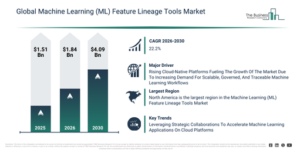
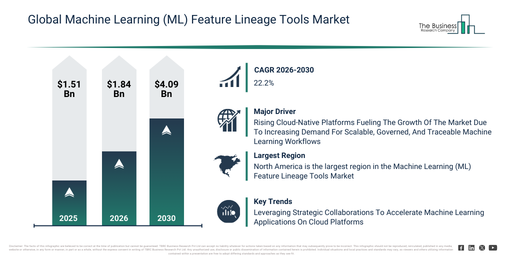
The machine learning (ml) feature lineage tools market size has experienced significant growth over recent years. It is forecast to expand from $1.51 billion in 2025 to $1.84 billion in 2026, achieving a compound annual growth rate (CAGR) of 22.0%. This past period’s growth can be attributed to the rising adoption of machine learning models, the necessity for reproducible AI results, an increase in data governance initiatives, the early implementation of feature tracking software, and regulatory requirements for AI transparency.
The market size for machine learning (ml) feature lineage tools is projected for substantial expansion in the coming years. This market is predicted to reach $4.09 billion by 2030, exhibiting a compound annual growth rate (CAGR) of 22.2%. Factors contributing to this growth during the forecast period include an increased emphasis on ml model auditability, the broadening of AI governance frameworks, greater uptake of cloud-based ml platforms, enhanced integration of ml ops tools, and the need for automated feature lineage analytics. Significant trends anticipated in this period encompass feature provenance tracking, comprehensive feature lifecycle management, automatic metadata capture, feature versioning coupled with change impact analysis, and model-feature traceability.
Get A Free Sample Report With In-Depth Market Insights:
Machine Learning (ML) Feature Lineage Tools Market Demand Drivers: What’s Powering Industry Growth?
The increasing prevalence of cloud-native platforms is anticipated to drive expansion in the machine learning (ML) feature lineage tools market in the future. These platforms represent technological environments designed for developing, deploying, and managing applications, leveraging cloud infrastructure concepts like microservices, containers, and automated scaling to guarantee adaptability, robustness, and effective resource usage. Their growth stems from their ability to empower organizations to scale applications swiftly and economically, facilitating real-time adjustment of computing resources according to demand, thereby enhancing deployment velocity and operational effectiveness. Machine learning feature lineage tools offer advantages to cloud-native platforms by enabling comprehensive traceability of features across dispersed pipelines, which consequently boosts model transparency, speeds up debugging processes, and ensures uniform governance within fluid, containerized settings. For example, data from March 2025, released by the Cloud Native Computing Foundation (CNCF), a US-based nonprofit, showed that the uptake of cloud-native methodologies reached an unprecedented 89% in 2024. Furthermore, 37% of businesses currently utilize two cloud service providers, an increase from 34% in 2023, and 26% employ three providers, marking a 3% year-over-year rise. Consequently, the expansion of cloud-native platforms is stimulating the development of the machine learning (ML) feature lineage tools market.
Machine Learning (ML) Feature Lineage Tools Market Segment Performance And Emerging Opportunities
The machine learning (ml) feature lineage tools market covered in this report is segmented –
1) By Component: Software, Services
2) By Deployment Mode: On-Premises, Cloud
3) By Enterprise Size: Small And Medium Enterprises, Large Enterprises
4) By Application: Model Development, Data Governance, Compliance, Monitoring, Other Applications
5) By End-Users: Banking, Financial Services, And Insurance (BFSI), Healthcare, Retail And E-commerce, Information Technology And Telecommunications, Manufacturing, Other End-Users
Subsegments:
1) By Software: Feature Metadata Management Software, Feature Lineage Visualization Software, Feature Version Control Software, Feature Dependency Tracking Software, Feature Governance And Audit Software
2) By Services: Implementation And Integration Services, Consulting And Advisory Services, Training And Enablement Services, Maintenance And Support Services, Managed Feature Lineage Services
Machine Learning (ML) Feature Lineage Tools Market Innovation Trends: What Developments Are Reshaping The Industry?
Companies actively engaged in the machine learning (ML) feature lineage tools market are strategically focusing on forming collaborations to develop machine learning-powered applications leveraging Google Cloud. These strategic collaborations are defined as intentional partnerships between various organizations, designed to achieve shared objectives by capitalizing on their collective strengths. For example, in July 2023, Tecton Inc., a US-based machine learning (ML) feature platform company, joined forces with Google Cloud, a US-based cloud services provider, to make its Tecton feature platform accessible to customers on Google Cloud. Through this alliance, Tecton offers a unified data framework that empowers organizations to build and deploy highly accurate predictive and generative AI models at an enterprise scale. The platform integrates seamlessly with Google Cloud’s AI and data ecosystem, simplifying the development and deployment of machine learning features across batch, streaming, and real-time data sources. It provides support for the entire feature lifecycle, spanning from creation and transformation to live serving and performance oversight. Operating on Google Cloud, Tecton assists data teams in accelerating outcomes, boosting model reliability, and optimizing costs, concurrently supporting next-generation real-time AI workloads.
Machine Learning (ML) Feature Lineage Tools Market Top Companies Driving Competitive Growth
Major companies operating in the machine learning (ml) feature lineage tools market are Amazon Web Services Inc., Google LLC, Microsoft Corporation, International Business Machines Corporation, Snowflake Inc., Databricks Inc., DataRobot Inc., Abacus.AI Inc., Redis Ltd., H2O.ai Inc., Neptune Labs Inc., Iguazio Ltd., Onehouse, Unify AI Business Corporation, Logical Clocks AB, Hopsworks AB, Qwak AI Ltd., Featureform Inc., Datafold Inc., FeatureByte Inc.
View The Full Machine Learning (ML) Feature Lineage Tools Market Report:
Machine Learning (ML) Feature Lineage Tools Market Global Footprint: Which Region Leads The Market?
North America was the largest region in the machine learning (ML) feature lineage tools market in 2025. Asia-Pacific is expected to be the fastest-growing region in the forecast period. The regions covered in the machine learning (ml) feature lineage tools market report are Asia-Pacific, South East Asia, Western Europe, Eastern Europe, North America, South America, Middle East, Africa.
Reach Out To Our Team:
The Business Research Company: https://www.thebusinessresearchcompany.com/
Americas: +1 310-496-7795
Asia: +44 7882 955267 & +91 8897263534
Europe: +44 7882 955267
Email us at: marketing@tbrc.info
Follow us on:
LinkedIn: https://in.linkedin.com/company/the-business-research-company
YouTube: https://www.youtube.com/channel/UC24_fI0rV8cR5DxlCpgmyFQ
Global Market Model: https://www.thebusinessresearchcompany.com/global-market-model

Wasay has over a decade of experience in market research, data modelling, and analytics, with prior experience at GlobalData and Decision Tree Consulting Services. At The Business Research Company , he leads research operations across syndicated studies, customized consulting engagements, and the Global Market Model platform. His professional experience includes supporting organizations such as Boston Consulting Group, KPMG, and Ernst & Young. Wasay holds a degree in Electronics and Communications Engineering, postgraduate management qualifications from International Management Institute Belgium and Indian School of Business and Entrepreneurship, and completed the Integrated Program in Business Analytics from Indian Institute of Management Indore.