Backed by market attractiveness analysis, total addressable market sizing, company benchmarking matrices, interactive Excel dashboards, wider supply chain intelligence, emerging startup coverage, and detailed product-level insights, The Business Research Company’s 2026 market reports are designed to offer research that is more actionable and strategically valuable than ever.
Multi-Access Edge Computing (MEC)-Enabled Content Delivery Network Cache Market Set To Climb From $3.76 Billion In 2026 To $7.49 Billion By 2030
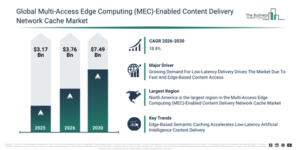
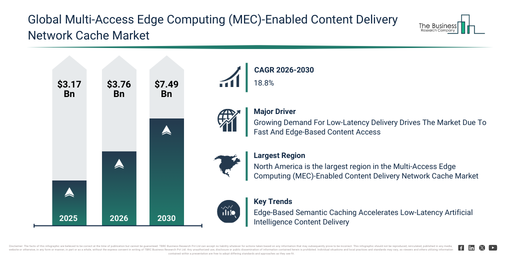
The market for multi-access edge computing (mec)-enabled content delivery network cache has shown rapid expansion in recent years. It is anticipated to increase from $3.17 billion in 2025 to $3.76 billion in 2026, exhibiting a compound annual growth rate (CAGR) of 18.5%. The historical growth of this market can be attributed to factors like the rise in video streaming consumption, the increasing demand for faster web content delivery, the expansion of telecom edge infrastructure, growing network congestion in core networks, and the early adoption of CDN acceleration services.
The multi-access edge computing (mec)-enabled content delivery network cache market is poised for significant growth in the upcoming years. It is projected to expand to $7.49 billion by 2030, demonstrating a compound annual growth rate (CAGR) of 18.8%. This expansion over the forecast period is primarily driven by the increasing deployment of 5G networks, the rising adoption of AR and VR applications, a surging demand for ultra-low latency gaming experiences, the growth of IoT-driven edge workloads, and amplified investment in edge analytics and monitoring. Noteworthy trends for the forecast period include low-latency edge content caching, optimization of real-time video streaming, dynamic content routing and load balancing, network traffic offloading at the edge, and enhanced edge security and content protection.
Get A Free Sample Report With In-Depth Market Insights:
Multi-Access Edge Computing (MEC)-Enabled Content Delivery Network Cache Market Development Factors: What’s Supporting Demand?
The rising need for low-latency content delivery is expected to boost the multi-access edge computing (MEC)-enabled content delivery network cache market moving forward. Low-latency content delivery refers to the swift transmission of digital content to end users with minimal delay, facilitating quicker load times, real-time responsiveness, and an enhanced user experience. The surge in low-latency content delivery, driven by increasing consumer desire for real-time digital experiences, is intensifying the requirement for faster data transmission, reduced delays, and improved platform performance. Multi-access edge computing (MEC)-enabled content delivery network cache supports low-latency content delivery by storing and processing content nearer to end users, significantly decreasing the distance data must travel and enabling faster, immediate access. As an illustration, in April 2023, the Department for Science, Innovation & Technology, a UK-based government department, noted that the widespread adoption of standalone 5G, which offers higher capacity and significantly lower latency, is predicted to bolster the digital economy, accelerate expansion across both established and emerging sectors like artificial intelligence, and provide up to $219.45 billion (£159 billion) in productivity benefits by 2035. Thus, the escalating demand for low-latency content delivery is propelling the growth of the multi-access edge computing (MEC)-enabled content delivery network cache market.
Multi-Access Edge Computing (MEC)-Enabled Content Delivery Network Cache Market Segment Trends And Revenue Contributors
The multi-access edge computing (mec)-enabled content delivery network cache market covered in this report is segmented –
1) By Component: Hardware, Software, Services
2) By Deployment: On-Premises, Cloud, Hybrid
3) By Organization Size: Large Enterprises, Small And Medium Enterprises (SMEs)
4) By Application: Video Streaming, Web Content Delivery, Online Gaming, Augmented Reality Or Virtual Reality (AR/VR), Internet Of Things (IoT), Other Applications
5) By End-User: Telecommunications, Media And Entertainment, Information Technology And Cloud Service Providers, Enterprises, Other End-Users
Subsegments:
1) By Hardware: Edge Servers, Network Equipment, Storage Systems
2) By Software: Cache Management Software, Content Delivery Software, Orchestration Software, Security Software, Analytics And Monitoring Software
3) By Services: Consulting Services, Deployment And Integration Services, Managed Services, Maintenance And Support Services
Multi-Access Edge Computing (MEC)-Enabled Content Delivery Network Cache Market Transformation Trends: What Innovations Are Driving Change?
Major companies operating in the multi-access edge computing (MEC)–enabled content delivery network cache market are focusing on developing innovative products such as edge AI caches to reduce latency, lower backend processing costs, and support real-time, artificial intelligence–driven digital experiences. An edge AI cache is a content delivery solution that utilizes semantic intelligence to cache and deliver artificial intelligence responses directly from edge infrastructure. For instance, in June 2024, Fastly, a US-based edge cloud platform provider, launched Fastly AI Accelerator. This solution employs semantic caching at the edge to serve repeated or similar large language model queries locally, effectively reducing latency and minimizing repeated calls to centralized artificial intelligence providers. By extending traditional content delivery network caching to artificial intelligence workloads, the product strengthens low-latency edge delivery and supports the scalable deployment of real-time, intelligent applications.
Multi-Access Edge Computing (MEC)-Enabled Content Delivery Network Cache Market Competitive Analysis Of Leading Industry Participants
Major companies operating in the multi-access edge computing (mec)-enabled content delivery network cache market are Amazon.com Inc., Alphabet Inc., Microsoft Corporation, Alibaba Cloud, Dell Technologies, Huawei Technologies Co. Ltd., Tencent Cloud EdgeOne, Cisco Systems Inc., Intel Corporation, JUNIPER NETWORKS (Hewlett Packard Enterprise), Akamai Technologies, Red Hat, Cloudflare, Mavenir, Harmonic, fastly, Synamedia, Vecima Networks, Broadpeak, ATEME, Qwilt, European Telecommunications Standards Institute, Varnish Software, BytePlus, and Netskrt.
View The Full Multi-Access Edge Computing (MEC)-Enabled Content Delivery Network Cache Market Report:
Multi-Access Edge Computing (MEC)-Enabled Content Delivery Network Cache Market Geographic Distribution And Regional Opportunities
North America was the largest region in the multi-access edge computing (MEC)-enabled content delivery network cache market in 2025. Asia-Pacific is expected to be the fastest-growing region in the forecast period. The regions covered in the multi-access edge computing (mec)-enabled content delivery network cache market report are Asia-Pacific, South East Asia, Western Europe, Eastern Europe, North America, South America, Middle East, Africa.
Reach Out To Our Team:
The Business Research Company: https://www.thebusinessresearchcompany.com/
Americas: +1 310-496-7795
Asia: +44 7882 955267 & +91 8897263534
Europe: +44 7882 955267
Email us at: marketing@tbrc.info
Follow us on:
LinkedIn: https://in.linkedin.com/company/the-business-research-company
YouTube: https://www.youtube.com/channel/UC24_fI0rV8cR5DxlCpgmyFQ
Global Market Model: https://www.thebusinessresearchcompany.com/global-market-model

Wasay has over a decade of experience in market research, data modelling, and analytics, with prior experience at GlobalData and Decision Tree Consulting Services. At The Business Research Company , he leads research operations across syndicated studies, customized consulting engagements, and the Global Market Model platform. His professional experience includes supporting organizations such as Boston Consulting Group, KPMG, and Ernst & Young. Wasay holds a degree in Electronics and Communications Engineering, postgraduate management qualifications from International Management Institute Belgium and Indian School of Business and Entrepreneurship, and completed the Integrated Program in Business Analytics from Indian Institute of Management Indore.