Built to provide research that’s more actionable and strategically valuable, The Business Research Company’s 2026 market reports include market attractiveness analysis, total addressable market sizing, company benchmarking matrices, interactive Excel dashboards, broader supply chain intelligence, emerging startup tracking, and in-depth product insights.
Non-Terrestrial Networks (NTN) Device Satellite-Cellular Policy Control Market Forecast: Value Set To Climb From $2.78 Billion To $5.49 Billion
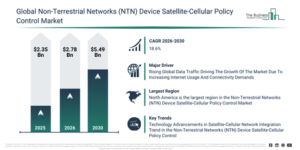
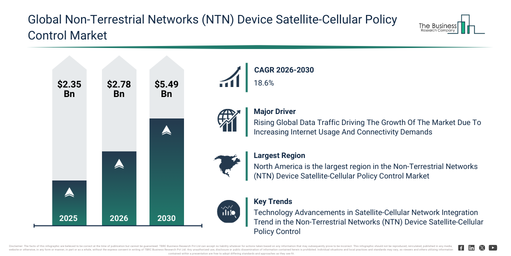
The non-terrestrial networks (ntn) device satellite-cellular policy control market size has experienced significant expansion recently. It will grow from $2.35 billion in 2025 to $2.78 billion in 2026 at a compound annual growth rate (CAGR) of 18.4%. Factors contributing to its historical growth include an increase in satellite communication deployments, wider cellular coverage in remote areas, a rise in connected IoT devices, the demand for uninterrupted roaming services, and the reliance on hybrid connectivity by defense and maritime sectors.
The non-terrestrial networks (ntn) device satellite-cellular policy control market size is anticipated to experience swift expansion in the coming years. It is projected to increase to $5.49 billion in 2030, achieving a compound annual growth rate (CAGR) of 18.6%. This projected growth can be linked to the widespread adoption of direct-to-device satellite services, the increasing use of autonomous vehicles and drones, the expansion of private 5G and ntn integration, a rising need for robust disaster recovery networks, and progress in multi-orbit satellite constellations. Significant trends during the forecast period include adaptive satellite-cellular network switching policies, edge-based policy control for ntn connectivity with low latency, the standardization of ntn policy frameworks under 3GPP releases, secure cross-network authentication and access governance, and device-level traffic prioritization for critical applications.
Get A Free Sample Report With In-Depth Market Insights:
Non-Terrestrial Networks (NTN) Device Satellite-Cellular Policy Control Market Growth Catalysts And Demand Drivers
The escalating volume of data traffic is projected to fuel the expansion of the non-terrestrial networks (NTN) device satellite-cellular policy control market. Data traffic volumes signify the quantity of information transmitted across a network within a given timeframe, serving as a metric for data exchange. This surge in data traffic can be attributed to heightened internet usage for various online activities, all of which entail sending and receiving substantial data. Non-terrestrial networks (NTN) device satellite-cellular policy control facilitates data traffic by intelligently managing network selection, prioritizing services, and enforcing quality of service across both satellite and terrestrial connections. For instance, in December 2024, the International Telecommunications Union (ITU), a Switzerland-based organization, reported that global mobile broadband traffic surpassed 1 zettabyte (ZB) for the first time in 2023 in terms of end-user internet usage, subsequently reaching nearly 1.3 ZB in 2024. Simultaneously, fixed broadband traffic increased to about 6 ZB in 2024, an uptick from 5.1 ZB in the previous year. Hence, the growing need for data traffic volumes is a primary driver for the growth of the non-terrestrial networks (NTN) device satellite-cellular policy control market.
Non-Terrestrial Networks (NTN) Device Satellite-Cellular Policy Control Market Segment Analysis: What Are The Core Market Categories?
The non-terrestrial networks (ntn) device satellite-cellular policy control market covered in this report is segmented –
1) By Component: Hardware, Software, Services
2) By Device Type: Smartphones, Internet Of Things (IOT) Devices, Wearables, Other Device Types
3) By Connectivity: Satellite, Cellular, Hybrid
4) By Application: Telecommunications, Automotive, Industrial, Consumer Electronics, Defense, Other Applications
5) By End-Users: Enterprises, Government, Consumers, Other End Users
Subsegments:
1) By Hardware: Satellite Communication Modules, Cellular Communication Modules, Radio Frequency Front End, Device Control Modules
2) By Software: Device Configuration Software, Traffic Routing Software, Service Orchestration Software, Network Analytics Software
3) By Services: System Design And Planning Services, Remote Monitoring Services, Policy Optimization Services, Training And Enablement Services
Non-Terrestrial Networks (NTN) Device Satellite-Cellular Policy Control Market Trends Shaping Long-Term Demand
Major companies operating in the non-terrestrial networks (NTN) device satellite-cellular policy control market are concentrating on developing innovative solutions, such as 5G-Advanced NTN connectivity platforms and integrated satellite-cellular policy orchestration tools. This focus addresses the growing demand for ubiquitous, seamless connectivity, which allows devices to intelligently switch between terrestrial cellular networks. 5G-Advanced NTN connectivity is defined as the convergence of 5G-Advanced networks with non-terrestrial networks, designed to deliver continuous, expansive, and dependable wireless coverage extending beyond conventional terrestrial infrastructure. An illustrative example occurred in November 2025, when the European Space Agency (ESA), a France-based government organization, in collaboration with MediaTek Inc., a Taiwan-based semiconductor manufacturing company, Eutelsat Group, a France-based satellite company, Airbus Defence and Space, Sharp, the Industrial Technology Research Institute (ITRI), and Rohde & Schwarz (R&S), announced the world’s first Rel-19 5G-Advanced NR-NTN connection trial. This trial was conducted using Eutelsat’s OneWeb low Earth orbit (LEO) satellites. This groundbreaking demonstration highlighted integrated satellite-cellular network interoperability, complete with 3GPP Rel-19 standard support, facilitating broader hybrid connectivity. This allows devices to maintain service through either satellite or terrestrial networks, while policy control systems manage seamless transitions and optimize performance. This represents a significant leap forward compared to earlier NTN trials that focused exclusively on basic connectivity.
Non-Terrestrial Networks (NTN) Device Satellite-Cellular Policy Control Market Competitive Overview And Top Companies
Major companies operating in the non-terrestrial networks (ntn) device satellite-cellular policy control market are Huawei Technologies Co. Ltd., Lockheed Martin Corporation, Cisco Systems Inc., Hewlett Packard Enterprise Company, Thales Group, Telefonaktiebolaget LM Ericsson, Nokia Corporation, ZTE Corporation, EchoStar Corporation, Viasat Inc., Mavenir Systems Inc., Iridium Communications Inc., Microsoft Corporation, NEC Corporation, Eutelsat Group, Celona Inc., Druid Software Ltd., Global Connectivity Xchange (GXC), IPLOOK Technologies Co. Ltd., Summa Networks
View The Full Non-Terrestrial Networks (NTN) Device Satellite-Cellular Policy Control Market Report:
Non-Terrestrial Networks (NTN) Device Satellite-Cellular Policy Control Market Leading Geography: Which Region Contributes The Most Revenue?
North America was the largest region in the non-terrestrial networks (NTN) device satellite-cellular policy control market in 2025. Asia-Pacific is expected to be the fastest-growing region in the forecast period. The regions covered in the non-terrestrial networks (ntn) device satellite-cellular policy control market report are Asia-Pacific, South East Asia, Western Europe, Eastern Europe, North America, South America, Middle East, Africa.
Reach Out To Our Team:
The Business Research Company: https://www.thebusinessresearchcompany.com/
Americas: +1 310-496-7795
Asia: +44 7882 955267 & +91 8897263534
Europe: +44 7882 955267
Email us at: marketing@tbrc.info
Follow us on:
LinkedIn: https://in.linkedin.com/company/the-business-research-company
YouTube: https://www.youtube.com/channel/UC24_fI0rV8cR5DxlCpgmyFQ
Global Market Model: https://www.thebusinessresearchcompany.com/global-market-model

Wasay has over a decade of experience in market research, data modelling, and analytics, with prior experience at GlobalData and Decision Tree Consulting Services. At The Business Research Company , he leads research operations across syndicated studies, customized consulting engagements, and the Global Market Model platform. His professional experience includes supporting organizations such as Boston Consulting Group, KPMG, and Ernst & Young. Wasay holds a degree in Electronics and Communications Engineering, postgraduate management qualifications from International Management Institute Belgium and Indian School of Business and Entrepreneurship, and completed the Integrated Program in Business Analytics from Indian Institute of Management Indore.