Built to provide research that’s more actionable and strategically valuable, The Business Research Company’s 2026 market reports include market attractiveness analysis, total addressable market sizing, company benchmarking matrices, interactive Excel dashboards, broader supply chain intelligence, emerging startup tracking, and in-depth product insights.
Open Source Vulnerability Scanner Market Value Analysis: What Growth Lies Ahead Over The Forecast Period?
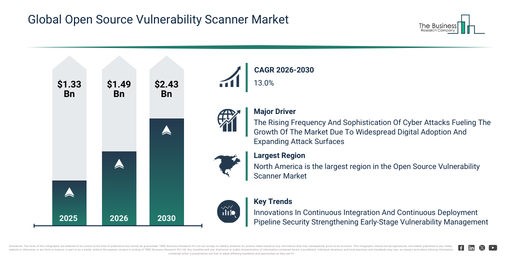
The open source vulnerability scanner market size has experienced substantial expansion in recent years. This market is forecasted to increase from $1.33 billion in 2025 to $1.49 billion in 2026, achieving a compound annual growth rate (CAGR) of 12.7%. The historical growth can be linked to several factors, including a rise in cyberattack incidents, the increasing adoption of open-source security tools, a growing requirement for network security assessments, the expansion of enterprise risk management practices, and the demand for cost-effective security solutions.
The open source vulnerability scanner market is projected to experience substantial expansion in the coming years. It is anticipated to reach $2.43 billion by 2030, exhibiting a compound annual growth rate (CAGR) of 13.0%. This growth during the forecast period is fueled by several factors, including the wider uptake of cloud and container environments, a greater need for automated vulnerability prioritization, the expansion of managed security services, heightened regulatory demands for cybersecurity compliance, and the broadening application of DevOps and DevSecOps practices. Key trends anticipated in the same period involve the increasing embrace of continuous vulnerability monitoring, a sharpened focus on scanning for misconfigurations and within container environments, improvements in security tools driven by community contributions, wider integration with CI/CD pipelines, and an emphasis on prioritizing vulnerabilities based on risk.
Get A Free Sample Report With In-Depth Market Insights:
Open Source Vulnerability Scanner Market Expansion Drivers: What’s Shaping Future Growth?
The escalating frequency and sophistication of cyber attacks are expected to drive the growth of the open source vulnerability scanner market in the future. The frequency and sophistication of cyber attacks refer to how often these attacks occur and the degree of complexity, advancement, and stealth involved in their execution. This increase in cyber attack frequency and sophistication is fueled by the widespread embrace of digital technologies, as this expands the number of potential targets and opportunities for attackers. Open-source vulnerability scanners play a vital role by continuously identifying and evaluating security weaknesses, thereby enabling organizations to proactively detect and mitigate threats before they can be leveraged. For instance, in October 2025, according to the National Cyber Security Centre, a UK-based government organization, the cyber defence authority addressed 204 nationally significant cyber attacks, an increase from 89 incidents in the preceding reporting year, indicating more than double year-on-year growth. Therefore, the rising frequency and sophistication of cyber attacks are significantly contributing to the expansion of the open source vulnerability scanner market.
Open Source Vulnerability Scanner Market Segment Analysis Spotlighting Growth Areas
The open source vulnerability scanner market covered in this report is segmented –
1) By Component: Software And Engines, Professional Services, Managed Security Services
2) By Deployment Mode: Cloud-Based, On-Premise
3) By Application: Network Vulnerability Scanners, Web Application Vulnerability Scanners
4) By End User: Information Technology And Telecommunications, Banking, Financial Services, And Insurance, Manufacturing, Retail, Government, Travel And Transportation, Energy And Utilities, Healthcare, Other End Users
Subsegments:
1) By Software And Engines: Network Vulnerability Scanning Software, Web Application Vulnerability Scanning Software, Cloud And Container Scanning Engines, Configuration And Misconfiguration Analysis Engines, Threat And Risk Assessment Engines
2) By Professional Services: Integration And Deployment Services, Customization And Configuration Services, Consulting And Advisory Services, Training And Certification Services, Support And Maintenance Services
3) By Managed Security Services: Continuous Vulnerability Monitoring Services, Managed Risk Assessment Services, Managed Compliance And Reporting Services, Incident Response And Remediation Services, Security Operations Center Support Services
Open Source Vulnerability Scanner Market Strategic Trends: What Defines The Next Growth Phase?
Major entities within the open source vulnerability scanner market are prioritizing sophisticated open-source vulnerability scanners, such as shift-left security, to facilitate continuous integration and deployment pipeline automation. This approach automates the scanning of source code and dependencies during initial development phases, delivering instant insights. An advanced open-source vulnerability scanner represents a complimentary security solution designed to constantly pinpoint, evaluate, and rank software, container, and infrastructure vulnerabilities. It achieves this by leveraging current threat data, automation, and adaptable detection features. As an example, in March 2025, Google LLC, a US-based technology firm, launched OSV-Scanner V2.0.0. This open-source tool for scanning and remediation incorporates OSV-SCALIBR for sophisticated dependency extraction. It is compatible with multiple programming language ecosystems, including NET, Python, JavaScript, and Haskell, and delivers enhanced vulnerability identification coupled with guided repair functionalities. Its purpose is to aid organizations in bolstering their vulnerability management strategies, thereby advancing open-source scanning methodologies.
Open Source Vulnerability Scanner Market Competitive Landscape: Who Leads The Industry?
Major companies operating in the open source vulnerability scanner market are Google LLC, Rapid7 Inc., Cloudflare Inc., Elastic N.V., Tenable Holdings Inc., GitLab Inc., Qualys Inc., JFrog Ltd., Snyk Ltd., Canonical Ltd., Checkmarx Ltd., Sysdig Inc., Aqua Security Software Ltd., Cilium, Anchore Inc., Greenbone Networks GmbH, Project Discovery Inc., StackHawk Inc., Deepfence Inc., Prowler Project
View The Full Open Source Vulnerability Scanner Market Report:
Open Source Vulnerability Scanner Market Geographic Landscape: Which Region Dominates Industry Growth?
North America was the largest region in the open source vulnerability scanner market in 2025. Asia-Pacific is expected to be the fastest-growing region in the forecast period. The regions covered in the open source vulnerability scanner market report are Asia-Pacific, South East Asia, Western Europe, Eastern Europe, North America, South America, Middle East, Africa.
Reach Out To Our Team:
The Business Research Company: https://www.thebusinessresearchcompany.com/
Americas: +1 310-496-7795
Asia: +44 7882 955267 & +91 8897263534
Europe: +44 7882 955267
Email us at: marketing@tbrc.info
Follow us on:
LinkedIn: https://in.linkedin.com/company/the-business-research-company
YouTube: https://www.youtube.com/channel/UC24_fI0rV8cR5DxlCpgmyFQ
Global Market Model: https://www.thebusinessresearchcompany.com/global-market-model

Wasay has over a decade of experience in market research, data modelling, and analytics, with prior experience at GlobalData and Decision Tree Consulting Services. At The Business Research Company , he leads research operations across syndicated studies, customized consulting engagements, and the Global Market Model platform. His professional experience includes supporting organizations such as Boston Consulting Group, KPMG, and Ernst & Young. Wasay holds a degree in Electronics and Communications Engineering, postgraduate management qualifications from International Management Institute Belgium and Indian School of Business and Entrepreneurship, and completed the Integrated Program in Business Analytics from Indian Institute of Management Indore.