Backed by market attractiveness analysis, total addressable market sizing, company benchmarking matrices, interactive Excel dashboards, wider supply chain intelligence, emerging startup coverage, and detailed product-level insights, The Business Research Company’s 2026 market reports are designed to offer research that is more actionable and strategically valuable than ever.
Remote Terminal Unit In Smart Grid Market Growth From $3.04 Billion In 2026 To $4.7 Billion By 2030 At A CAGR Of 11.6%
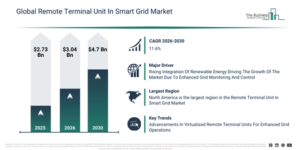
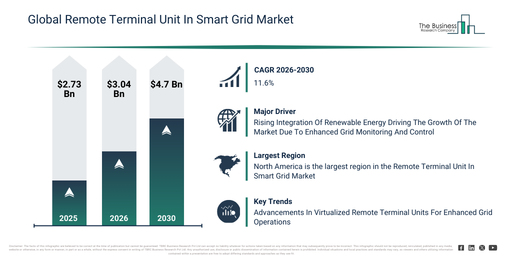
The remote terminal unit in smart grid market has experienced substantial growth in recent years. Its value is projected to climb from $2.73 billion in 2025 to $3.04 billion in 2026, at a compound annual growth rate (CAGR) of 11.3%. This historical expansion can be ascribed to several factors, including the enlargement of electricity transmission networks, the increase in grid modernization initiatives, a heightened demand for automated monitoring systems, growth in industrial power consumption, and the early adoption of SCADA infrastructure.
The remote terminal unit in smart grid market is anticipated to experience significant expansion over the coming years, projected to reach $4.7 billion in 2030 at a compound annual growth rate (CAGR) of 11.6%. This anticipated growth is driven by factors such as increasing integration of renewable energy sources, the expanding infrastructure for electric vehicle charging, the development of smart city initiatives, a heightened need for real-time energy analysis, and the advancement of distributed energy resource management. Key developments shaping this period encompass a greater deployment of intelligent field monitoring tools, the increased uptake of cloud-integrated remote control systems, the broadening of wireless and cellular communication technologies, the escalating incorporation of renewable energy monitoring functions, and improvements in real-time grid automation and protection frameworks.
Get A Free Sample Report With In-Depth Market Insights:
Remote Terminal Unit In Smart Grid Market Growth Momentum: What Factors Are Shaping Demand?
The increasing adoption of renewable energy sources is anticipated to drive expansion in the remote terminal unit in the smart grid market in the coming years. Renewable energy refers to power derived from naturally regenerating origins like sunlight, wind, water, biomass, and geothermal heat, which can be utilized repeatedly with minimal harm to the environment. This surge in renewable energy integration stems from increasing worries regarding climate change, the imperative to decrease greenhouse gas emissions, and the exhaustion of fossil fuel reserves. Within smart grids, remote terminal units facilitate renewable energy by enabling real-time surveillance, data collection, and management of distributed energy assets, including utility-scale and rooftop solar installations, wind farms, and other renewable facilities. As an illustration, the International Renewable Energy Agency, a UAE-based non-profit body, reported in March 2024 that the US renewable energy capacity grew from 356,413 MW in 2022 to 387,549 MW in 2023, marking an 8.7% annual increase. Consequently, the expanding incorporation of renewable energy sources is fueling the growth of the remote terminal unit in the smart grid market.
Remote Terminal Unit In Smart Grid Market Segment Landscape And Growth Outlook
The remote terminal unit in smart grid market covered in this report is segmented –
1) By Type: Hardware Remote Terminal Units (RTUs), Software Remote Terminal Units (RTUs), Hybrid Remote Terminal Units (RTUs)
2) By Deployment Mode: On-Premises Deployment, Cloud-Based Deployment
3) By Communication Technology: Wired Communication, Ethernet, Serial Communication, Wireless Communication, Cellular Networks, Satellite Communication, Radio Frequency Communication (RF)
4) By Application: Transmission Monitoring, Distribution Automation, Renewable Energy Management, Substation Automation
5) By End-User Industry: Utility Companies, Industrial Sector, Commercial Sector, Government And Regulatory Bodies
Subsegments:
1) By Hardware Remote Terminal Units (RTUs): Standalone Field Mounted Units, Rack Mounted Control Room Units, Ruggedized Outdoor Units
2) By Software Remote Terminal Units (RTUs): Virtualized Control Platform Units, Cloud Integrated Monitoring Units, Centralized Data Processing Units
3) By Hybrid Remote Terminal Units (RTUs): Hardware Integrated Software Units, Modular Remote Monitoring Units, Intelligent Automation Enabled Units
Remote Terminal Unit In Smart Grid Market Trends Redefining Industry Growth
Leading companies in the remote terminal unit within the smart grid market are focusing on developing advanced solutions, such as virtualized remote terminal units (RTUs), to enhance grid monitoring, improve operational efficiency, and support the integration of renewable energy. Virtualized remote terminal units in smart grid (RTUs) are devices designed to replicate the functionality of traditional hardware RTUs on a software-enabled platform, allowing utilities to remotely monitor and control substations, manage distributed energy resources, and streamline grid operations. For instance, in October 2024, Schneider Electric SE, a France-based energy management and automation solutions company, announced the virtualization of its PowerLogic T300 RTU on the Edge for Smart Secondary Substation Systems (E4S) platform at Enlit Europe 2024. This solution is specifically designed for smart grid applications, simplifying substation design, enhancing operational capabilities, and integrating with Schneider Electric’s EcoStruxure ADMS and DERMS platforms to foster grid flexibility, decarbonization, and improved reliability, while enabling utilities to efficiently manage complex low-voltage and secondary substation networks.
Remote Terminal Unit In Smart Grid Market Top Companies Driving Competitive Growth
Major companies operating in the remote terminal unit in smart grid market are Advantech Co. Ltd., Itron Inc., Dongfang Electronics, Mitsubishi Electric Corporation, Siemens AG, Schneider Electric SE, Honeywell International Inc., ABB, Eaton Corporation plc, Emerson Electric Co., Rockwell Automation Inc., phoenix Contact GmbH & Co. KG, Landis+Gyr AG, WAGO GmbH & Co. KG, Lucy Electric, Moxa Inc., Efacec Energia, Kalki Communication Technologies Pvt. Ltd., Sprecher Automation GmbH, and ICP DAS Co. Ltd.
View The Full Remote Terminal Unit In Smart Grid Market Report:
Remote Terminal Unit In Smart Grid Market Global Footprint: Which Region Leads The Industry?
North America was the largest region in the remote terminal unit in smart grid market in 2025. Asia-Pacific is expected to be the fastest-growing region in the forecast period. The regions covered in the remote terminal unit in smart grid market report are Asia-Pacific, South East Asia, Western Europe, Eastern Europe, North America, South America, Middle East, Africa.
Reach Out To Our Team:
The Business Research Company: https://www.thebusinessresearchcompany.com/
Americas: +1 310-496-7795
Asia: +44 7882 955267 & +91 8897263534
Europe: +44 7882 955267
Email us at: marketing@tbrc.info
Follow us on:
LinkedIn: https://in.linkedin.com/company/the-business-research-company
YouTube: https://www.youtube.com/channel/UC24_fI0rV8cR5DxlCpgmyFQ
Global Market Model: https://www.thebusinessresearchcompany.com/global-market-model

Wasay has over a decade of experience in market research, data modelling, and analytics, with prior experience at GlobalData and Decision Tree Consulting Services. At The Business Research Company , he leads research operations across syndicated studies, customized consulting engagements, and the Global Market Model platform. His professional experience includes supporting organizations such as Boston Consulting Group, KPMG, and Ernst & Young. Wasay holds a degree in Electronics and Communications Engineering, postgraduate management qualifications from International Management Institute Belgium and Indian School of Business and Entrepreneurship, and completed the Integrated Program in Business Analytics from Indian Institute of Management Indore.