Featuring market attractiveness scoring, total addressable market sizing, company benchmarking matrices, interactive Excel dashboards, deeper supply chain intelligence, emerging startup tracking, and granular product-level insights, The Business Research Company’s 2026 market reports are built to deliver research that is both more actionable and more strategically valuable.
Precision Cancer Imaging Market Size Forecast: How Big Could The Market Get By 2030?
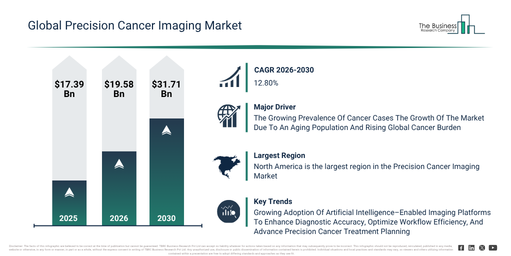
The precision cancer imaging market has expanded rapidly in recent years. This sector is projected to grow from $17.39 billion in 2025 to $19.58 billion in 2026, achieving a compound annual growth rate (CAGR) of 12.6%. The historical expansion of this market is attributable to the rising occurrence of cancer cases, innovations in molecular imaging technologies, increased adoption of PET and MRI systems, the development of hospital diagnostic infrastructure, and the increase in government-sponsored cancer screening programs.
The precision cancer imaging market size is forecasted to undergo significant expansion in the coming years. It is expected to grow to $31.71 billion by 2030, achieving a compound annual growth rate (CAGR) of 12.8%. This expansion during the forecast period is primarily driven by the increasing demand for personalized oncology treatments, the wider deployment of AI-driven imaging analytics, growing investments in precision medicine research, the rising adoption of cloud-based imaging platforms, and the increasing development of non-invasive diagnostic solutions. Noteworthy trends in the forecast period include the uptake of precision oncology imaging, the integration of hybrid imaging systems, the development of multi-modal diagnostic workflows, radiomics-based tumor characterization, and advancements in early-stage cancer detection.
Get A Free Sample Report With In-Depth Market Insights:
Precision Cancer Imaging Market Growth Factors: What’s Supporting Expansion?
The increasing occurrence of cancer diagnoses is projected to fuel the expansion of the precision cancer imaging market. This rise in cancer cases is primarily linked to an aging population, as older individuals carry a higher risk of developing cancer due to the accumulation of genetic mutations and extended exposure to risk factors over time. Precision cancer imaging aids cancer management by enabling earlier identification, more accurate tumor placement, and personalized therapy planning, which improves patient outcomes and reduces unnecessary medical procedures. For example, in February 2024, the World Health Organization reported that over 35 million new cancer cases are forecast for 2050, representing a 77% increase from the estimated 20 million cases in 2022. Therefore, the growing incidence of cancer cases is a significant driver for the growth of the precision cancer imaging market.
Precision Cancer Imaging Market Segment Outlook: Which Categories Are Growing Fastest?
The precision cancer imaging market covered in this report is segmented –
1) By Component: Hardware, Software, Services
2) By Cancer Type: Breast Cancer, Lung Cancer, Prostate Cancer, Colorectal Cancer, Other Cancer Types
3) By Imaging Modality: Magnetic Resonance Imaging (MRI), Computed Tomography (CT), Positron Emission Tomography (PET), Single Photon Emission Computed Tomography (SPECT), Other Modalities
4) By Application: Cardiovascular, Neurology, Gastroenterology, Infectious Diseases, Oncology, Other Applications
5) By End-user: Hospitals And Clinics, Diagnostic Imaging Centers, Ambulatory Surgical Centers, Other End-users
Subsegments:
1) By Hardware: Imaging Systems, Detection Devices, Radiation Equipment, Biopsy Guidance Systems, Monitoring Devices
2) By Software: Image Analysis Software, Visualization Software, Data Management Software, Diagnostic Software, Reporting Software
3) By Services: Imaging Services, Consulting Services, Maintenance Services, Training Services, Integration Services
Precision Cancer Imaging Market Industry Trends: What’s Reshaping Demand?
Leading firms in the precision cancer imaging market are concentrating on employing advanced technologies, including artificial intelligence-powered imaging platforms, to improve diagnostic precision and simplify the process of planning cancer treatment. These AI-driven platforms represent sophisticated CT and MR systems, utilizing machine learning algorithms to enhance image clarity, identify tumors, and visualize anatomy, thereby enabling medical professionals to achieve quicker, more accurate diagnoses and tailor cancer treatment plans with greater exactitude. As an illustration, in September 2025, Koninklijke Philips N. V., a health technology company based in the Netherlands, introduced its newest CT and MR solutions at the American Society for Radiation Oncology (ASTRO) 2025 meeting, specifically developed to progress precision cancer care. These systems incorporate features such as exceptionally fast AI-supported reconstruction, sustainable helium-free MR systems, expanded field-of-view 4D imaging, and user-friendly interfaces, all aimed at simplifying radiation therapy planning and enhancing patient comfort. The integration of superior image quality with streamlined operational processes allows oncology teams to provide individualized treatment plans with increased assurance and accuracy.
Precision Cancer Imaging Market Competitive Landscape: Who Leads The Industry?
Major companies operating in the precision cancer imaging market are Hitachi Medical Corporation, Thermo Fisher Scientific Inc., Siemens Healthineers AG, FUJIFILM Holdings Corporation, Koninklijke Philips N. V., GE HealthCare Technologies Inc., Shimadzu Corporation, Agilent Technologies Inc., Mindray Bio-Medical Electronics Co Ltd., Bruker Corporation, Canon Medical Systems Corporation, Shanghai United Imaging Healthcare Co Ltd., Agfa-Gevaert N. V., Hologic Inc., Carestream Health Inc., Perceptive Discovery, Esaote S. p. A., Alliance Medical Group, Quibim S. L., Mediso Ltd
View The Full Precision Cancer Imaging Market Report:
Precision Cancer Imaging Market Geographic Landscape: Which Region Leads Industry Growth?
North America was the largest region in the precision cancer imaging market in 2025. Asia-Pacific is expected to be the fastest-growing region in the forecast period. The regions covered in the precision cancer imaging market report are Asia-Pacific, South East Asia, Western Europe, Eastern Europe, North America, South America, Middle East and Africa.
Reach Out To Our Team:
The Business Research Company: https://www.thebusinessresearchcompany.com/
Americas: +1 310-496-7795
Asia: +44 7882 955267 & +91 8897263534
Europe: +44 7882 955267
Email us at: marketing@tbrc.info
Follow us on:
LinkedIn: https://in.linkedin.com/company/the-business-research-company
YouTube: https://www.youtube.com/channel/UC24_fI0rV8cR5DxlCpgmyFQ
Global Market Model: https://www.thebusinessresearchcompany.com/global-market-model

Wasay has over a decade of experience in market research, data modelling, and analytics, with prior experience at GlobalData and Decision Tree Consulting Services. At The Business Research Company , he leads research operations across syndicated studies, customized consulting engagements, and the Global Market Model platform. His professional experience includes supporting organizations such as Boston Consulting Group, KPMG, and Ernst & Young. Wasay holds a degree in Electronics and Communications Engineering, postgraduate management qualifications from International Management Institute Belgium and Indian School of Business and Entrepreneurship, and completed the Integrated Program in Business Analytics from Indian Institute of Management Indore.