
Backed by market attractiveness analysis, total addressable market sizing, company benchmarking matrices, interactive Excel dashboards, wider supply chain intelligence, emerging startup coverage, and detailed product-level insights, The Business Research Company’s 2026 market reports are designed to offer research that is more actionable and strategically valuable than ever.
Self-Administered Biologics Market Size Forecast: How Big Could The Market Get By 2030?
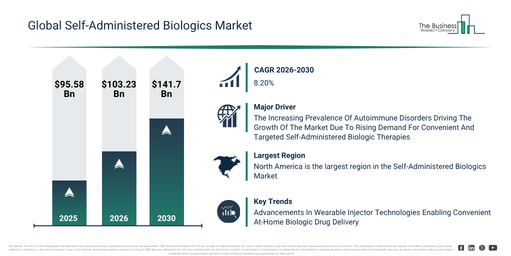
The self-administered biologics market size has demonstrated strong growth in recent years. It is anticipated to expand from $95.58 billion in 2025 to $103.23 billion in 2026, achieving a compound annual growth rate (CAGR) of 8.0%. Historically, this expansion has been driven by factors including the increasing prevalence of chronic diseases, a rise in biologics drug approvals, the growth of hospital-based infusion therapies, constraints on patient convenience in clinical administration, and the significant strain on healthcare facilities.
The self-administered biologics market is projected to experience substantial expansion in the coming years. This market is anticipated to reach a valuation of $141.7 billion by 2030, exhibiting a compound annual growth rate (CAGR) of 8.2%. The anticipated growth during this period can be attributed to factors such as the expansion of homecare healthcare delivery models, the increasing adoption of self-injection devices, the growth in the biosimilar pipeline, a rising patient preference for independence in treatment, and advancements in subcutaneous biologic formulations. Major trends expected in the forecast period include the increasing prevalence of home-based biologic self-administration therapies, the rising adoption of patient-centric chronic disease management models, the growing use of prefilled syringes and autoinjectors for simplified dosing, the expansion of biosimilar self-injectable therapies in autoimmune and metabolic diseases, and improving regulatory approvals and reimbursement support for home-use biologics.
Get A Free Sample Report With In-Depth Market Insights:
Self-Administered Biologics Market Expansion Drivers: What’s Shaping Future Growth?
A rise in autoimmune disorders is projected to fuel the expansion of the self-administered biologics market in the future. These conditions involve the immune system erroneously targeting the body’s own healthy components like cells, tissues, or organs, encompassing examples such as rheumatoid arthritis (RA), lupus, and multiple sclerosis. The growing incidence of autoimmune disorders is largely attributed to evolving lifestyles that impact and disturb the immune system’s regular operations. Self-administered biologics assist in handling autoimmune disorders by providing patients with an easy way to administer precise treatments that moderate immune system activity, decrease inflammation, and enhance long-term management of the disease. For example, Arthritis Australia, an Australia-based non-profit organization, reported in February 2024 that 212,136 males and 362,137 females were affected by rheumatoid arthritis (RA) in 2025, with projections indicating an increase to approximately 280,040 males and 479,828 females by 2040. Consequently, the rising occurrence of autoimmune disorders is a key factor propelling the expansion of the self-administered biologics market.
Self-Administered Biologics Market Segment Landscape: Which Areas Lead Development?
The self-administered biologics market covered in this report is segmented –
1) By Product: Prefilled Syringes, Autoinjectors, Wearable Injectors, Drug Reconstitution
2) By Indications: Diabetes, Rheumatoid Arthritis, Anaphylaxis, Other Indications
3) By Mode Of Delivery: Subcutaneous, Intramuscular, Transdermal
4) By Application: Autoimmune Disease Management, Diabetes Care, Oncology Supportive Care, Rare Disease Therapy
5) By End User: Homecare Settings, Hospitals Or Clinics
Subsegments:
1) By Prefilled Syringes: Glass Prefilled Syringes, Plastic Prefilled Syringes, Siliconized Syringes, Polymer Coated Syringes
2) By Autoinjectors: Spring Activated Autoinjectors, Button Activated Autoinjectors, Manual Autoinjectors, Single Dose Autoinjectors
3) By Wearable Injectors: Patch Pump Wearable Injectors, Mechanical Wearable Injectors, Electronic Wearable Injectors, Large Volume Wearable Injectors
4) By Drug Reconstitution: Vial-Based Drug Reconstitution, Dual Chamber Cartridge Reconstitution, Lyophilized Powder Reconstitution, On-Demand Mixing Systems
Self-Administered Biologics Market Strategic Trends: What Defines The Next Growth Phase?
Leading companies in the self-administered biologics market are prioritizing the development of technologically advanced solutions, such as wearable injector technologies, to boost patient convenience and facilitate the efficient at-home delivery of complex biologic therapies. These wearable injector technologies are drug delivery devices designed to adhere to the body and automatically dispense precise doses of medications, particularly biologics, over a set period without the need for manual injection. For instance, in July 2025, Becton, Dickinson and Company (BD), a US-based medical technology company, announced the first pharma-sponsored clinical trial utilizing its BD Libertas Wearable Injector. This innovative drug delivery technology is engineered to deliver high-viscosity biologic drugs in volumes greater than standard autoinjectors, enabling patients to self-administer treatments at home with minimal discomfort. It boasts a lightweight, on-body design with a simple activation mechanism, fostering ease of use and improved patient compliance. The system integrates precise flow rate control and safety mechanisms to ensure accurate dosing and mitigate the risk of administration errors. Additionally, it supports a broad spectrum of biologic formulations, making it well-suited for addressing chronic conditions like autoimmune disorders. This technology contributes to reducing the frequency of hospital visits while simultaneously enhancing patient convenience and overall healthcare efficiency.
Self-Administered Biologics Market Leading Companies And Competitive Benchmarking
Major companies operating in the self-administered biologics market are Johnson And Johnson, F. Hoffmann-La Roche Ltd., Merck And Co Inc., Pfizer Inc., AbbVie Inc., Sanofi S. A., Novartis AG, AstraZeneca PLC, Bristol-Myers Squibb Company, GlaxoSmithKline plc, Eli Lilly and Company, Novo Nordisk A/S, Takeda Pharmaceutical Company Limited, Amgen Inc., Regeneron Pharmaceuticals Inc., Biogen Inc., UCB S. A., Genentech Inc., Wockhardt Limited, Gan And Lee Pharmaceuticals Co Ltd., The United Laboratories International Holdings Limited, Tonghua Dongbao Pharmaceutical Co Ltd.
View The Full Self-Administered Biologics Market Report:
Self-Administered Biologics Market Largest Region By Revenue And Market Share
North America was the largest region in the self-administered biologics market in 2025. Asia-Pacific is expected to be the fastest-growing region in the forecast period. The regions covered in the self-administered biologics market report are Asia-Pacific, South East Asia, Western Europe, Eastern Europe, North America, South America, Middle East and Africa.
Reach Out To Our Team:
The Business Research Company: https://www.thebusinessresearchcompany.com/
Americas: +1 310-496-7795
Asia: +44 7882 955267 & +91 8897263534
Europe: +44 7882 955267
Email us at: marketing@tbrc.info
Follow us on:
LinkedIn: https://in.linkedin.com/company/the-business-research-company
YouTube: https://www.youtube.com/channel/UC24_fI0rV8cR5DxlCpgmyFQ
Global Market Model: https://www.thebusinessresearchcompany.com/global-market-model

Wasay has over a decade of experience in market research, data modelling, and analytics, with prior experience at GlobalData and Decision Tree Consulting Services. At The Business Research Company , he leads research operations across syndicated studies, customized consulting engagements, and the Global Market Model platform. His professional experience includes supporting organizations such as Boston Consulting Group, KPMG, and Ernst & Young. Wasay holds a degree in Electronics and Communications Engineering, postgraduate management qualifications from International Management Institute Belgium and Indian School of Business and Entrepreneurship, and completed the Integrated Program in Business Analytics from Indian Institute of Management Indore.