
Built to provide research that’s more actionable and strategically valuable, The Business Research Company’s 2026 market reports include market attractiveness analysis, total addressable market sizing, company benchmarking matrices, interactive Excel dashboards, broader supply chain intelligence, emerging startup tracking, and in-depth product insights.
Veterinary Lab Automation Market Growth Potential: How Will Market Size Shift Through 2030?
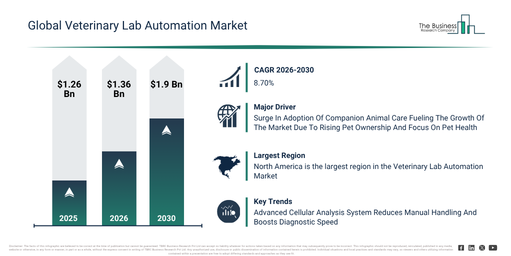
The market for veterinary lab automation has experienced substantial expansion in recent years. It will grow from $1. 26 billion in 2025 to $1. 36 billion in 2026 at a compound annual growth rate (CAGR) of 8. 4%. This historical growth can be attributed to several factors, including an increased demand for quicker veterinary diagnostic results, the rising occurrence of animal diseases that require laboratory testing, advancements in veterinary healthcare infrastructure, the expansion of services for companion animals, and the integration of basic laboratory instruments in veterinary clinics.
The veterinary lab automation market is anticipated to expand significantly over the coming years. It is projected to reach $1.9 billion by 2030, exhibiting a compound annual growth rate (CAGR) of 8.7%. This expansion during the forecast period stems from factors such as heightened demand for high-throughput diagnostic automation systems, greater incorporation of AI and data analytics in veterinary diagnostics, an intensifying focus on precision veterinary medicine, the growth of centralized veterinary diagnostic laboratories, and increased investment in intelligent laboratory infrastructure and robotics. Key trends observed during this period involve the increasing embrace of robotic sample processing and automated diagnostic workflows in veterinary laboratories, enhanced integration of AI-driven diagnostic interpretation systems for animal health testing, wider deployment of fully automated hematology and chemistry analyzers in veterinary labs, the broadening of cloud-based laboratory information management systems for veterinary diagnostics, and greater utilization of high-throughput automated sample handling systems to boost testing efficiency.
Get A Free Sample Report With In-Depth Market Insights:
Veterinary Lab Automation Market Demand Drivers: What’s Powering Industry Growth?
The rising acceptance of companion animal care is anticipated to drive the expansion of the veterinary lab automation market moving forward. Companion animal care encompasses offering medical, preventative, and wellness services for pets such as dogs, cats, and other domesticated animals. The increasing adoption of companion animal care is fueled by growing pet ownership, as more households are prioritizing their pets’ health and well-being. Veterinary lab automation assists companion animal care by facilitating faster and more accurate diagnostic testing, which supports prompt treatment and improved health outcomes for pets. For instance, in April 2025, according to the American Animal Hospital Association, a US-based animal veterinary hospital, expenditures on veterinary care, including pharmaceuticals and related products distributed through veterinary clinics in the United States, were projected to total approximately $41.4 billion in 2025. Therefore, the increasing adoption of companion animal care is a key driver for the growth of the veterinary lab automation market.
Veterinary Lab Automation Market Segment Landscape: Which Areas Lead Development?
The veterinary lab automation market covered in this report is segmented –
1) By Product Type: Pre-Analytical Systems, Analytical Systems, Post-Analytical Systems, Software, Other Product Types
2) By Animal Type: Companion Animals, Livestock Animals, Exotic Animals
3) By Automation Level: Semi-Automated Systems, Fully Automated Systems
4) By Application: Clinical Chemistry, Hematology, Immunodiagnostics, Molecular Diagnostics, Other Applications
5) By End User: Veterinary Hospitals, Diagnostic Laboratories, Research Institutes, Other End Users
Subsegments:
1) By Pre-Analytical Systems: Sample Handling Systems, Automated Specimen Processors, Barcode Labeling Systems, Centrifugation Units
2) By Analytical Systems: Hematology Analyzers, Clinical Chemistry Analyzers, Immunoassay Analyzers, Urinalysis Analyzers, Molecular Diagnostic Analyzers
3) By Post-Analytical Systems: Data Management Systems, Result Verification Systems, Automated Report Generation Systems
4) By Software: Laboratory Information Management Software, Workflow Automation Software, Data Analytics Software, Quality Control Software
5) By Other Product Types: Consumables And Reagents, Automated Storage Systems, Robotic Sample Handling Systems
Veterinary Lab Automation Market Innovation Trends: What Developments Are Reshaping The Industry?
Leading entities within the veterinary lab automation market are concentrating on creating sophisticated diagnostic solutions, such as slide-free cellular analysis, aiming to boost testing accuracy, lessen manual interaction, and optimize operational efficiency in veterinary laboratories. This slide-free cellular analysis method involves inspecting and characterizing cells directly within their fluid or natural condition, eliminating the need for microscope slide preparation, frequently utilizing automated imaging or sensing technologies. An example is seen in January 2024, when IDEXX Laboratories, a prominent US-based veterinary diagnostics provider, introduced inVue Dx, their groundbreaking slide-free cellular analyzer. This system streamlines sample processing and digital cytology interpretation, assisting veterinarians by delivering quicker turnaround times, minimizing human error, and achieving greater diagnostic precision across diverse tests, such as blood and cytology analyses, thereby elevating patient care and laboratory productivity.
Veterinary Lab Automation Market Competitive Landscape: Which Companies Lead The Industry?
Major companies operating in the veterinary lab automation market are Roche Diagnostics International AG, Thermo Fisher Scientific Incorporated, Abbott Laboratories Incorporated, Siemens Healthineers AG, Fujifilm Holdings Corporation, Zoetis Incorporated, Mindray Medical International Limited, bioMérieux SA, IDEXX Laboratories Incorporated, Sysmex Corporation, Bio-Rad Laboratories Incorporated, EKF Diagnostics Holdings PLC, IDvet Innovative Diagnostics Veterinary, DiaSys Diagnostic Systems GmbH, SignalPET Incorporated, Bionote Incorporated, QBC Diagnostics Incorporated, Drew Scientific Incorporated, Cortex Technology Incorporated, Ozelle Med
View The Full Veterinary Lab Automation Market Report:
Veterinary Lab Automation Market Regional Outlook: Where Is Opportunity Concentrated?
North America was the largest region in the veterinary lab automation market in 2025. Asia-Pacific is expected to be the fastest-growing region in the forecast period. The regions covered in the veterinary lab automation market report are Asia-Pacific, South East Asia, Western Europe, Eastern Europe, North America, South America, Middle East and Africa.
Reach Out To Our Team:
The Business Research Company: https://www.thebusinessresearchcompany.com/
Americas: +1 310-496-7795
Asia: +44 7882 955267 & +91 8897263534
Europe: +44 7882 955267
Email us at: marketing@tbrc.info
Follow us on:
LinkedIn: https://in.linkedin.com/company/the-business-research-company
YouTube: https://www.youtube.com/channel/UC24_fI0rV8cR5DxlCpgmyFQ
Global Market Model: https://www.thebusinessresearchcompany.com/global-market-model

Wasay has over a decade of experience in market research, data modelling, and analytics, with prior experience at GlobalData and Decision Tree Consulting Services. At The Business Research Company , he leads research operations across syndicated studies, customized consulting engagements, and the Global Market Model platform. His professional experience includes supporting organizations such as Boston Consulting Group, KPMG, and Ernst & Young. Wasay holds a degree in Electronics and Communications Engineering, postgraduate management qualifications from International Management Institute Belgium and Indian School of Business and Entrepreneurship, and completed the Integrated Program in Business Analytics from Indian Institute of Management Indore.