
Backed by market attractiveness analysis, total addressable market sizing, company benchmarking matrices, interactive Excel dashboards, wider supply chain intelligence, emerging startup coverage, and detailed product-level insights, The Business Research Company’s 2026 market reports are designed to offer research that is more actionable and strategically valuable than ever.
Veterinary Robotic Surgery Enablers Market Size Outlook: How Quickly Will Revenue Expand Through 2030?
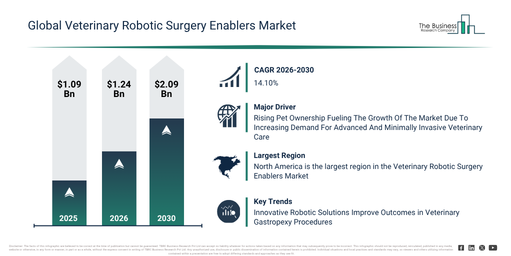
The veterinary robotic surgery enablers market size has experienced swift expansion in recent years. This market is anticipated to expand from $1. 09 billion in 2025 to $1. 24 billion in 2026, at a compound annual growth rate (CAGR) of 13. 8%. The historical growth can be attributed to increasing demand for minimally invasive veterinary surgeries, rising adoption of advanced diagnostic imaging systems, growth in companion animal surgical procedures, limited availability of skilled veterinary surgeons, and early adoption of robotic-assisted human surgical technologies influencing veterinary use.
The veterinary robotic surgery enablers market is set for considerable expansion in the coming years, with expectations to reach $2.09 billion by 2030, exhibiting a compound annual growth rate (CAGR) of 14.1%. This expansion during the forecast period can be attributed to the growing adoption of AI-driven surgical robotics platforms, increased investment in veterinary automation infrastructure, a rising demand for precise and error-free surgical outcomes, the integration of real-time imaging and navigation systems, and advancements in tele-operated and remote robotic surgery capabilities. Significant trends anticipated for this period encompass the increasing use of AI-assisted robotic surgical decision support systems in veterinary procedures, greater integration of precision imaging-guided robotic navigation for minimally invasive animal surgeries, the broadening of automated robotic instrument calibration and control systems in veterinary operating rooms, the expanded deployment of cloud-connected robotic surgery platforms for remote monitoring and analytics, and the intensified application of high-precision multi-articulating robotic instruments for complex veterinary surgical procedures.
Get A Free Sample Report With In-Depth Market Insights:
Veterinary Robotic Surgery Enablers Market Growth Drivers: What’s Behind The Acceleration?
The escalating trend of pet ownership is anticipated to stimulate the growth of the veterinary robotic surgery enablers market. A pet is characterized as an animal kept by humans primarily for companionship, emotional connection, or personal enjoyment, rather than for economic or utilitarian purposes. The increase in pet ownership is attributed to heightened social isolation and stress prevalent in modern lifestyles, prompting more individuals to adopt animals as companions to enhance emotional well-being and alleviate loneliness. This surge in pet ownership consequently boosts the demand for veterinary robotic surgery enablers, given that a growing number of pet owners are seeking advanced, minimally invasive procedures offering superior precision and faster recovery for their animals. For example, data from March 2025, published by the American Pet Products Association, a US-based non-profit trade organization, indicates a recovery in pet ownership. Specifically, 94 million U. S. households now own at least one pet, an increase from 82 million in 2023. This growth encompasses both dogs and cats, with dogs found in 51% of households (68 million) and cats in 37% (49 million). Thus, the expanding trend of pet ownership is a significant driver for the growth of the veterinary robotic surgery enablers market.
Veterinary Robotic Surgery Enablers Market Segment Analysis: What Are The Core Market Categories?
The veterinary robotic surgery enablers market covered in this report is segmented –
1) By Product Type: Robotic Surgery Systems, Surgical Navigation Systems, Imaging Systems, Robotic Arms, Automated Anesthesia Systems, Endoscopic Robotic Tools
2) By Animal Type: Companion Animals, Livestock Animals, Other Animal Types
3) By Application: Orthopedic Surgery, Soft Tissue Surgery, Neurological Surgery, Oncological Surgery, Other Applications
4) By End-User: Veterinary Hospitals, Veterinary Clinics, Research And Academic Institutes, Other End-Users
Subsegments:
1) By Robotic Surgery Systems: General Surgery Robotic Systems, Orthopedic Surgery Robotic Systems, Neurological Surgery Robotic Systems, Cardiovascular Surgery Robotic Systems, Minimally Invasive Surgery Robotic Systems
2) By Surgical Navigation Systems: Optical Tracking Navigation Systems, Electromagnetic Tracking Navigation Systems, Hybrid Tracking Navigation Systems, Real Time Surgical Navigation Systems, Augmented Reality Navigation Systems
3) By Imaging Systems: Magnetic Resonance Imaging Systems, Computed Tomography Imaging Systems, Ultrasound Imaging Systems, Fluoroscopy Imaging Systems, Intraoperative Imaging Systems
4) By Robotic Arms: Articulated Robotic Arms, Cartesian Robotic Arms, Selective Compliance Assembly Robot Arm Robotic Arms, Delta Robotic Arms, Modular Robotic Arms
5) By Automated Anesthesia Systems: Gas Delivery Anesthesia Systems, Intravenous Anesthesia Systems, Closed Loop Anesthesia Systems, Monitoring Integrated Anesthesia Systems, Portable Anesthesia Systems
6) By Endoscopic Robotic Tools: Rigid Endoscopic Robotic Tools, Flexible Endoscopic Robotic Tools, Single Port Endoscopic Robotic Tools, Articulating Endoscopic Robotic Tools, High Definition Endoscopic Robotic Tools
Veterinary Robotic Surgery Enablers Market Trends: What’s Defining The Industry’s Next Phase?
Companies operating within the veterinary robotic surgery enablers market are prioritizing the development of advanced robotic-assisted surgical solutions, such as minimally invasive robotic gastropexy, to enhance surgical accuracy, improve clinical results, and broaden the adoption of robotics in veterinary care. Robotic gastropexy itself is a minimally invasive surgical procedure executed with robotic assistance to prevent gastric dilatation-volvulus (GDV) by securing the stomach to the abdominal wall, offering superior precision and reduced recovery time compared to conventional methods. For instance, in January 2024, R2 Surgical, a US-based medical technology company, partnered with Cornell University College of Veterinary Medicine to perform the first live animal robotic-assisted gastropexy using its Dexter robotic system. This landmark procedure showcased the system’s capability to support minimally invasive veterinary surgeries with enhanced dexterity, improved visualization, and greater control for surgeons, marking a significant step forward in integrating robotic technologies into veterinary surgical practice.
Veterinary Robotic Surgery Enablers Market Competitive Landscape: Which Companies Lead The Industry?
Major companies operating in the veterinary robotic surgery enablers market are Johnson & Johnson, Medtronic plc, Karl Storz SE & Co. KG, Stäubli International AG, Renishaw plc, Accuray Incorporated, Meere Company Inc., Kinova Inc., CMR Surgical Ltd., Mecademic Inc., Vicarious Surgical Inc., Shanghai MicroPort MedBot Co. Ltd., Mindray Medical International Limited, Robocath Inc., R2 Surgical Inc., Panda Surgical Inc., VetOvation Inc., Avante Health Solutions, Apixia Inc., Harbin Sagebot Intelligent Medical Equipment Co. Ltd.
View The Full Veterinary Robotic Surgery Enablers Market Report:
Veterinary Robotic Surgery Enablers Market Regional Breakdown: Where Is Demand Concentrated?
North America was the largest region in the veterinary robotic surgery enablers market in 2025. Asia-Pacific is expected to be the fastest-growing region in the forecast period. The regions covered in the veterinary robotic surgery enablers market report are Asia-Pacific, South East Asia, Western Europe, Eastern Europe, North America, South America, Middle East and Africa.
Reach Out To Our Team:
The Business Research Company: https://www.thebusinessresearchcompany.com/
Americas: +1 310-496-7795
Asia: +44 7882 955267 & +91 8897263534
Europe: +44 7882 955267
Email us at: marketing@tbrc.info
Follow us on:
LinkedIn: https://in.linkedin.com/company/the-business-research-company
YouTube: https://www.youtube.com/channel/UC24_fI0rV8cR5DxlCpgmyFQ
Global Market Model: https://www.thebusinessresearchcompany.com/global-market-model

Wasay has over a decade of experience in market research, data modelling, and analytics, with prior experience at GlobalData and Decision Tree Consulting Services. At The Business Research Company , he leads research operations across syndicated studies, customized consulting engagements, and the Global Market Model platform. His professional experience includes supporting organizations such as Boston Consulting Group, KPMG, and Ernst & Young. Wasay holds a degree in Electronics and Communications Engineering, postgraduate management qualifications from International Management Institute Belgium and Indian School of Business and Entrepreneurship, and completed the Integrated Program in Business Analytics from Indian Institute of Management Indore.