
Featuring market attractiveness scoring, total addressable market sizing, company benchmarking matrices, interactive Excel dashboards, deeper supply chain intelligence, emerging startup tracking, and granular product-level insights, The Business Research Company’s 2026 market reports are built to deliver research that is both more actionable and more strategically valuable.
Rare Disease Contract Research Organization (CRO) Market Value Growth And Long-Term Outlook
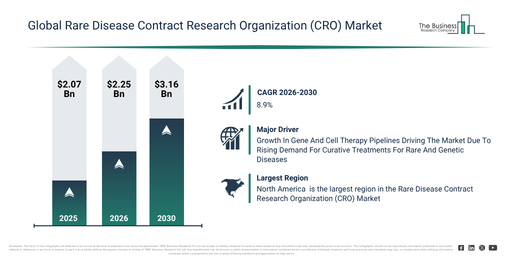
The rare disease contract research organization (CRO) market size has experienced significant expansion in recent years. This market is set to increase from $2.07 billion in 2025 to $2.25 billion in 2026, achieving a compound annual growth rate (CAGR) of 8.6%. Historically, this growth can be ascribed to elements such as limited rare disease awareness hindering patient identification, fragmented clinical data systems impairing trial recruitment efficiency, the high expense of orphan drug development reducing the scale of trial outsourcing, a reliance on traditional site-based clinical research models, and the absence of standardized global rare disease regulatory frameworks.
The rare disease contract research organization (CRO) market is set to experience robust expansion in the upcoming years. It is forecast to reach $3.16 billion in 2030, progressing at a compound annual growth rate (CAGR) of 8.9%. This growth throughout the forecast period can be attributed to advancements in genomic sequencing, which enable earlier detection of rare diseases; an increase in orphan drug approvals, thereby driving demand for CRO outsourcing; the expansion of precision medicine, accelerating niche clinical research; the rising adoption of decentralized trials, improving global patient access; and growing biotech investments in rare disease therapeutics. Notable trends during the forecast period include adaptive, patient-centric trial designs for ultra-rare disease cohorts, the expansion of global rare disease patient registry ecosystems, a greater embrace of decentralized and hybrid rare disease clinical trials, the development of specialized orphan drug regulatory consulting services, and the increasing integration of real-world evidence in rare disease clinical validation.
Get A Free Sample Report With In-Depth Market Insights:
Rare Disease Contract Research Organization (CRO) Market Expansion Drivers: What’s Shaping Future Growth?
The expansion of gene and cell therapy pipelines is anticipated to fuel the future growth of the rare disease contract research organization market. These sophisticated treatments work by modifying genes or utilizing engineered cells to address the fundamental cause of illnesses. The increasing prevalence of chronic and rare genetic diseases primarily drives the rise in gene and cell therapies, as they provide focused, potentially curative solutions by targeting the underlying genetic or cellular issues rather than merely alleviating symptoms. Rare disease contract research organizations (CROs) aid gene and cell therapy by developing and overseeing highly specialized clinical studies, facilitating effective patient identification and enrollment for uncommon genetic conditions, ensuring adherence to regulations, and managing the intricate data and logistical demands of these cutting-edge, precision-based treatments. For instance, in March 2024, IQVIA Holdings Inc., a US-based provider of advanced analytics, technology solutions, and clinical research services for the life sciences and healthcare industries, noted that global expenditure on cell and gene therapies escalated to $5.9 billion in 2023, marking a 38% rise from 2022. Consequently, the development in gene and cell therapy pipelines is propelling the expansion of the rare disease contract research organization market. An anticipated increase in research and development (R&D) activities is set to boost the rare disease contract research organization (CRO) market in the coming years. R&D encompasses efforts aimed at generating novel knowledge and applying it to create or enhance products, services, or technologies. The surge in R&D endeavors stems from the escalating requirement for ongoing innovation to maintain a competitive edge in rapidly evolving markets, motivating companies to invest in advanced products and technologies that cater to shifting consumer demands and industry patterns. Rare disease contract research organizations (CROs) assist research and development by offering specialized knowledge, facilities, and patient sourcing abilities that help expedite the planning, execution, and oversight of intricate clinical trials and drug development initiatives for rare diseases. For example, in 2023, the Office for National Statistics, a UK-based government agency, stated that the UK government’s net expenditure on research and development (R&D) grew to £17.4 ($22.1 billion) in 2023, an increase from £16.1 billion ($20.45 billion) in 2022, signifying an 8.2% surge. Thus, the expansion of research and development activities is stimulating the growth of the rare disease contract research organization market.
Rare Disease Contract Research Organization (CRO) Market Segmentation And Category Overview
The rare disease contract research organization (CRO) market covered in this report is segmented –
1) By Service Type: Drug Development Strategy, Clinical Trial Management, Patient Recruitment And Retention Services, Data Management And Biostatistics, Regulatory Affairs And Consulting, Pharmacovigilance Services, Medical Writing And Documentation, Decentralized Clinical Trial Services, Other Service Types
2) By Phase: Pre Clinical, Phase One, Phase Two, Phase Three, Phase Four
3) By Therapeutic Area: Oncology, Neurology, Cardiovascular Disorders, Metabolic Disorders, Genetic Disorders, Hematology, Immunology, Rare Infectious Diseases, Other Rare Indications
4) By Delivery Model: On Site Clinical Trials, Decentralized Clinical Trials, Hybrid Clinical Trials
5) By End User: Pharmaceutical And Biotechnology Companies, Non Profit And Government Organizations, Academic And Research Institutes, Other End Users
Subsegments:
1) By Drug Development Strategy: Preclinical Development Planning, Clinical Development Planning, Target Identification And Validation, Portfolio Strategy Optimization
2) By Clinical Trial Management: Phase One Trial Management, Phase Two Trial Management, Phase Three Trial Management, Site Monitoring And Coordination
3) By Patient Recruitment And Retention Services: Patient Identification Services, Patient Enrollment Support, Patient Engagement Programs, Patient Retention Strategies
4) By Data Management And Biostatistics: Clinical Data Collection And Processing, Statistical Analysis And Modeling, Database Design And Management, Data Quality Assurance
5) By Regulatory Affairs And Consulting: Regulatory Strategy Development, Submission Preparation And Filing, Compliance And Audit Support, Regulatory Advisory Services
6) By Pharmacovigilance Services: Adverse Event Monitoring, Safety Data Analysis, Risk Management Planning, Signal Detection And Reporting
7) By Medical Writing And Documentation: Clinical Study Report Writing, Protocol Development Documentation, Regulatory Writing Services, Scientific Publication Writing
8) By Decentralized Clinical Trial Services: Remote Patient Monitoring, Virtual Trial Management, Home Healthcare Services, Digital Data Collection Solutions
9) By Other Service Types: Rare Disease Consulting Services, Genetic Research Support, Biomarker Development Services, Translational Research Services
Rare Disease Contract Research Organization (CRO) Market Leading Players And Competitive Positioning
Major companies operating in the rare disease contract research organization (cro) market are Thermo Fisher Scientific Inc., IQVIA Holdings Inc., Laboratory Corporation of America Holdings, ICON plc, SGS SA, Charles River Laboratories International Inc., Fortrea Holdings Inc., Medpace Holdings Inc., ALS Limited, PSI CRO AG, Ratos AB, Precision for Medicine Inc., Allucent, QPS Holdings LLC, Alira Health SAS, Rho Inc., Veristat LLC, Quanticate Ltd., Cromos Pharma LLC, Frontage Laboratories Inc., ProTrials Research Inc., PROMETRIKA LLC, Machaon Diagnostics Inc., Sofpromed GmbH
View The Full Rare Disease Contract Research Organization (CRO) Market Report:
Rare Disease Contract Research Organization (CRO) Market Regional Distribution: Which Areas Power Market Growth?
North America was the largest region in the rare disease contract research organization (CRO) market in 2025. Asia-Pacific is expected to be the fastest-growing region in the forecast period. The regions covered in the rare disease contract research organization (CRO) market report are Asia-Pacific, South East Asia, Western Europe, Eastern Europe, North America, South America, Middle East, Africa.
Reach Out To Our Team:
The Business Research Company: https://www.thebusinessresearchcompany.com/
Americas: +1 310-496-7795
Asia: +44 7882 955267 & +91 8897263534
Europe: +44 7882 955267
Email us at: marketing@tbrc.info
Follow us on:
LinkedIn: https://in.linkedin.com/company/the-business-research-company
YouTube: https://www.youtube.com/channel/UC24_fI0rV8cR5DxlCpgmyFQ
Global Market Model: https://www.thebusinessresearchcompany.com/global-market-model

Wasay has over a decade of experience in market research, data modelling, and analytics, with prior experience at GlobalData and Decision Tree Consulting Services. At The Business Research Company , he leads research operations across syndicated studies, customized consulting engagements, and the Global Market Model platform. His professional experience includes supporting organizations such as Boston Consulting Group, KPMG, and Ernst & Young. Wasay holds a degree in Electronics and Communications Engineering, postgraduate management qualifications from International Management Institute Belgium and Indian School of Business and Entrepreneurship, and completed the Integrated Program in Business Analytics from Indian Institute of Management Indore.
