
Featuring market attractiveness scoring, total addressable market sizing, company benchmarking matrices, interactive Excel dashboards, deeper supply chain intelligence, emerging startup tracking, and granular product-level insights, The Business Research Company’s 2026 market reports are built to deliver research that is both more actionable and more strategically valuable.
3D Hydrogel Culture Market Revenue Growth On Track For A 16.9% CAGR Through 2030
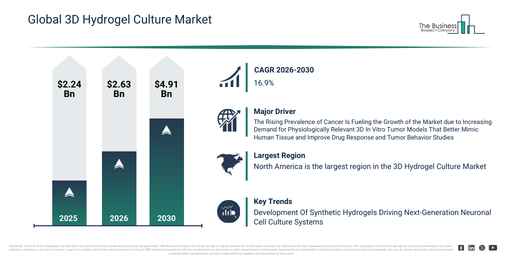
The 3D hydrogel culture market has seen substantial expansion in recent years. It is projected to increase from $2.24 billion in 2025 to $2.63 billion in 2026, achieving a compound annual growth rate (CAGR) of 17.2%. This historical growth is attributable to advancements in cell culture techniques, the growing application of in vitro disease models, the expansion of pharmaceutical research and development activities, the escalating demand for predictive drug testing models, and the increasing adoption of tissue engineering tools.
The 3D hydrogel culture market is poised for significant expansion over the coming years. This market is projected to reach $4.91 billion by 2030, exhibiting a compound annual growth rate (CAGR) of 16.9%. Several factors will drive this anticipated growth, including escalating investments in regenerative medicine research, a wider embrace of personalized medicine approaches, the broader implementation of organ-on-chip technologies, an increasing need for advanced toxicology testing platforms, and ongoing breakthroughs in hydrogel material science. During the forecast period, key trends observed will involve the increasing uptake of organoid and spheroid culture models, a growing utilization of biomimetic hydrogel matrices, the expanding integration of microfluidic 3D culture platforms, the proliferation of bioprinting-based cell culture systems, and a heightened emphasis on physiologically relevant drug screening.
Get A Free Sample Report With In-Depth Market Insights:
3D Hydrogel Culture Market Growth Factors Behind Sustained Expansion
The growing occurrence of cancer is projected to drive the expansion of the 3D hydrogel culture market in the future. Cancer constitutes a range of illnesses defined by unchecked cellular proliferation and the capacity to infiltrate or disseminate throughout the body, presenting intricate obstacles for investigation and pharmaceutical innovation. The escalation in cancer diagnoses is fueling the need for sophisticated in vitro models capable of accurately replicating human tissue environments, thereby facilitating more precise examinations of tumor characteristics and treatment efficacy. 3D hydrogel culture aids cancer research by offering three-dimensional scaffolds that emulate the extracellular matrix, which permits investigators to examine cell-cell interactions, tumor advancement, and drug effectiveness within a physiologically pertinent setting. As an illustration, in October 2025, the Australian Institute of Health and Welfare, an Australia-based government agency, forecasts that approximately 969,000 individuals will be living after having been diagnosed with cancer over the preceding 10 years, and about 170,000 new cancer cases will be identified in Australia. This signifies a growth of about 93% over 25 years, with the age-standardized cancer incidence projected at 614 cases per 100,000 people and mortality rates anticipated to decline to 194 deaths per 100,000 people. Consequently, the growing frequency of cancer is propelling the 3D hydrogel culture market.
3D Hydrogel Culture Market Segment Analysis: What Are The Core Market Categories?
The 3D hydrogel culture market covered in this report is segmented –
1) By Product: Scaffold Based, Scaffold Free, Bioreactors, Microfluidic, Bioprinting
2) By Application: Cancer Research, Stem Cell Research And Tissue Engineering, Drug Discovery And Toxicology Testing, Other Applications
3) By End-User: Pharmaceutical And Biotechnology Companies, Academic And Research Institutes, Hospitals, Other End-Users
Subsegments:
1) By Scaffold Based: Natural Polymer Hydrogels, Synthetic Polymer Hydrogels, Composite Hydrogels, Functionalized Hydrogels, Thermoresponsive Hydrogels
2) By Scaffold Free: Multicellular Spheroids, Patient Derived Organoids, Cell Sheets, Low Attachment Plate Aggregates, Magnetic Levitation Microtissues
3) By Bioreactors: Spinner Flask Bioreactors, Rotating Wall Vessel Bioreactors, Perfusion Bioreactors, Wave Bag Bioreactors, Stirred Tank Bioreactors
4) By Microfluidic: Organ On A Chip Platforms, Perfusion Microfluidic Chips, Droplet Microfluidic Systems, Gradient Generation Chips, Barrier Model Chips
5) By Bioprinting: Inkjet Bioprinting, Extrusion Bioprinting, Laser Assisted Bioprinting, Microvalve Bioprinting, Stereolithography Bioprinting
3D Hydrogel Culture Market Industry Trends Fueling Future Revenue Growth
Leading companies in the 3D hydrogel culture market are concentrating on innovations in tissue engineering, specifically the development of synthetic and xeno-free hydrogels. This focus aims to create more physiologically relevant, accurate, and reproducible three-dimensional neuronal cell culture systems. Synthetic and xeno-free hydrogel development involves crafting hydrogel formulations that exclude animal-derived components, yet effectively support robust cell-cell and cell matrix interactions, thereby improving in vitro modeling and enabling potential in vivo applications. For example, in September 2025, TheWell Bioscience Inc., a US-based company recognized for its advanced 3D cell culture platforms in precision medicine, cell therapy, and biomanufacturing, commercially launched its VitroGel NEURON. This innovative synthetic and xeno-free hydrogel delivers a defined, reproducible, and scalable environment conducive to neuronal growth, differentiation, and network formation. The product effectively overcomes the limitations associated with animal-derived matrices by efficiently supporting both 3D and 2D neuronal cultures and functioning as an injectable carrier for in vivo delivery. The hydrogel is specifically engineered to foster strong cell-cell and cell-matrix interactions, allowing researchers to construct more physiologically relevant neuronal models for studies pertaining to neurodevelopment and neurodegeneration.
3D Hydrogel Culture Market Top Companies Driving Competitive Growth
Major companies operating in the 3D hydrogel culture market are Merck KGaA, Thermo Fisher Scientific Inc., Corning Incorporated, Lonza Group AG, Sartorius, Bio-Techne Corporation, PromoCell GmbH, Cosmo Bio, AIM Biotech, AMSBIO (AMS Biotechnology), TheWell Bioscience, Cell Guidance Systems (CellGS), Cellendes GmbH, CD Bioparticles, Ferentis (Ferentis AG), Gelomics, TissueLabs, CELLINK (BICO), PepGel LLC, 3D Biotek Inc.
View The Full 3D Hydrogel Culture Market Report:
3D Hydrogel Culture Market Global Footprint: Which Region Leads The Market?
North America was the largest region in the 3D hydrogel culture market in 2025. Asia-Pacific is expected to be the fastest-growing region in the forecast period. The regions covered in the 3D hydrogel culture market report are Asia-Pacific, South East Asia, Western Europe, Eastern Europe, North America, South America, Middle East, Africa.
Reach Out To Our Team:
The Business Research Company: https://www.thebusinessresearchcompany.com/
Americas: +1 310-496-7795
Asia: +44 7882 955267 & +91 8897263534
Europe: +44 7882 955267
Email us at: marketing@tbrc.info
Follow us on:
LinkedIn: https://in.linkedin.com/company/the-business-research-company
YouTube: https://www.youtube.com/channel/UC24_fI0rV8cR5DxlCpgmyFQ
Global Market Model: https://www.thebusinessresearchcompany.com/global-market-model

Wasay has over a decade of experience in market research, data modelling, and analytics, with prior experience at GlobalData and Decision Tree Consulting Services. At The Business Research Company , he leads research operations across syndicated studies, customized consulting engagements, and the Global Market Model platform. His professional experience includes supporting organizations such as Boston Consulting Group, KPMG, and Ernst & Young. Wasay holds a degree in Electronics and Communications Engineering, postgraduate management qualifications from International Management Institute Belgium and Indian School of Business and Entrepreneurship, and completed the Integrated Program in Business Analytics from Indian Institute of Management Indore.