
Featuring market attractiveness scoring, total addressable market sizing, company benchmarking matrices, interactive Excel dashboards, deeper supply chain intelligence, emerging startup tracking, and granular product-level insights, The Business Research Company’s 2026 market reports are built to deliver research that is both more actionable and more strategically valuable.
Non-Marking Forklift Tires Market Size Outlook: How Quickly Will Revenue Expand Through 2030?
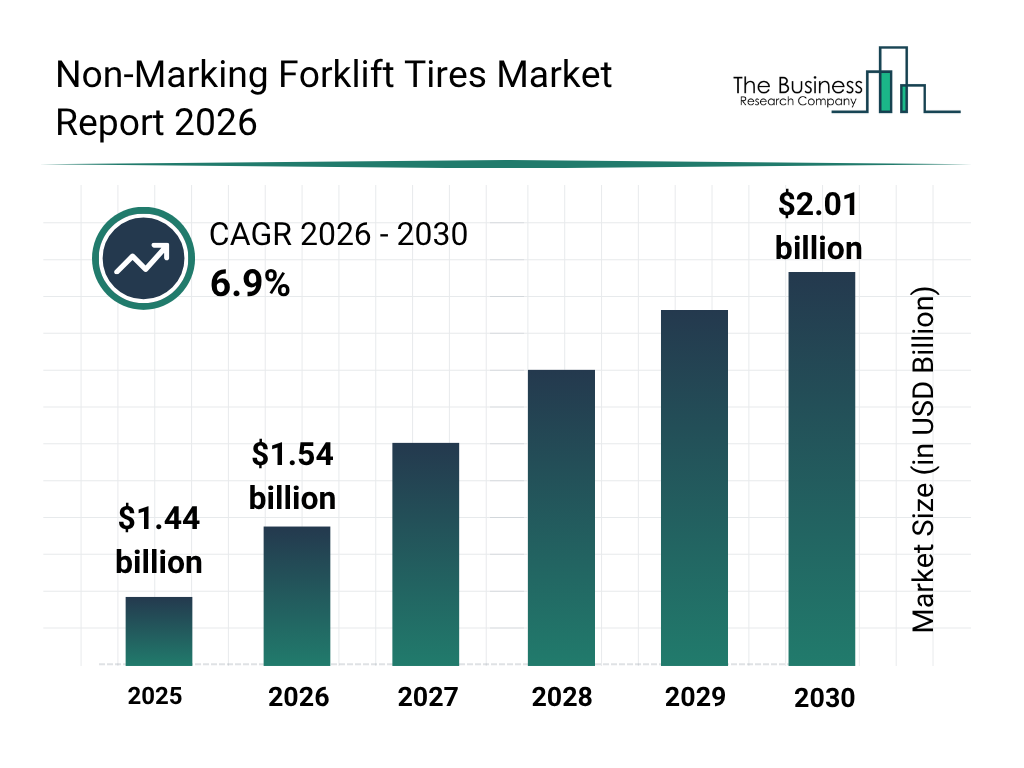
The non-marking forklift tires market has experienced robust expansion in recent years. This market is projected to expand from $1.44 billion in 2025 to $1.54 billion in 2026, demonstrating a compound annual growth rate (CAGR) of 6.6%. Historically, this growth can be ascribed to factors such as the rise in warehouse and logistics activities, the expansion of retail and manufacturing industries, an increase in forklift fleet numbers, the necessity for safer material handling options, and the broader development of industrial infrastructure.
The non-marking forklift tires market size is anticipated to experience substantial growth over the next few years, projected to reach $2.01 billion by 2030, exhibiting a compound annual growth rate (CAGR) of 6.9%. This expansion during the forecast period is driven by the increasing adoption of automation in warehouses and manufacturing, a rising preference for floor-protective non-marking tires, the ongoing growth in e-commerce and retail logistics, escalating investments in clean and hygienic facilities, and advancements in tire materials and customization technologies. Significant trends expected during this period include a heightened demand for non-marking forklift tires in clean environments, the growing use of polyurethane and hybrid tire materials, enhanced warehouse automation and material handling efficiency, a strong focus on floor protection and aesthetic preservation, and the expansion of aftermarket sales and tire customization options.
Get A Free Sample Report With In-Depth Market Insights:
Non-Marking Forklift Tires Market Growth Drivers: What’s Behind The Acceleration?
The non-marking forklift tires market is anticipated to expand due to the projected increase in logistics operations. Logistics operations involve the coordinated management of storing, handling, and moving goods across various facilities such as warehouses, distribution centers, and entire supply chain networks. This surge in logistics activities is largely spurred by the rapid growth of e-commerce, which has led to a greater volume of online orders, necessitating expanded warehousing capabilities and advanced fulfillment infrastructure to satisfy consumer delivery expectations. Consequently, the rise in logistics operations escalates the usage of forklifts in distribution centers and storage sites, thereby boosting the requirement for non-marking tires that safeguard floor surfaces and adhere to hygiene standards in sensitive logistics environments. For example, in February 2024, the U.S. Freight Transportation Services Index (TSI), reported by the Bureau of Transportation Statistics (BTS), a U.S.-based government agency under the Department of Transportation that monitors and reports national transportation trends, saw an increase from 136.6 in December 2022 to 139.1 in December 2023, marking a 1.8% rise. Therefore, the expansion in logistics operations is a key driver for the growth of the non-marking forklift tires market. Increasing Use Of Automated Robotics In Warehouses Driving The Market Growth Due To Rising Demand For Clean-Floor Compatible Material Handling Equipment
Non-Marking Forklift Tires Market Segmentation And Category Overview
The non-marking forklift tires market covered in this report is segmented –
1) By Product Type: Solid Tires, Pneumatic Tires, Cushion Tires, Other Product Types
2) By Tire Material: Rubber, Polyurethane, Other Tire Materials
3) By Tire Size: Small, Medium, Large
4) By Sales Channel: Original Equipment Manufacturer (OEM) Sales, Aftermarket Sales, Direct Sales, Distributor And Dealer Sales, Other Sales Channels
5) By Application: Warehousing, Manufacturing, Retail, Logistics, Food And Beverage, Pharmaceuticals, Other Applications
Subsegments:
1) By Solid Tires: Solid Rubber Tires, Solid Polyurethane Tires, Solid Composite Tires, Other Solid Variants
2) By Pneumatic Tires: Air Filled Pneumatic Tires, Foam Filled Pneumatic Tires, Tubeless Pneumatic Tires, Other Pneumatic Variants
3) By Cushion Tires: Smooth Cushion Tires, Treaded Cushion Tires, High Resilience Cushion Tires, Other Cushion Variants
4) By Other Product Types: Rubber And Polyurethane Blend Tires, Hybrid Non Marking Tires, Custom Engineered Non Marking Tires, Other Specialized Variants
Non-Marking Forklift Tires Market Trends: What’s Defining The Industry’s Next Phase?
Leading companies in the non-marking forklift tires market are concentrating on developing advanced products, such as forklift solid tires, to enhance load-bearing capacity and extend service life in challenging industrial environments. These robust, airless rubber tires are engineered to resist punctures while offering superior load support, increased stability, and a longer operational lifespan in rigorous material handling settings. For instance, in February 2023, Yokohama Off-Highway Tires, an India-based manufacturer of industrial and off-highway tires, introduced the Galaxy MFS 101 SDS, a solid tire specifically designed for forklift operations. This puncture-proof tire incorporates a three-layer construction: a sturdy base for stability, a cushion layer to reduce vibration and improve comfort, and a wear-resistant tread with more rubber beyond the 60J wear limit for extended durability and better traction on hard indoor and outdoor surfaces. It is built for continuous, heavy-duty use in warehouses, ports, and loading docks. Key features include a zig-zag tread pattern for heat dissipation, improved steering, and anti-slip steel beads, initially available in 28 sizes for 8- to 15-inch rims.
Non-Marking Forklift Tires Market Industry Leaders And Competitive Landscape
Major companies operating in the non-marking forklift tires market are Continental AG, Michelin, Bridgestone Corporation, The Yokohama Rubber Co Ltd, Trelleborg AB, Camso Inc, Balkrishna Industries Limited, Marangoni S.p.A., TVS Srichakra Limited, Magna Tyres Group B.V., Velox Tyres Private Limited, Maxam Tire International Limited, Solideal, Global Rubber Industries Pvt Ltd, Apexway Products Corp, Sentry Tire and Rubber LLC, Royal Tyres Private Limited, Shandong Forlander Tyre Co Ltd, Stradrex Rubber Industries, Nimsa Enterprises.
View The Full Non-Marking Forklift Tires Market Report:
Non-Marking Forklift Tires Market Regional Analysis And Leading Geography
North America was the largest region in the non-marking forklift tires market in 2025. Asia-Pacific is expected to be the fastest-growing region in the forecast period. The regions covered in the non-marking forklift tires market report are Asia-Pacific, South East Asia, Western Europe, Eastern Europe, North America, South America, Middle East, Africa.
Reach Out To Our Team:
The Business Research Company: https://www.thebusinessresearchcompany.com/
Americas: +1 310-496-7795
Asia: +44 7882 955267 & +91 8897263534
Europe: +44 7882 955267
Email us at: marketing@tbrc.info
Follow us on:
LinkedIn: https://in.linkedin.com/company/the-business-research-company
YouTube: https://www.youtube.com/channel/UC24_fI0rV8cR5DxlCpgmyFQ
Global Market Model: https://www.thebusinessresearchcompany.com/global-market-model

Wasay has over a decade of experience in market research, data modelling, and analytics, with prior experience at GlobalData and Decision Tree Consulting Services. At The Business Research Company , he leads research operations across syndicated studies, customized consulting engagements, and the Global Market Model platform. His professional experience includes supporting organizations such as Boston Consulting Group, KPMG, and Ernst & Young. Wasay holds a degree in Electronics and Communications Engineering, postgraduate management qualifications from International Management Institute Belgium and Indian School of Business and Entrepreneurship, and completed the Integrated Program in Business Analytics from Indian Institute of Management Indore.