
Featuring market attractiveness scoring, total addressable market sizing, company benchmarking matrices, interactive Excel dashboards, deeper supply chain intelligence, emerging startup tracking, and granular product-level insights, The Business Research Company’s 2026 market reports are built to deliver research that is both more actionable and more strategically valuable.
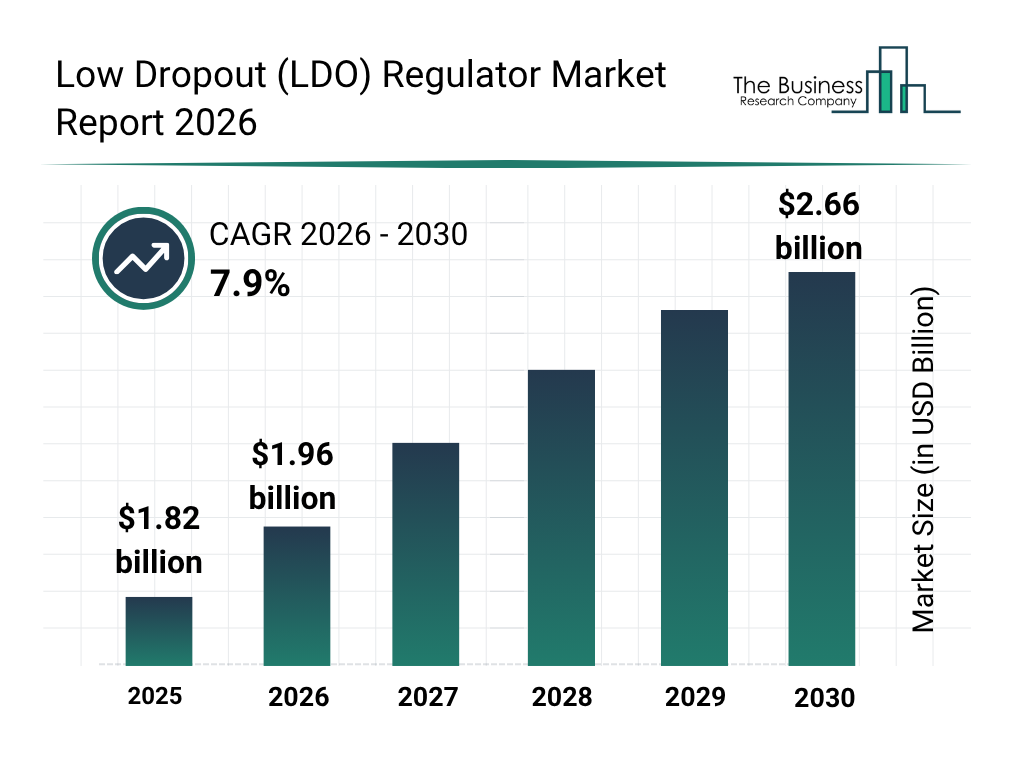
Low Dropout (LDO) Regulator Market Forecast: Value Set To Climb From $1.96 Billion To $2.66 Billion
The size of the low dropout (LDO) regulator market has experienced robust growth in recent years. Its valuation is expected to increase from $1.82 billion in 2025 to $1.96 billion in 2026, with a compound annual growth rate (CAGR) reaching 7.7%. This historical growth can be attributed to factors like the increasing use of consumer electronics, expansion in automotive electronics, rising industrial automation, the demand for stable voltage in telecommunications, and the proliferation of healthcare electronics.
The low dropout (LDO) regulator market size is anticipated to experience substantial growth over the next few years. It is projected to expand to $2.66 billion by 2030, achieving a compound annual growth rate (CAGR) of 7.9%. This projected growth throughout the forecast period can be attributed to several factors, including the increasing adoption of electric vehicles and energy-efficient devices, the expanding deployment of IoT and connected devices, a rising demand for high-performance and low-noise LDOs, the expansion of wearable and portable electronics, and a growing emphasis on energy-efficient and thermal-protected LDO solutions. Significant trends during the forecast period involve an increasing need for low-noise voltage regulation solutions, the growing use of ultra-low dropout regulators in consumer electronics, a rising preference for LDOs that offer high precision and fast transient response, the integration of adjustable LDOs into automotive and industrial applications, and a strong focus on thermal protection and energy efficiency in LDO designs.
Get A Free Sample Report With In-Depth Market Insights:
Low Dropout (LDO) Regulator Market Demand Drivers Opening New Revenue Streams
The expanding requirement for consumer electronics is projected to drive the future growth of the low dropout (LDO) regulator market. These electronics are devices crafted for daily individual usage, primarily for personal enjoyment, communication, or domestic applications. The impetus behind this consumer electronics demand arises from accelerated smartphone replacement cycles and a rising preference among consumers for electronic devices that are rich in features and easily portable. LDO regulators assist consumer electronics by delivering accurate voltage regulation for delicate semiconductor components, boosting battery efficiency, and allowing for compact circuit designs in portable equipment. As an illustration, in February 2024, the Japan Electronics and Information Technology Industries Association, a Japan-based trade organization, reported that consumer electronic equipment production reached $200.44 million (¥31,685 million), a notable rise from $148.23 million (¥23,425 million) in January 2023. Hence, the escalating demand for consumer electronics is a significant factor propelling the advancement of the low dropout (LDO) regulator market.
Low Dropout (LDO) Regulator Market Segment Analysis And Revenue Potential
The low dropout (LDO) regulator market covered in this report is segmented –
1) By Product Type: Low Dropout Linear Regulators, Ultra-Low Dropout Regulators, Adjustable Low-Dropout Regulators, Fixed Low-Dropout Regulators
2) By Channel Type: Single Channel, Dual Channel, Multi-Channel
3) By Output Voltage: Less Than 1V, 1V–5V, Above 5V
4) By Application: Consumer Electronics, Automotive, Industrial, Telecommunications, Healthcare, Other Applications
5) By End-User: Original Equipment Manufacturer (OEMs), Aftermarket
Subsegments:
1) By Low Dropout Linear Regulators: Standard Output Voltage, High Output Current, Low Quiescent Current, Temperature Compensated
2) By Ultra-Low Dropout Regulators: High Precision, Low Noise, Fast Transient Response, Low Power Consumption
3) By Adjustable Low-Dropout Regulators: Variable Output Voltage, Multi-Range Adjustment, Precision Reference, Programmable Output
4) By Fixed Low-Dropout Regulators: Single Output Voltage, High Current Capability, Low Dropout Voltage, Thermal Protection Enabled
Low Dropout (LDO) Regulator Market Trends Powering Strategic Industry Growth
Major companies operating in the low dropout (LDO) regulator market are concentrating on advancements in ultra-low noise regulator design, specifically employing low-dropout transient response optimization. This effort aims to enhance power efficiency, improve signal integrity in sensitive analog and RF applications, and meet the rising demand for high-performance, compact, and energy-efficient electronic devices. Low-dropout transient response optimization involves boosting an LDO regulator’s capacity to maintain stable output voltage during rapid changes in load current or input voltage, all while operating with a minimal input–output voltage differential. For example, in May 2024, Toshiba Electronic Devices & Storage Corporation, a semiconductor company based in Japan, unveiled the TCR3LM series. The series is characterized by an ultra-compact DFN4D package, measuring 1.0 mm × 1.0 mm × 0.37 mm, delivering up to 300 mA output current, and achieving a typical dropout voltage of 137 mV, thereby enabling lower input voltage operation and extended battery life in IoT modules and wearable devices. Additionally, it integrates overcurrent protection, overtemperature protection, and autodischarge functionality, ensuring dependable and efficient miniature power management.
Low Dropout (LDO) Regulator Market Competitive Landscape: Which Companies Lead The Industry?
Major companies operating in the low dropout (LDO) regulator market are Toshiba Electronic Devices & Storage Corporation, Texas Instruments Incorporated, Infineon Technologies AG, STMicroelectronics N.V., NXP Semiconductors N.V., Analog Devices Inc., Renesas Electronics Corporation, Microchip Technology Incorporated, ROHM Co. Ltd., Diodes Incorporated, Kinetic Technologies (Kinet-ic), Semtech Corporation, MaxLinear Inc., Nordic Semiconductor ASA, Silergy Corp., Richtek Technology Corporation, SG Micro Corp (SGMICRO), Torex Semiconductor Ltd., ABLIC Inc., EM Microelectronic-Marin SA, Fortune Advanced Technology Co. Ltd.
View The Full Low Dropout (LDO) Regulator Market Report:
Low Dropout (LDO) Regulator Market Regional Breakdown: Where Is Demand Concentrated?
Asia-Pacific was the largest region in the low dropout (LDO) regulator market in 2025. North America is expected to be the fastest-growing region in the forecast period. The regions covered in the low dropout (LDO) regulator market report are Asia-Pacific, South East Asia, Western Europe, Eastern Europe, North America, South America, Middle East, Africa.
Reach Out To Our Team:
The Business Research Company: https://www.thebusinessresearchcompany.com/
Americas: +1 310-496-7795
Asia: +44 7882 955267 & +91 8897263534
Europe: +44 7882 955267
Email us at: marketing@tbrc.info
Follow us on:
LinkedIn: https://in.linkedin.com/company/the-business-research-company
YouTube: https://www.youtube.com/channel/UC24_fI0rV8cR5DxlCpgmyFQ
Global Market Model: https://www.thebusinessresearchcompany.com/global-market-model

Wasay has over a decade of experience in market research, data modelling, and analytics, with prior experience at GlobalData and Decision Tree Consulting Services. At The Business Research Company , he leads research operations across syndicated studies, customized consulting engagements, and the Global Market Model platform. His professional experience includes supporting organizations such as Boston Consulting Group, KPMG, and Ernst & Young. Wasay holds a degree in Electronics and Communications Engineering, postgraduate management qualifications from International Management Institute Belgium and Indian School of Business and Entrepreneurship, and completed the Integrated Program in Business Analytics from Indian Institute of Management Indore.