
Built to provide research that’s more actionable and strategically valuable, The Business Research Company’s 2026 market reports include market attractiveness analysis, total addressable market sizing, company benchmarking matrices, interactive Excel dashboards, broader supply chain intelligence, emerging startup tracking, and in-depth product insights.
Three-Dimensional (3D) Modeling Software For Architecture Market Growth Potential: How Will Market Size Shift Through 2030?
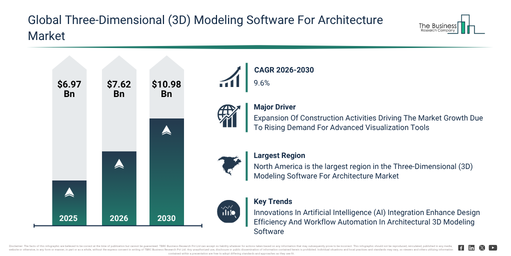
The market for three-dimensional (3D) modeling software in architecture has shown strong growth in recent years. This market is anticipated to expand, rising from $6.97 billion in 2025 to $7.62 billion in 2026, at a compound annual growth rate (CAGR) of 9.3%. Historically, the expansion can be attributed to several factors including the rising adoption of CAD tools, a strong demand for realistic architectural visualization, continued growth in commercial and residential construction, the imperative for precision in design planning, and the broadening of architectural education and training.
The three-dimensional (3D) modeling software for architecture market is anticipated to experience substantial expansion in the coming years. Its valuation is projected to reach $10.98 billion in 2030, exhibiting a compound annual growth rate (CAGR) of 9.6%. This growth during the forecast period is primarily driven by several factors, including the increasing adoption of AI-assisted design, the availability of cloud-based modeling solutions, a rising demand for immersive VR/AR experiences, the integration of these tools with smart infrastructure projects, and the expansion of collaborative design platforms. Key developments expected to shape the market in the forecast period encompass the widespread adoption of parametric design, the shift towards cloud-based 3D modeling, the evolution of collaborative architecture workflows, enhanced integration with BIM systems, and advancements in real-time visualization and rendering.
Get A Free Sample Report With In-Depth Market Insights:
Three-Dimensional (3D) Modeling Software For Architecture Market Development Factors: What’s Supporting Demand?
The anticipated rise in construction endeavors is projected to fuel the expansion of the three-dimensional (3D) modeling software for the architecture market in the foreseeable future. These activities encompass the conceptualization, architectural design, and ultimate execution of various building initiatives, spanning residential, commercial, and infrastructure sectors. This surge in construction is primarily propelled by heightened investments in infrastructure and extensive development undertakings, as both governmental bodies and private entities commit significant capital to upgrade urban infrastructure and broaden real estate portfolios. Professionals in architecture and construction are progressively adopting sophisticated three-dimensional visualization solutions to optimize project planning, minimize potential design flaws, and foster better communication among all involved parties throughout intricate construction ventures. As an illustration, data from Eurostat, a Luxembourg-based statistical office of the European Union, indicated that in April 2025, construction production saw an increase of 3.0% in the euro area and 2.5% in the EU compared to April 2024, as reported in June 2025. Consequently, the burgeoning scope of construction activities is directly contributing to the advancement of the three-dimensional (3D) modeling software for the architecture market.
Three-Dimensional (3D) Modeling Software For Architecture Market Segment Analysis And Revenue Potential
The three-dimensional (3D) modeling software for architecture market covered in this report is segmented –
1) By Software Type: Parametric Modeling Software, Surface Modeling Software, Solid Modeling Software, Mesh Modeling Software, Hybrid Modeling Software
2) By Workflow Integration: Standalone Software, Collaborative Software, Integrated Software Solutions
3) By Deployment Mode: Cloud-Based Software, On-Premises Software
4) By Application: Architectural Design, Building Information Modeling (BIM), Visualization and Rendering, Construction Planning, Virtual Reality Integration
5) By End-User Industry: Residential Architecture, Commercial Architecture, Industrial Architecture, Urban Planning and Design, Landscape Architecture
Subsegments:
1) By Parametric Modeling Software: Constraint Based Modeling, Feature Based Modeling, History Based Modeling, Rule Driven Modeling
2) By Surface Modeling Software: Nurb Surface Modeling, Freeform Surface Modeling, Subdivision Surface Modeling, Patch Surface Modeling
3) By Solid Modeling Software: Constructive Solid Geometry, Boundary Representation, Feature Based Solid Modeling, Parametric Solid Modeling
4) By Mesh Modeling Software: Polygon Mesh Modeling, Triangle Mesh Modeling, Quad Mesh Modeling, Subdivision Mesh Modeling
5) By Hybrid Modeling Software: Combination Modeling, Multi Technique Modeling, Mixed Representation Modeling, Integrated Modeling
Three-Dimensional (3D) Modeling Software For Architecture Market Transformation Trends: What Innovations Are Driving Change?
Leading companies in the three-dimensional (3D) modeling software for the architecture market are concentrating on developing sophisticated solutions, such as building information modeling (BIM) software, to facilitate data-driven decision-making from initial conceptual planning through construction and subsequent facility management. Building information modeling (BIM) software serves as a digital platform that creates and manages intelligent 3D models of buildings and infrastructure, thereby fostering collaboration by integrating design, scheduling, cost, and project data onto a single shared platform. For example, in October 2025, Graphisoft, a Hungary-based developer specializing in building information modeling (BIM) software, introduced Archicad 29, which is the most recent version of its building information modeling software. This new release includes an integrated AI assistant specifically designed to improve productivity, optimize modeling workflows, and provide architects with intelligent automation tools, leading to accelerated project execution and enhanced design precision across challenging architectural projects.
Three-Dimensional (3D) Modeling Software For Architecture Market Competitive Overview And Top Companies
Major companies operating in the three-dimensional (3D) modeling software for architecture market are Dassault Systèmes SE, Hexagon AB, Autodesk Inc., Trimble Inc., Bentley Systems Incorporated, Nemetschek SE, Dlubal Software GmbH, Revizto SA, Snaptrude Technologies Private Limited, Coohom Inc., Dalux AS, Chief Architect Inc., Renga Software LLC, KUBUS BV, ACCA Software S.p.A., Robert McNeel & Associates, Blender Foundation, Concept3D Inc., PROKON Software Consultants Pty Ltd, Cedreo SAS, Asuni CAD S.A., and Cadwork Informatik AG.
View The Full Three-Dimensional (3D) Modeling Software For Architecture Market Report:
Three-Dimensional (3D) Modeling Software For Architecture Market Leading Geography: Which Region Contributes The Most Revenue?
North America was the largest region in the three-dimensional (3D) modeling software for the architecture market in 2025. Asia-Pacific is expected to be the fastest-growing region in the forecast period. The regions covered in the three-dimensional (3D) modeling software for architecture market report are Asia-Pacific, South East Asia, Western Europe, Eastern Europe, North America, South America, Middle East, Africa.
Reach Out To Our Team:
The Business Research Company: https://www.thebusinessresearchcompany.com/
Americas: +1 310-496-7795
Asia: +44 7882 955267 & +91 8897263534
Europe: +44 7882 955267
Email us at: marketing@tbrc.info
Follow us on:
LinkedIn: https://in.linkedin.com/company/the-business-research-company
YouTube: https://www.youtube.com/channel/UC24_fI0rV8cR5DxlCpgmyFQ
Global Market Model: https://www.thebusinessresearchcompany.com/global-market-model

Wasay has over a decade of experience in market research, data modelling, and analytics, with prior experience at GlobalData and Decision Tree Consulting Services. At The Business Research Company , he leads research operations across syndicated studies, customized consulting engagements, and the Global Market Model platform. His professional experience includes supporting organizations such as Boston Consulting Group, KPMG, and Ernst & Young. Wasay holds a degree in Electronics and Communications Engineering, postgraduate management qualifications from International Management Institute Belgium and Indian School of Business and Entrepreneurship, and completed the Integrated Program in Business Analytics from Indian Institute of Management Indore.