
Built to provide research that’s more actionable and strategically valuable, The Business Research Company’s 2026 market reports include market attractiveness analysis, total addressable market sizing, company benchmarking matrices, interactive Excel dashboards, broader supply chain intelligence, emerging startup tracking, and in-depth product insights.
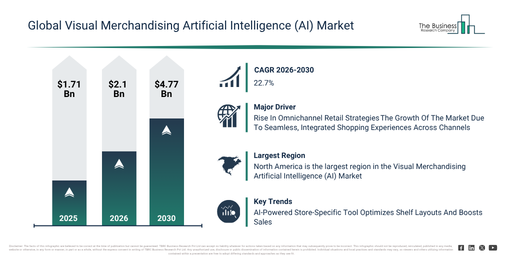
Visual Merchandising Artificial Intelligence (AI) Market Poised To Hit $4.77 Billion By 2030 With A 22.7% CAGR
The visual merchandising artificial intelligence (AI) market has expanded significantly over recent years. It is anticipated to increase from $1.71 billion in 2025 to $2.1 billion in 2026, exhibiting a compound annual growth rate (CAGR) of 22.5%. This growth in the past has been driven by the adoption of basic merchandising software, expanding e-commerce reach, the requirement for better in-store customer experiences, the incorporation of digital displays, and heightened retail competition.
The visual merchandising artificial intelligence (AI) market is anticipated to experience substantial growth in the upcoming years, with its size projected to reach $4.77 billion in 2030, exhibiting a compound annual growth rate (CAGR) of 22.7%. This expansion during the forecast period is attributed to factors such as ai-driven visual merchandising adoption, integration with immersive technologies, growth of omnichannel retailing, real-time analytics for product placement, and the expansion of smart retail infrastructure. Furthermore, major trends for the forecast period encompass ai-powered customer behavior analysis, automated planogram optimization, personalized visual displays, real-time shelf monitoring, and predictive sales and demand forecasting.
Get A Free Sample Report With In-Depth Market Insights:
Visual Merchandising Artificial Intelligence (AI) Market Demand Drivers: What’s Powering Industry Growth?
The expanding integration of omnichannel retail approaches is anticipated to drive the advancement of the Visual Merchandising Artificial Intelligence (AI) market in the future. Omnichannel retail strategies involve a harmonized method where retailers combine various shopping avenues, including physical stores, online platforms, mobile applications, and social media, to deliver a smooth and uniform shopping experience for consumers across every interaction point. The increased uptake of omnichannel retail strategies stems from consumers’ rising expectation for an effortless and convenient shopping journey across both digital and physical channels, thereby compelling retailers to merge various points of interaction to satisfy these needs. These strategies improve Visual Merchandising Artificial Intelligence (AI) by consolidating data from both online and offline sources, facilitating AI-powered, customized shelf arrangements and refined in-store encounters. For example, in May 2025, data from Digital Commerce 360, managed by Vertical Web Media LLC, a US-based media and research entity, indicated that the proportion of the leading 1000 retail chains providing in-store stock status to shoppers as an omnichannel capability rose from 64.4% in 2023 to 65.5% in 2024. Consequently, the expanding implementation of omnichannel retail strategies is fueling the expansion of the Visual Merchandising Artificial Intelligence (AI) market.
Visual Merchandising Artificial Intelligence (AI) Market Segment Analysis: What Are The Core Market Categories?
The visual merchandising artificial intelligence (AI) market covered in this report is segmented –
1) By Component: Software, Hardware, Services
2) By Deployment Mode: On-Premises, Cloud
3) By Enterprise Size: Small And Medium Enterprises, Large Enterprises
4) By Application: Retail Stores, Supermarkets And Hypermarkets, Shopping Malls, E-Commerce, Other Applications
5) By End-User: Apparel And Fashion, Electronics, Grocery, Home Décor, Other End-Users
Subsegments:
1) By Software: Planogram Optimization Software, Image Recognition Software, Shelf Monitoring Software, Analytics And Reporting Software
2) By Hardware: Smart Cameras, Digital Display Devices, Sensor Devices, Edge Computing Devices
3) By Services: Consulting Services, Implementation Services, Integration Services, Support And Maintenance Services
Visual Merchandising Artificial Intelligence (AI) Market Innovation Trends: What Developments Are Reshaping The Industry?
Leading companies operating within the visual merchandising artificial intelligence (AI) market are concentrating on developing advanced AI-powered instruments, such as store-specific AI planogram tools, to bolster efficiency, accuracy, and sustainability in retail operations. Store-specific AI planogram tools refer to sophisticated software platforms designed to automatically generate customized visual display plans for individual retail locations, utilizing real-time inventory data and business objectives. For instance, in January 2025, Optimum Retailing, a brand of Unefi Inc., a Canada-based software company, launched Realgram AI. This offering is an AI-driven visual merchandising platform featuring a generative AI engine that autonomously produces custom planograms for individual stores with a single click, considerably reducing the time and complexity involved in manual merchandising. Its capabilities include the ability to align planograms with business goals such as profit optimization and inventory levels, and it incorporates a generative AI chatbot named ORKA (Optimum Retailing Knowledge Assistant) that enables teams to query and access on-demand sales and performance insights, thereby extending operational intelligence and reducing waste for retailers managing hundreds or thousands of stores.
Visual Merchandising Artificial Intelligence (AI) Market Competitive Landscape: Which Companies Lead The Industry?
Major companies operating in the visual merchandising artificial intelligence (AI) market are Google LLC, Microsoft Corporation, Amazon Web Services Inc., International Business Machines Corporation, Oracle Corporation, SAP SE, Zebra Technologies Corporation, Scandit AG, SpreeAI Corporation, Evatro Inc., Pensa Systems Inc., Focal Systems Inc., InContext Solutions Inc., StrataVision Inc., Constems-AI Systems, DRESSX Inc., Retail VR Inc., Shopic Technologies Ltd, Leafio Inc., VirtualRetail.io.
View The Full Visual Merchandising Artificial Intelligence (AI) Market Report:
Visual Merchandising Artificial Intelligence (AI) Market Regional Outlook: Where Is Opportunity Concentrated?
North America was the largest region in the visual merchandising artificial intelligence (AI) market in 2025. Asia-Pacific is expected to be the fastest-growing region in the forecast period. The regions covered in the visual merchandising artificial intelligence (AI) market report are Asia-Pacific, South East Asia, Western Europe, Eastern Europe, North America, South America, Middle East, Africa.
Reach Out To Our Team:
The Business Research Company: https://www.thebusinessresearchcompany.com/
Americas: +1 310-496-7795
Asia: +44 7882 955267 & +91 8897263534
Europe: +44 7882 955267
Email us at: marketing@tbrc.info
Follow us on:
LinkedIn: https://in.linkedin.com/company/the-business-research-company
YouTube: https://www.youtube.com/channel/UC24_fI0rV8cR5DxlCpgmyFQ
Global Market Model: https://www.thebusinessresearchcompany.com/global-market-model

Wasay has over a decade of experience in market research, data modelling, and analytics, with prior experience at GlobalData and Decision Tree Consulting Services. At The Business Research Company , he leads research operations across syndicated studies, customized consulting engagements, and the Global Market Model platform. His professional experience includes supporting organizations such as Boston Consulting Group, KPMG, and Ernst & Young. Wasay holds a degree in Electronics and Communications Engineering, postgraduate management qualifications from International Management Institute Belgium and Indian School of Business and Entrepreneurship, and completed the Integrated Program in Business Analytics from Indian Institute of Management Indore.