
Backed by market attractiveness analysis, total addressable market sizing, company benchmarking matrices, interactive Excel dashboards, wider supply chain intelligence, emerging startup coverage, and detailed product-level insights, The Business Research Company’s 2026 market reports are designed to offer research that is more actionable and strategically valuable than ever.
Acceleration And Yaw Rate Sensors Market Poised To Hit $5.09 Billion By 2030 With A 10.2% CAGR
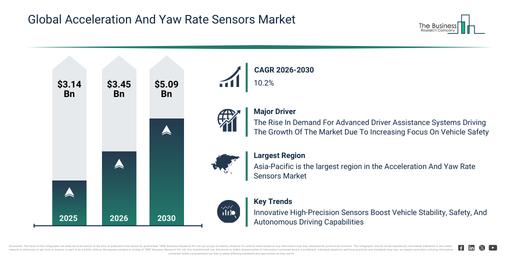
The acceleration and yaw rate sensors market has experienced strong growth over recent years. This market is projected to expand from $3.14 billion in 2025 to $3.45 billion in 2026, at a compound annual growth rate (CAGR) of 10.0%. Historically, this growth can be attributed to the increasing adoption of electronic stability control (ESC) systems, more stringent automotive safety regulations, rising demand for motion sensing in consumer electronics, the expansion of aerospace and defense navigation systems, and increasing industrial automation.
The acceleration and yaw rate sensors market is projected to experience substantial growth over the next few years. It will grow to $5.09 billion in 2030 at a compound annual growth rate (CAGR) of 10.2%. This anticipated expansion during the forecast period can be attributed to the increasing deployment of electric vehicles, advancements in autonomous vehicle development, the expanding integration of sensors into industrial IoT, the development of aerospace navigation systems, and the greater application of AI-enabled motion analytics. Significant trends expected in this period include the integration of multi-axis inertial sensor modules, the rising adoption of fiber optic gyroscopes (FOG) for high-precision uses, the increasing availability of sensor calibration and testing services, the growth of embedded software solutions for motion and stability monitoring, and the broadening of sensor-based data analytics and monitoring services.
Get A Free Sample Report With In-Depth Market Insights:
Acceleration And Yaw Rate Sensors Market Growth Backed By Core Demand Fundamentals
The escalating demand for advanced driver assistance systems is projected to fuel the expansion of the acceleration and yaw rate sensors market in the future. Advanced driver assistance systems (ADAS) are defined as electronic vehicle systems that leverage sensors, cameras, and software to support drivers in operating vehicles safely and efficiently, thereby enhancing control and mitigating accident risks. This surge in demand for advanced driver assistance systems stems from a heightened focus on vehicle safety, as both automotive manufacturers and regulatory bodies prioritize technologies designed to reduce accidents and safeguard passengers. Acceleration and yaw rate sensors contribute to advanced driver assistance systems by supplying precise vehicle motion data, enabling features such as stability control, lane-keeping assistance, and collision avoidance to react accurately and in real-time. For instance, in October 2024, the MITRE Corporation, a US-based not-for-profit organization, reported that by the 2023 model year, 10 of the 14 advanced driver assistance systems (ADAS) features achieved over 50% market penetration, with five features surpassing 90%. This contrasts with a prior situation where none of the ADAS features had reached 75% penetration. Ultimately, the rising demand for advanced driver assistance systems is propelling the growth of the acceleration and yaw rate sensors market.
Acceleration And Yaw Rate Sensors Market Segmentation: How Does The Market Break Down By Category?
The acceleration and yaw rate sensors market covered in this report is segmented –
1) By Sensor Type: Micro-Electro-Mechanical Systems, Piezoelectric, Piezoresistive, Capacitive, Fiber Optic Gyroscopes (FOG), Ring Laser Gyroscopes (RLG)
2) By Performance Range: Consumer Grade, Industrial Grade
3) By Distribution Channel: Online Retailers, Direct Manufacturers, Distributors And Wholesalers, Specialty Electronics Stores
4) By Application: Navigation And Dead Reckoning, Electronic Stability Control (ESC), Motion Sensing And Gesture Recognition, Vibration And Tilt Monitoring, Roll-over Detection
5) By End-User Industry: Automotive, Consumer Electronics, Industrial Manufacturing, Aerospace And Defense, Healthcare
Subsegments:
1) By Micro-Electro-Mechanical Systems: Single Axis, Dual Axis, Three Axis
2) By Piezoresistive: Silicon Based, Metal Based, Polymer Based
3) By Piezoelectric: Quartz Based, Ceramic Based, Thin Film Based
4) By Capacitive: Surface Capacitive, Differential Capacitive, Interdigitated Capacitive
5) By Fiber Optic Gyroscopes: Interferometric Fiber Optic, Resonator Fiber Optic, Polarization Maintaining Fiber Optic
6) By Ring Laser Gyroscopes: Helium Neon Based, Solid State Based, Semiconductor Based
Acceleration And Yaw Rate Sensors Market Growth Trends Reshaping The Competitive Landscape
Leading companies in the acceleration and yaw rate sensors market are concentrating on developing innovative products, such as high-precision automotive sensors, to improve vehicle stability, safety, and capabilities for autonomous driving. These high-precision automotive sensors are advanced devices that accurately measure vehicle parameters like acceleration, rotation, or position, providing crucial support for safety, control, and autonomous driving systems. For instance, in July 2025, Seiko Epson Corporation, a Japan-based technology company, launched the XV4311BD, a high precision automotive yaw rate sensor compliant with AEC Q100, specifically designed for integration into next generation ADAS and autonomous driving systems. This particular high precision gyro sensor combines Epson’s proprietary quartz crystal gyro element with an integrated circuit to provide excellent bias stability, low noise, diagnostic functions, and compatibility with six degree of freedom inertial setups, making it suitable for vehicle localization and safety critical applications where cost, size, and reliability are key considerations. The compact device supports enhanced vehicle dynamics control by delivering precise yaw axis angular velocity data that complements multi axis motion sensing, thereby improving both performance and safety in modern automotive systems.
Acceleration And Yaw Rate Sensors Market Competitive Overview And Top Companies
Major companies operating in the acceleration and yaw rate sensors market are Robert Bosch GmbH, Honeywell International Inc., Qualcomm Technologies Inc., Thales Group, L3Harris Technologies Inc., Infineon Technologies AG, STMicroelectronics N.V., TDK Corporation, NXP Semiconductors N.V., Analog Devices Inc., Murata Manufacturing Co Ltd., Seiko Epson Corporation, Trimble Inc., Sensata Technologies Holding plc, MEMSIC Semiconductor Inc., KVH Industries Inc., Xsens Technologies B.V., ACEINNA Inc., Gladiator Technologies Inc., and ASC GmbH.
View The Full Acceleration And Yaw Rate Sensors Market Report:
Acceleration And Yaw Rate Sensors Market Top Region: Where Does Most Revenue Come From?
Asia-Pacific was the largest region in the acceleration and yaw rate sensors market in 2025 and is expected to be the fastest-growing region in the forecast period. The regions covered in the acceleration and yaw rate sensors market report are Asia-Pacific, South East Asia, Western Europe, Eastern Europe, North America, South America, Middle East, Africa.
Reach Out To Our Team:
The Business Research Company: https://www.thebusinessresearchcompany.com/
Americas: +1 310-496-7795
Asia: +44 7882 955267 & +91 8897263534
Europe: +44 7882 955267
Email us at: marketing@tbrc.info
Follow us on:
LinkedIn: https://in.linkedin.com/company/the-business-research-company
YouTube: https://www.youtube.com/channel/UC24_fI0rV8cR5DxlCpgmyFQ
Global Market Model: https://www.thebusinessresearchcompany.com/global-market-model

Wasay has over a decade of experience in market research, data modelling, and analytics, with prior experience at GlobalData and Decision Tree Consulting Services. At The Business Research Company , he leads research operations across syndicated studies, customized consulting engagements, and the Global Market Model platform. His professional experience includes supporting organizations such as Boston Consulting Group, KPMG, and Ernst & Young. Wasay holds a degree in Electronics and Communications Engineering, postgraduate management qualifications from International Management Institute Belgium and Indian School of Business and Entrepreneurship, and completed the Integrated Program in Business Analytics from Indian Institute of Management Indore.