
Featuring market attractiveness scoring, total addressable market sizing, company benchmarking matrices, interactive Excel dashboards, deeper supply chain intelligence, emerging startup tracking, and granular product-level insights, The Business Research Company’s 2026 market reports are built to deliver research that is both more actionable and more strategically valuable.
Application Lifecycle Management (ALM) Tools Market Forecast: What Value Will The Market Reach By 2030?
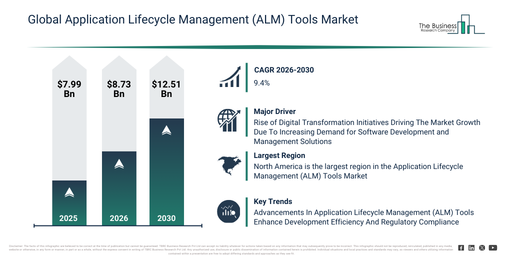
The application lifecycle management (alm) tools market has witnessed substantial growth in recent years. It is projected to increase from $7.99 billion in 2025 to $8.73 billion in 2026, showing a compound annual growth rate (CAGR) of 9.2%. This historical growth can be linked to the rising acceptance of software development lifecycle tools, an expanding need for version control and source code management, the growing requirement for application testing and defect tracking, the enlargement of enterprise IT infrastructure, and the increased embrace of agile methodologies.
The application lifecycle management (alm) tools market is anticipated to demonstrate robust growth in the coming years. It is forecast to expand to $12.51 billion in 2030, achieving a compound annual growth rate (CAGR) of 9.4%. The expansion during this period can be ascribed to factors such as the increasing need for cloud-based and hybrid deployment options, the greater integration of AI and automation in application lifecycle management, a heightened emphasis on continuous integration and delivery, the widening scope of mobile and web application development, and the escalating requirement for end-to-end traceability and compliance. Prominent trends for the forecast duration encompass the rising adoption of cloud-based ALM tools, the enhanced integration of continuous integration and deployment pipelines, an increase in automated testing and defect tracking solutions, the broadening of collaboration and version control platforms, and an amplified focus on comprehensive application lifecycle visibility.
Get A Free Sample Report With In-Depth Market Insights:
Application Lifecycle Management (ALM) Tools Market Expansion Drivers: What’s Shaping Future Growth?
The expansion of the application lifecycle management (ALM) tools market is anticipated to be driven by the increasing number of digital transformation initiatives. Such initiatives involve organizations strategically adopting digital technologies to modernize operations, automate workflows, and establish new digital capabilities across various business functions. The widespread adoption of digital transformation is significantly influenced by extensive enterprise cloud adoption, as companies increasingly migrate their infrastructure and applications to cloud environments to facilitate scalability, remote collaboration, and quicker deployment cycles. This rising trend of digital transformation mandates enterprises to concurrently develop, manage, and maintain a growing volume of complex software applications, consequently boosting the need for structured tools that govern the entire software lifecycle, from planning and development to testing and deployment. For instance, in November 2023, the Central Digital and Data Office, a UK-based government agency overseeing digital transformation across UK government departments, indicated that the Government Digital and Data profession’s overall size increased by 19% between April 2022 and April 2023. Therefore, the growth of digital transformation initiatives is a primary catalyst for the application lifecycle management (ALM) tools market.
Application Lifecycle Management (ALM) Tools Market Breakdown By Product Type And Application
The application lifecycle management (alm) tools market covered in this report is segmented –
1) By Component: Software, Services
2) By Organization Size: Small And Medium Enterprises, Large Enterprises
3) By Deployment Type: On-Premises, Cloud-Based, Hybrid
4) By Application Type: Web Applications, Mobile Applications, Desktop Applications
5) By Industry Vertical: Information Technology And Telecommunications, Banking, Financial Services, And Insurance (BFSI), Healthcare, Retail, Manufacturing, Other Industry Verticals
Subsegments:
1) By Software: Requirement Management Tools, Application Development Tools, Source Code Management Tools, Application Testing Tools, Build And Release Management Tools, Application Deployment Tools, Maintenance And Support Tools
2) By Services: Consulting Services, Implementation Services, Integration Services, Training And Education Services, Support And Maintenance Services
Application Lifecycle Management (ALM) Tools Market Strategic Trends: What Defines The Next Growth Phase?
Leading companies in the application lifecycle management (ALM) tools market are concentrating on developing advanced enterprise-grade lifecycle management solutions. This strategic focus aims to achieve superior development efficiency, ensure stronger regulatory compliance, and deliver enhanced product quality. Enterprise-grade lifecycle management solutions are robust platforms designed to oversee applications, products, or systems through every phase of their lifecycle, spanning from initial planning and development to deployment and ongoing maintenance. They achieve this by guaranteeing strong security, scalability, regulatory compliance, and seamless collaboration across teams. For instance, in March 2025, PTC Inc., a US-based computer software company, unveiled Codebeamer 3.0, an enterprise-grade lifecycle management solution. This offering provides enhanced speed, scalability, and collaboration by leveraging modern branching methods and scaled working sets, which simplify development across complex product variants. It allows teams to reuse requirements and test cases, effectively reducing duplication and development errors. The solution further strengthens end-to-end lifecycle traceability, which is vital for supporting quality management and regulatory compliance in regulated industries. Additionally, it introduces sustainability-focused templates that encourage eco-friendly design practices and diminish reliance on physical prototypes.
Application Lifecycle Management (ALM) Tools Market Company Landscape And Competitive Strategy
Major companies operating in the application lifecycle management (ALM) tools market are Microsoft Corporation, Siemens AG, International Business Machines Corporation, Broadcom Inc., OpenText Corporation, Atlassian Corporation Plc, Zoho Corporation Private Limited, PTC Inc., Rocket Software Inc., Perforce Software Inc., GitLab Inc., Planview Inc., JetBrains s.r.o., ClickUp Inc., Digital.ai, SmartBear Software Inc., Kovair Software Inc., Digité Inc., Relution GmbH, Inflectra Corporation, and Rommana Software Private Limited.
View The Full Application Lifecycle Management (ALM) Tools Market Report:
Application Lifecycle Management (ALM) Tools Market Largest Region: Which Geography Holds The Biggest Share?
North America was the largest region in the application lifecycle management (ALM) tools market in 2025. Asia-Pacific is expected to be the fastest-growing region in the forecast period. The regions covered in the application lifecycle management (ALM) tools market report are Asia-Pacific, South East Asia, Western Europe, Eastern Europe, North America, South America, Middle East, Africa.
Reach Out To Our Team:
The Business Research Company: https://www.thebusinessresearchcompany.com/
Americas: +1 310-496-7795
Asia: +44 7882 955267 & +91 8897263534
Europe: +44 7882 955267
Email us at: marketing@tbrc.info
Follow us on:
LinkedIn: https://in.linkedin.com/company/the-business-research-company
YouTube: https://www.youtube.com/channel/UC24_fI0rV8cR5DxlCpgmyFQ
Global Market Model: https://www.thebusinessresearchcompany.com/global-market-model

Wasay has over a decade of experience in market research, data modelling, and analytics, with prior experience at GlobalData and Decision Tree Consulting Services. At The Business Research Company , he leads research operations across syndicated studies, customized consulting engagements, and the Global Market Model platform. His professional experience includes supporting organizations such as Boston Consulting Group, KPMG, and Ernst & Young. Wasay holds a degree in Electronics and Communications Engineering, postgraduate management qualifications from International Management Institute Belgium and Indian School of Business and Entrepreneurship, and completed the Integrated Program in Business Analytics from Indian Institute of Management Indore.