
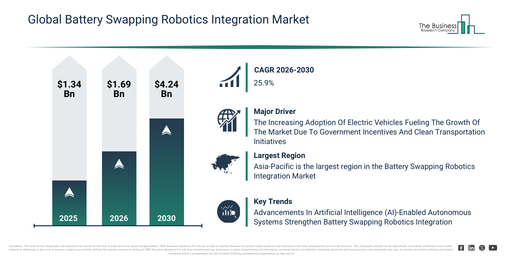
Featuring market attractiveness scoring, total addressable market sizing, company benchmarking matrices, interactive Excel dashboards, deeper supply chain intelligence, emerging startup tracking, and granular product-level insights, The Business Research Company’s 2026 market reports are built to deliver research that is both more actionable and more strategically valuable.
Battery Swapping Robotics Integration Market Growth Analysis: How Will Revenue Trend Over The Forecast Period?
The battery swapping robotics integration market has experienced significant growth in its size over recent years. It is anticipated to expand from $1.34 billion in 2025 to $1.69 billion in 2026, registering a compound annual growth rate (CAGR) of 25.7%. The market’s growth during the historical period is attributable to the increasing adoption of electric vehicles, a growing requirement for fast charging solutions, advancements in logistics automation, the development of industrial robotics, and the expansion of public transportation networks.
The battery swapping robotics integration market size is anticipated to undergo significant expansion over the coming years. It is projected to achieve a value of $4.24 billion in 2030, demonstrating a compound annual growth rate (CAGR) of 25.9%. This expansion during the forecast period is primarily driven by the increasing deployment of autonomous fleet solutions, the rising electrification of industrial equipment, the growth in drone applications for battery replacement, the widespread adoption of predictive maintenance software, and the integration of AI-driven energy optimization systems. Key trends expected in the forecast period include the increasing adoption of mobile battery swapping units, the integration of predictive maintenance services for robotic systems, a growing demand for fleet management and energy optimization software, the expansion of automated guided vehicles for industrial applications, and an escalating focus on training and consulting services for battery swapping operations.
Get A Free Sample Report With In-Depth Market Insights:
Battery Swapping Robotics Integration Market Growth Factors Behind Sustained Expansion
The increasing acceptance of electric vehicles is projected to stimulate the expansion of the battery swapping robotics integration market moving forward. An electric vehicle (EV) is a type of automobile that runs fully or primarily on electric power stored in rechargeable batteries, rather than utilizing a traditional fuel-based internal combustion engine. The rapid increase in electric vehicle adoption is largely fueled by government incentives and regulatory frameworks that improve their affordability and encourage the shift to cleaner transportation. Battery swapping robotics integration facilitates electric vehicle adoption by providing automated battery replacement systems that significantly minimize vehicle downtime, boost operational efficiency, and allow high-utilization fleets to scale quickly without lengthy charging delays. For instance, in January 2024, a report from Kelley Blue Book, a US-based Cox Automotive company, revealed that in 2023, a record 1.2 million car buyers in the United States selected electric vehicles, accounting for 7.6% of the entire U.S. vehicle market, an increase from 5.9% in 2022. Therefore, the growing adoption of electric vehicles is driving the development of the battery swapping robotics integration market.
Battery Swapping Robotics Integration Market Segmentation: How Does The Market Break Down By Category?
The battery swapping robotics integration market covered in this report is segmented –
1) By Component: Robotic Systems, Battery Modules, Control Software, Services
2) By Deployment Mode: On-Site, Mobile
3) By Application: Electric Vehicles, Industrial Equipment, Drones, Other Applications
4) By End-User: Automotive, Logistics, Public Transportation, Industrial, Other End-Users
Subsegments:
1) By Robotic Systems: Articulated Robots, Delta Robots, Cartesian Robots, Collaborative Robots, Mobile Robots
2) By Battery Modules: Lithium Ion Battery, Nickel Metal Hydride Battery, Solid State Battery, Lead Acid Battery
3) By Control Software: Battery Management Software, Fleet Management Software, Predictive Maintenance Software, Energy Optimization Software
4) By Services: Installation Services, Maintenance Services, Consulting Services, Training Services
Battery Swapping Robotics Integration Market Industry Trends Fueling Future Revenue Growth
Major companies operating in the battery swapping robotics integration market are concentrating on developing advanced autonomous and AI-powered robotic solutions to enhance operational efficiency, enable seamless battery exchange, and support continuous logistics operations. Autonomous and AI-powered robotic solutions are sophisticated self-guided systems that utilize artificial intelligence, sensor networks, and automated control mechanisms to manage battery transport, positioning, and exchange processes without manual involvement. For instance, in December 2024, U Power Limited, a China-based electric vehicle battery power solutions company, launched an artificial intelligence (AI)-enabled autonomous unmanned battery swapping logistics vehicle designed for continuous logistics operations. This solution integrates perception, decision-making, and control technologies, supports real-time route planning using convolutional neural networks, and enables automated docking and battery exchange with UOTTA battery swapping stations, while also offering cloud-based connectivity for centralized fleets and energy management.
Battery Swapping Robotics Integration Market Industry Leaders And Competitive Landscape
Major companies operating in the battery swapping robotics integration market are Honda Motor Co. Ltd., Robert Bosch GmbH, BYD Company Limited, Panasonic Holdings Corporation, Contemporary Amperex Technology Co. Limited, ABB Ltd, Delta Electronics Inc., NIO Inc., Yadea Group Holdings Ltd, Ola Electric Mobility Private Limited, Gogoro Inc., Tier Mobility SE, Kwang Yang Motor Co. Ltd., Yulu Bikes Private Limited, SUN Mobility Private Limited, E Chargeup Solutions Private Limited, Race Energy Private Limited, Ample Inc., Lithion Power Private Limited, Esmito Solutions Private Limited, Oyika Pte. Ltd., and Numocity Technologies Private Limited.
View The Full Battery Swapping Robotics Integration Market Report:
Battery Swapping Robotics Integration Market Regional Analysis And Top Geography
Asia-Pacific was the largest region in the battery swapping robotics integration market in 2025. Europe is expected to be the fastest-growing region in the forecast period. The regions covered in the battery swapping robotics integration market report are Asia-Pacific, South East Asia, Western Europe, Eastern Europe, North America, South America, Middle East, Africa.
Reach Out To Our Team:
The Business Research Company: https://www.thebusinessresearchcompany.com/
Americas: +1 310-496-7795
Asia: +44 7882 955267 & +91 8897263534
Europe: +44 7882 955267
Email us at: marketing@tbrc.info
Follow us on:
LinkedIn: https://in.linkedin.com/company/the-business-research-company
YouTube: https://www.youtube.com/channel/UC24_fI0rV8cR5DxlCpgmyFQ
Global Market Model: https://www.thebusinessresearchcompany.com/global-market-model

Wasay has over a decade of experience in market research, data modelling, and analytics, with prior experience at GlobalData and Decision Tree Consulting Services. At The Business Research Company , he leads research operations across syndicated studies, customized consulting engagements, and the Global Market Model platform. His professional experience includes supporting organizations such as Boston Consulting Group, KPMG, and Ernst & Young. Wasay holds a degree in Electronics and Communications Engineering, postgraduate management qualifications from International Management Institute Belgium and Indian School of Business and Entrepreneurship, and completed the Integrated Program in Business Analytics from Indian Institute of Management Indore.