
Built to provide research that’s more actionable and strategically valuable, The Business Research Company’s 2026 market reports include market attractiveness analysis, total addressable market sizing, company benchmarking matrices, interactive Excel dashboards, broader supply chain intelligence, emerging startup tracking, and in-depth product insights.
Business-To-Consumer(B2C) E-Commerce Market Growth Analysis: How Will Revenue Trend Over The Forecast Period?
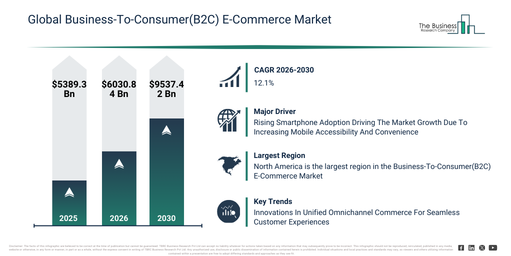
The business-to-consumer(b2c) e-commerce market size has seen significant expansion in recent years. It is anticipated to expand from $5389.3 billion in 2025 to $6030.84 billion in 2026, registering a compound annual growth rate (CAGR) of 11.9%. The drivers behind this past growth include increased internet penetration, wider smartphone adoption, the proliferation of online payment solutions, the strengthening of e-commerce logistics infrastructure, and the growing consumer demand for convenient shopping.
The business-to-consumer (b2c) e-commerce market is projected for substantial expansion over the upcoming years, with its size anticipated to reach $9537.42 billion by 2030, demonstrating a compound annual growth rate (CAGR) of 12.1%. This projected growth is driven by factors such as the proliferation of social commerce platforms, the implementation of AI-powered personalized recommendations, the spread of subscription-based services, the rise of mobile app-centric e-commerce, and increasing consumer desire for sustainable and environmentally friendly products. Key developments foreseen during this period encompass the growing popularity of mobile commerce platforms, enhanced usage of digital wallets and contactless payment methods, the evolution of tailored online shopping experiences, the broadening reach of online grocery and essential delivery services, and a heightened emphasis on health and wellness products within e-commerce.
Get A Free Sample Report With In-Depth Market Insights:
Business-To-Consumer(B2C) E-Commerce Market Development Factors: What’s Supporting Demand?
The growing adoption of smartphones is projected to accelerate the expansion of the business-to-consumer (B2C) e-commerce market in the coming years. A smartphone is a portable mobile device that integrates telephone communication with advanced computing functionalities, allowing users to access the internet, various applications, multimedia content, and digital services all from one device. Smartphone adoption is increasing primarily due to enhanced internet accessibility, which enables more individuals to conveniently use online services, social media, and digital apps via their mobile devices. The widespread use of smartphones propels B2C e-commerce by making shopping convenient anytime and anywhere through dedicated mobile apps, digital payment systems, and immediate product access, thereby boosting engagement and sales by offering personalized deals, real-time alerts, and fast, frictionless checkout experiences. For instance, in May 2025, according to Ericsson, a Sweden-based telecommunications company, 5G mobile subscriptions are projected to grow from 1.62 billion in 2023 to 6.29 billion by 2030. Therefore, the increasing adoption of smartphones is a significant factor driving the growth of the business-to-consumer (B2C) e-commerce market.
Business-To-Consumer(B2C) E-Commerce Market Segment Landscape: Which Areas Lead Development?
The business-to-consumer(b2c) e-commerce market covered in this report is segmented –
1) By Product Type: Fashion And Apparel, Grocery And Essentials, Beauty And Personal Care, Home And Furniture, Books, Media, And Entertainment, Health And Wellness, Other Product Category
2) By Device: Mobile Or Smartphone, Desktop
3) By Payment Method: Cards, Digital Wallet, Cash On Delivery, Other Payment Methods
4) By Application: Automotive, Beauty And Personal Care, Books And Stationery, Consumer Electronics, Clothing And Footwear, Home Décor And Electronics, Sports And Leisure, Media And Entertainment, Information Technology, Other Application
Subsegments:
1) By Fashion And Apparel: Men Clothing, Women Clothing, Children Clothing, Footwear, Accessories
2) By Grocery And Essentials: Fresh Food, Packaged Food, Beverages, Household Supplies, Personal Essentials
3) By Beauty And Personal Care: Skin Care, Hair Care, Makeup Products, Fragrances, Personal Hygiene Products
4) By Home And Furniture: Living Room Furniture, Bedroom Furniture, Kitchen And Dining Furniture, Home Decor, Home Improvement Products
5) By Books, Media, And Entertainment: Printed Books, Electronic Books, Music, Movies And Television Content, Gaming Products
6) By Health And Wellness: Dietary Supplements, Fitness Equipment, Personal Care Devices, Health Monitoring Products, Wellness Services
7) By Other Product Category: Automotive Accessories, Pet Supplies, Office Supplies, Sports And Outdoor Equipment, Miscellaneous Products
Business-To-Consumer(B2C) E-Commerce Market Transformation Trends: What Innovations Are Driving Change?
Leading companies operating within the business-to-consumer (B2C) e-commerce market are concentrating on developing innovative solutions, such as unified omnichannel commerce platforms, to address the increasing demand for smooth customer experiences across both digital and physical retail channels. Unified omnichannel commerce platforms refer to integrated technological solutions designed to connect electronic commerce websites, mobile applications, physical stores, inventory systems, and customer data into a single, cohesive commerce ecosystem. For instance, in January 2025, Salesforce Inc., a US-based customer relationship management technology company, launched Agentforce for Retail to enhance productivity with digital labor and Retail Cloud to integrate in-store and digital shopping experiences. It deploys autonomous agents for tasks like order management, guided shopping, and loyalty promotions, integrating with data clouds for real-time personalization. Retail Cloud’s modern POS enables omnichannel features such as endless aisle inventory and mobile checkouts, directly supporting B2C e-commerce through seamless consumer experiences across channels. Early adopters such as SharkNinja and Saks report increased productivity and engagement.
Business-To-Consumer(B2C) E-Commerce Market Competitive Landscape: Which Companies Lead The Industry?
Major companies operating in the business-to-consumer (B2C) e-commerce market are Walmart Inc., Amazon.com Inc., Alibaba Group Holding Limited, Best Buy Co. Inc., PayPal Holdings Inc., Coupang Inc., Otto Group, MercadoLibre Inc., Rakuten Group Inc., Wayfair Inc., Zalando SE, Chewy Inc., eBay Inc., Shopify Inc., ASOS plc., Etsy Inc., Newegg Commerce Inc., FirstCry.com Pvt. Ltd., BigCommerce Holdings Inc., VTEX Commerce Cloud Ltd., Spryker Systems GmbH, Pepperfry Private Limited, commercetools GmbH, and JD.com Inc.
View The Full Business-To-Consumer(B2C) E-Commerce Market Report:
Business-To-Consumer(B2C) E-Commerce Market Regional Breakdown: Where Is Demand Concentrated?
North America was the largest region in the business-to-consumer (B2C) e-commerce market in 2025. Asia-Pacific is expected to be the fastest-growing region in the forecast period. The regions covered in the business-to-consumer (B2C) e-commerce market report are Asia-Pacific, South East Asia, Western Europe, Eastern Europe, North America, South America, Middle East, Africa.
Reach Out To Our Team:
The Business Research Company: https://www.thebusinessresearchcompany.com/
Americas: +1 310-496-7795
Asia: +44 7882 955267 & +91 8897263534
Europe: +44 7882 955267
Email us at: marketing@tbrc.info
Follow us on:
LinkedIn: https://in.linkedin.com/company/the-business-research-company
YouTube: https://www.youtube.com/channel/UC24_fI0rV8cR5DxlCpgmyFQ
Global Market Model: https://www.thebusinessresearchcompany.com/global-market-model

Wasay has over a decade of experience in market research, data modelling, and analytics, with prior experience at GlobalData and Decision Tree Consulting Services. At The Business Research Company , he leads research operations across syndicated studies, customized consulting engagements, and the Global Market Model platform. His professional experience includes supporting organizations such as Boston Consulting Group, KPMG, and Ernst & Young. Wasay holds a degree in Electronics and Communications Engineering, postgraduate management qualifications from International Management Institute Belgium and Indian School of Business and Entrepreneurship, and completed the Integrated Program in Business Analytics from Indian Institute of Management Indore.