
Built to provide research that’s more actionable and strategically valuable, The Business Research Company’s 2026 market reports include market attractiveness analysis, total addressable market sizing, company benchmarking matrices, interactive Excel dashboards, broader supply chain intelligence, emerging startup tracking, and in-depth product insights.
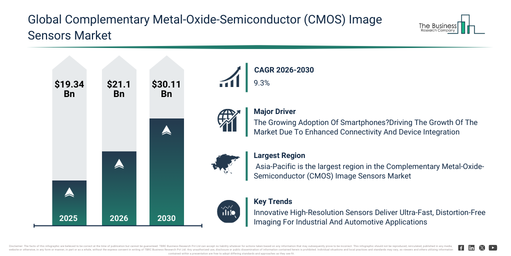
Complementary Metal-Oxide-Semiconductor (CMOS) Image Sensors Market Growth From $21.1 Billion In 2026 To $30.11 Billion By 2030 At A CAGR Of 9.3%
The complementary metal-oxide-semiconductor (cmos) image sensors market has shown significant expansion in recent years. Its value is anticipated to rise from $19.34 billion in 2025 to $21.1 billion in 2026, registering a compound annual growth rate (CAGR) of 9.1%. This historical development can be attributed to increased smartphone adoption, wider digital camera usage, growing automotive safety requirements, the expansion of medical imaging devices, and the emergence of consumer electronics equipped with imaging features.
The complementary metal-oxide-semiconductor (CMOS) image sensors market is projected to experience substantial expansion over the next few years. It is anticipated to achieve a valuation of $30.11 billion by 2030, growing at a compound annual growth rate (CAGR) of 9.3%. This expected increase can be attributed to factors such as the growth in autonomous vehicle applications, a rising demand for wearable imaging devices, the expansion of AI-powered surveillance systems, increased adoption of industrial automation with machine vision, and advancements in high-resolution and low-light imaging technologies. Key trends during this period include the rising adoption of back-illuminated image sensors, increasing integration of CMOS sensors in automotive safety systems, growth in high-resolution image sensors for smartphones and tablets, the expansion of CMOS sensors in security and surveillance applications, and a rising demand for stacked image sensors in industrial and machine vision.
Get A Free Sample Report With In-Depth Market Insights:
Complementary Metal-Oxide-Semiconductor (CMOS) Image Sensors Market Industry Drivers: What’s Behind The Revenue Growth?
The rising prevalence of smartphones is anticipated to fuel the expansion of the complementary metal-oxide-semiconductor (CMOS) image sensor market in the future. Smartphones are portable devices that merge the functions of a traditional telephone with advanced computing power, internet access, and a variety of applications for communication, entertainment, and productivity. This surge in smartphone adoption is attributed to advancements in mobile internet infrastructure, which offers quicker, more reliable, and widely accessible connectivity, thereby enhancing the overall user experience. Complementary metal-oxide-semiconductor (CMOS) image sensors significantly improve smartphones by enabling high-quality, energy-efficient photo and video capture, alongside supporting features such as low-light imaging, rapid autofocus, and sophisticated computational photography. For instance, in March 2024, as per Consumer Affairs, a US-based consumer news and advocacy organization, worldwide smartphone ownership escalated from 86% in 2022 to 92% in 2023. Thus, the increasing uptake of smartphones and other consumer electronics is propelling the growth of the complementary metal-oxide-semiconductor (CMOS) image sensor market.
Complementary Metal-Oxide-Semiconductor (CMOS) Image Sensors Market Segment Breakdown: Which Categories Lead On Revenue?
The complementary metal-oxide-semiconductor (cmos) image sensors market covered in this report is segmented –
1) By Type: Front-Illuminated Image Sensors, Back-Illuminated Image Sensors, Stacked Image Sensors
2) By Resolution: Up to 5 Megapixel, 5 Megapixel to 12 Megapixel, 12 Megapixel to 16 Megapixel, Above 16 Megapixel
3) By Spectrum: Visible Spectrum, Near-Infrared, Short-Wave Infrared
4) By Application: Camera, Personal Computers And Laptops, Watches And Wearables
5) By End-User: Consumer Electronics, Automotive, Healthcare, Industrial, Security And Surveillance
Subsegments:
1) By Front-Illuminated Image Sensors: High Fill Factor Front-Illuminated Sensors, Standard Pixel Architecture Front-Illuminated Sensors, Cost-Optimized Front-Illuminated Sensors
2) By Back-Illuminated Image Sensors: High Sensitivity Back-Illuminated Sensors, Low Noise Back-Illuminated Sensors, High Resolution Back-Illuminated Sensors
3) By Stacked Image Sensors: Logic And Imaging Layer Stacked Sensors, Memory Integrated Stacked Sensors, High Speed Processing Stacked Sensors
#Complementary Metal-Oxide-Semiconductor (CMOS) Image Sensors Market Growth Trends: What’s Shaping The Future Outlook?
Leading companies within the complementary metal-oxide-semiconductor (CMOS) image sensor market are concentrating on developing advanced solutions, such as large, high-resolution sensors, to facilitate ultra-detailed, high-speed imaging for industrial, automotive, and professional applications. These large, high-resolution sensors are imaging components featuring physically bigger pixel arrays, enabling greater detail capture and enhanced image clarity, especially in low-light or fast-moving scenarios. For instance, in January 2026, Sony Group Corporation, an electronics firm based in Japan, launched the IMX927, IMX928, and IMX929 large-format global shutter CMOS image sensors, specifically engineered for sophisticated industrial imaging. These sensors offer 8K-class resolution, simultaneous pixel exposure, and ultra-high frame rates, ensuring distortion-free capture even during rapid motion. Built on Sony’s Pregius S stacked architecture, they provide low-noise, high-sensitivity imaging, making them ideal for precise machine vision, automated inspection, and scientific applications that require extremely high-resolution, accurate, and fast imaging capable of up to 225 frames per second.
Complementary Metal-Oxide-Semiconductor (CMOS) Image Sensors Market Competitive Overview And Top Companies
Major companies operating in the complementary metal-oxide-semiconductor (CMOS) image sensors market are Sony Semiconductor Solutions Corporation, Samsung, Omnivision Technologies Inc., ON Semiconductor, STMicroelectronics, SK Hynix Inc., GalaxyCore Inc., Himax Technologies Inc., SmartSens Technology, Canon, Toshiba, SmartSens, Panasonic Corporation, Sony Corporation, Sony Semiconductor Solutions Corporation, Nikon, ams-OSRAM AG, PixArt Imaging Inc., Hamamatsu Photonics K.K., Semiconductor Components Industries, LLC (Onsemi), Elsevier, Fuji Electric, Honeywell, Intersil, Myriad Fiber, ANSYS, Inc., Tower Semiconductor, CMOS Sensor Inc., Teledyne Technologies, and Nextchip.
View The Full Complementary Metal-Oxide-Semiconductor (CMOS) Image Sensors Market Report:
Complementary Metal-Oxide-Semiconductor (CMOS) Image Sensors Market Top Region: Where Does Most Revenue Come From?
Asia-Pacific was the largest region in the complementary metal-oxide-semiconductor (CMOS) image sensors market in 2025. Middle East And Africa is expected to be the fastest-growing region in the forecast period. The regions covered in the complementary metal-oxide-semiconductor (CMOS) image sensors market report are Asia-Pacific, South East Asia, Western Europe, Eastern Europe, North America, South America, Middle East, Africa.
Reach Out To Our Team:
The Business Research Company: https://www.thebusinessresearchcompany.com/
Americas: +1 310-496-7795
Asia: +44 7882 955267 & +91 8897263534
Europe: +44 7882 955267
Email us at: marketing@tbrc.info
Follow us on:
LinkedIn: https://in.linkedin.com/company/the-business-research-company
YouTube: https://www.youtube.com/channel/UC24_fI0rV8cR5DxlCpgmyFQ
Global Market Model: https://www.thebusinessresearchcompany.com/global-market-model

Wasay has over a decade of experience in market research, data modelling, and analytics, with prior experience at GlobalData and Decision Tree Consulting Services. At The Business Research Company , he leads research operations across syndicated studies, customized consulting engagements, and the Global Market Model platform. His professional experience includes supporting organizations such as Boston Consulting Group, KPMG, and Ernst & Young. Wasay holds a degree in Electronics and Communications Engineering, postgraduate management qualifications from International Management Institute Belgium and Indian School of Business and Entrepreneurship, and completed the Integrated Program in Business Analytics from Indian Institute of Management Indore.