
Featuring market attractiveness scoring, total addressable market sizing, company benchmarking matrices, interactive Excel dashboards, deeper supply chain intelligence, emerging startup tracking, and granular product-level insights, The Business Research Company’s 2026 market reports are built to deliver research that is both more actionable and more strategically valuable.
Decentralized Computing Market Size, Value And Growth Trajectory Through 2030
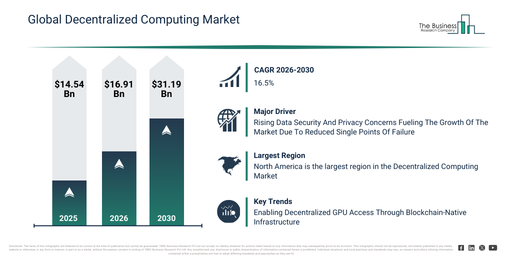
The decentralized computing market has seen substantial expansion in recent years. This market is anticipated to expand from $14.54 billion in 2025 to $16.91 billion in 2026, exhibiting a compound annual growth rate (CAGR) of 16.3%. The historical growth can be linked to factors such as an escalating demand for secure data storage, increasing uptake of cloud computing, a rising necessity for workload balancing, the broadening of distributed processing systems, and enhanced consciousness about data privacy.
The decentralized computing market is anticipated to experience substantial growth in the coming years, with projections indicating it will reach $31.19 billion by 2030, demonstrating a compound annual growth rate (CAGR) of 16.5%. This growth during the forecast period is primarily driven by the increasing integration of decentralized finance (DeFi) solutions, the escalating demand for identity verification platforms, the expansion of enterprise data sharing and storage solutions, the proliferation of AI-enabled distributed computing platforms, and a heightened focus on energy-efficient decentralized infrastructure. Notable trends expected over this period include the wider adoption of distributed storage solutions, a surge in the implementation of fault-tolerant and redundant systems, increased deployment of developer APIs and SDKs for decentralized platforms, the expansion of peer-to-peer networking software, and a growing emphasis on smart contract platforms tailored for enterprise applications.
Get A Free Sample Report With In-Depth Market Insights:
Decentralized Computing Market Development Factors: What’s Supporting Demand?
The increasing worries regarding data security and privacy are anticipated to stimulate the expansion of the decentralized computing market moving ahead. These concerns relate to the growing unease among people and entities concerning unauthorized access, improper use, or theft of private and sensitive data held and managed by centralized digital platforms. The rise in data security and privacy worries stems from the increasing quantity of sensitive data being stored and handled on centralized digital systems, which renders them more susceptible to extensive breaches. Decentralized computing addresses these issues by providing architectures that spread data storage and processing across numerous nodes, thereby decreasing dependence on single points of failure, improving data ownership, and lessening the risks of widespread breaches. For example, as reported by the National Cyber Security Centre (NCSC), a UK government body, in October 2025, the UK encountered 204 significant cyberattacks nationally in the 12 months before August 2025, a substantial rise from the 89 incidents noted in the prior year. Consequently, the escalating concerns regarding data security and privacy are propelling the growth of the decentralized computing market.
Decentralized Computing Market Segmentation: How Does The Market Break Down By Category?
The decentralized computing market covered in this report is segmented –
1) By Component: Hardware, Software, Services
2) By Deployment Mode: On-Premises, Cloud
3) By Enterprise Size: Small And Medium Enterprises, Large Enterprises
4) By Applications: Decentralized Finance (DeFi), Smart Contracts, Supply Chain Management, Identity Verification, Data Sharing And Storage
5) By End-User: Banking, Financial Services, And Insurance (BFSI), Healthcare, Retail And E-commerce, Media And Entertainment, Manufacturing, Information Technology (IT) And Telecommunications, Other End-Users
Subsegments:
1) By Hardware: Servers And Processing Units, Storage Devices And Systems, Networking Equipment, Edge Computing Devices
2) By Software: Distributed Computing Platforms, Workload Management Software, Data Management Software, Security And Encryption Software
3) By Services: Deployment And Integration Services, Monitoring And Maintenance Services, Consulting And Advisory Services, Support And Training Services
Decentralized Computing Market Transformation Trends: What Innovations Are Driving Change?
Leading entities within the decentralized computing market are concentrating efforts on creating sophisticated solutions, specifically modular blockchain infrastructure, to improve scalable decentralized AI services. This modular blockchain infrastructure serves as a fundamental framework, incorporating shared validator mechanisms, adaptable compute connectivity, and inter-chain communication. Its purpose is to facilitate decentralized workload processing and diminish reliance on centralized cloud services by integrating computing resources directly into the blockchain itself. An example of this is seen in August 2025, when Planck Network, a company based in the US, introduced the first-ever modular layer-0 blockchain infrastructure for decentralized AI services and decentralized physical infrastructure networks (DePINs). This infrastructure provides shared security and compatibility across more than 30 blockchain ecosystems, along with integrated access to large-scale decentralized GPU computing. Key functionalities of this platform encompass a modular layer-0 foundation supporting cross-chain messages and USDC payment channels, an AI-focused EVM-compatible layer-1 chain specifically designed for training, inference, and fine-tuning models on enterprise-level GPU nodes, a decentralized AI cloud offering GPU access at costs reported to be up to 90% less than traditional cloud providers, and an AI Studio low-code platform for on-chain model deployment, complete with dataset handling and automated pipeline operations.
Decentralized Computing Market Key Participants And Competitive Landscape
Major companies operating in the decentralized computing market are International Business Machines Corporation, Cisco Systems Inc., Intel Corporation, Hewlett Packard Enterprise Company, NVIDIA Corporation, Fujitsu Limited, VMware Inc., Red Hat Inc., Ankr Network, Storj Labs Inc., RunOnFlux, Livepeer Inc., Golem Factory GmbH, Akash Network, iExec Blockchain Tech, Protocol Labs, CUDOS Limited, Render Network Foundation, E-SPIN Group, and Acurast AG.
View The Full Decentralized Computing Market Report:
Decentralized Computing Market Geographic Analysis: Where Is Demand Rising Fastest?
North America was the largest region in the decentralized computing market in 2025. Asia-Pacific is expected to be the fastest-growing region in the forecast period. The regions covered in the decentralized computing market report are Asia-Pacific, South East Asia, Western Europe, Eastern Europe, North America, South America, Middle East, Africa.
Reach Out To Our Team:
The Business Research Company: https://www.thebusinessresearchcompany.com/
Americas: +1 310-496-7795
Asia: +44 7882 955267 & +91 8897263534
Europe: +44 7882 955267
Email us at: marketing@tbrc.info
Follow us on:
LinkedIn: https://in.linkedin.com/company/the-business-research-company
YouTube: https://www.youtube.com/channel/UC24_fI0rV8cR5DxlCpgmyFQ
Global Market Model: https://www.thebusinessresearchcompany.com/global-market-model

Wasay has over a decade of experience in market research, data modelling, and analytics, with prior experience at GlobalData and Decision Tree Consulting Services. At The Business Research Company , he leads research operations across syndicated studies, customized consulting engagements, and the Global Market Model platform. His professional experience includes supporting organizations such as Boston Consulting Group, KPMG, and Ernst & Young. Wasay holds a degree in Electronics and Communications Engineering, postgraduate management qualifications from International Management Institute Belgium and Indian School of Business and Entrepreneurship, and completed the Integrated Program in Business Analytics from Indian Institute of Management Indore.