
Featuring market attractiveness scoring, total addressable market sizing, company benchmarking matrices, interactive Excel dashboards, deeper supply chain intelligence, emerging startup tracking, and granular product-level insights, The Business Research Company’s 2026 market reports are built to deliver research that is both more actionable and more strategically valuable.
Reconfigurable Intelligent Surfaces (RIS) Hardware Market Poised To Hit $2.38 Billion By 2030 With A 21.4% CAGR
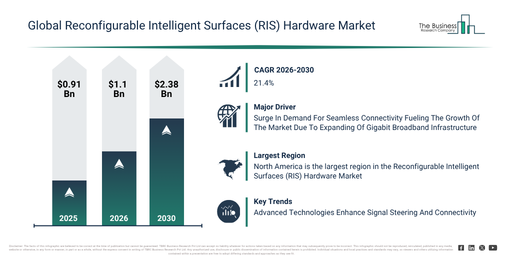
The reconfigurable intelligent surfaces (RIS) hardware market size has experienced exponential growth in recent years. It is forecast to expand from $0.91 billion in 2025 to $1.1 billion in 2026, demonstrating a compound annual growth rate (CAGR) of 21.2%. The growth observed in the preceding period can be attributed to an increasing demand for better wireless coverage, the adoption of both passive and active RIS components, the rising implementation of sub-6 GHz and mmWave networks, the overall expansion in telecommunication infrastructure, and the necessity for more energy-efficient signal propagation.
The reconfigurable intelligent surfaces (RIS) hardware market is projected to experience rapid expansion in the coming years. This market is anticipated to reach $2.38 billion by 2030, demonstrating a compound annual growth rate (CAGR) of 21.4%. Several factors are contributing to this growth over the projected period, including the increasing uptake of 6G and advanced wireless networks, greater integration of RIS with IoT and smart city applications, a surging need for hybrid RIS components, the broadening of automotive connectivity solutions, and an enhanced emphasis on energy-efficient and customizable wireless infrastructure. Key trends anticipated during this forecast period involve the expanded implementation of RIS in 5G and 6G networks, increased incorporation of beamforming and signal steering technologies, wider acceptance of hybrid RIS components to boost energy efficiency, broader deployment of RIS in smart cities and IoT infrastructure, and a heightened focus on connectivity solutions for automotive and transportation sectors.
Get A Free Sample Report With In-Depth Market Insights:
Reconfigurable Intelligent Surfaces (RIS) Hardware Market Growth Catalysts And Demand Drivers
The increasing requirement for effortless connectivity is anticipated to drive the expansion of the reconfigurable intelligent surfaces (RIS) hardware market in the foreseeable future. This seamless connectivity represents a consistent and trustworthy exchange of data across various networks and devices, ensuring continuous availability of services free from delays, interruptions, or signal degradation. The rising need for seamless connectivity is fueled by the demand for stable communication across multiple devices and diverse network environments. Reconfigurable intelligent surfaces (RIS) hardware addresses this by dynamically optimizing and steering wireless signals in real time, thereby improving coverage, enhancing signal quality, and mitigating interference in challenging or dense network conditions. For instance, in December 2023, according to the Office of Communications, a UK-based government agency, 78% of UK residential premises had access to gigabit-capable broadband in 2023, up from 71% in 2022. Hence, the escalating need for seamless connectivity is a significant catalyst for the growth of the reconfigurable intelligent surfaces (RIS) hardware market.
Reconfigurable Intelligent Surfaces (RIS) Hardware Market Segment Analysis Spotlighting Growth Areas
The reconfigurable intelligent surfaces (RIS) hardware market covered in this report is segmented –
1) By Component Type: Passive RIS Components, Active RIS Components, Hybrid RIS Components
2) By Frequency Band: Sub-6 GHz, Millimeter Wave (mmWave)
3) By Application: Wireless Communication Networks, Smart Cities And Infrastructure, Internet of Things (IoT), Automotive And Transportation
4) By End-User Industry: Telecommunications, Healthcare, Automotive, Manufacturing
Subsegments:
1) By Passive RIS Components: Reflective Panels, Metasurface Tiles, Reconfigurable Reflectors, Electromagnetic Wave Mirrors, Signal Steering Surfaces
2) By Active RIS Components: Amplified Reflectors, Programmable Phase Arrays, Electronic Beamforming Panels, Signal Modulation Units, Integrated Controller Surfaces
3) By Hybrid RIS Components: Combination Reflective-Active Panels, Adaptive Metasurface Arrays, Programmable Passive-Active Tiles, Smart Energy-Efficient Reflectors, Dynamic Signal Steering Units
Reconfigurable Intelligent Surfaces (RIS) Hardware Market Trends Shaping Long-Term Demand
Major companies active in the reconfigurable intelligent surfaces (RIS) hardware market are prioritizing the creation of innovative solutions, including dynamic cooperative RIS modules, to improve wireless signal coverage, increase energy efficiency, and support advanced 5G and future 6G network deployments. Dynamic cooperative RIS modules are specialized programmable metasurface-based hardware systems designed to intelligently manage and direct electromagnetic waves in real time, thereby optimizing signal coverage, beamforming, and overall network performance. As an example, in June 2023, ZTE Corporation, a telecommunications equipment manufacturer based in China, unveiled its Dynamic RIS 2.0. This advanced RIS hardware platform features reduced dimensions and power consumption, enhanced coverage capabilities, and simplified deployment procedures. The system skillfully integrates programmable metasurfaces with dynamic cooperative beamforming to broaden base station coverage, facilitate real-time user tracking, and adjust to evolving network environments, ultimately supporting scalable and energy-efficient next-generation communication networks.
Reconfigurable Intelligent Surfaces (RIS) Hardware Market Industry Leaders And Competitive Landscape
Major companies operating in the reconfigurable intelligent surfaces (RIS) hardware market are Samsung Electronics Co. Ltd., Huawei Technologies Co. Ltd., Sony Corporation, Cisco Systems Inc., Broadcom Inc., Qualcomm Technologies Inc., Ericsson AB, NEC Corporation, Nokia Corporation, ZTE Corporation, Texas Instruments Incorporated, Meta Materials Inc., Pivotal Commware Inc., Alcan Systems GmbH, SensorMetrix, Alphacore Inc., Greenerwave SAS, Metawave Corporation, AGC Inc., Wave Up S.r.l.
View The Full Reconfigurable Intelligent Surfaces (RIS) Hardware Market Report:
Reconfigurable Intelligent Surfaces (RIS) Hardware Market Regional Analysis And Leading Geography
North America was the largest region in the reconfigurable intelligent surfaces (RIS) hardware market in 2025. Asia-Pacific is expected to be the fastest-growing region in the forecast period. The regions covered in the reconfigurable intelligent surfaces (RIS) hardware market report are Asia-Pacific, South East Asia, Western Europe, Eastern Europe, North America, South America, Middle East, Africa.
Reach Out To Our Team:
The Business Research Company: https://www.thebusinessresearchcompany.com/
Americas: +1 310-496-7795
Asia: +44 7882 955267 & +91 8897263534
Europe: +44 7882 955267
Email us at: marketing@tbrc.info
Follow us on:
LinkedIn: https://in.linkedin.com/company/the-business-research-company
YouTube: https://www.youtube.com/channel/UC24_fI0rV8cR5DxlCpgmyFQ
Global Market Model: https://www.thebusinessresearchcompany.com/global-market-model

Wasay has over a decade of experience in market research, data modelling, and analytics, with prior experience at GlobalData and Decision Tree Consulting Services. At The Business Research Company , he leads research operations across syndicated studies, customized consulting engagements, and the Global Market Model platform. His professional experience includes supporting organizations such as Boston Consulting Group, KPMG, and Ernst & Young. Wasay holds a degree in Electronics and Communications Engineering, postgraduate management qualifications from International Management Institute Belgium and Indian School of Business and Entrepreneurship, and completed the Integrated Program in Business Analytics from Indian Institute of Management Indore.