
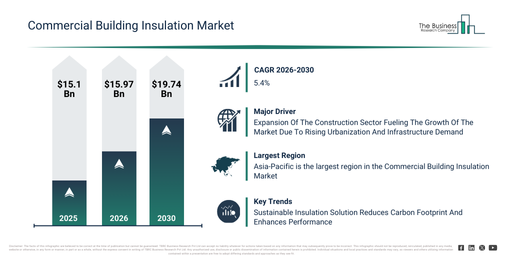
Enhanced with market attractiveness analysis, total addressable market evaluation, company benchmarking matrices, interactive Excel dashboards, expanded supply chain intelligence, emerging startup coverage, and detailed product insights, The Business Research Company’s 2026 market reports deliver more actionable and strategically valuable research.
Commercial Building Insulation Market Growth Analysis: How Will Revenue Expand During The Forecast Period?
The commercial building insulation market size has experienced robust growth over recent years. This market is projected to expand from $15.1 billion in 2025 to $15.97 billion by 2026, demonstrating a compound annual growth rate (CAGR) of 5.8%. Factors contributing to its growth during the historical period include the increased application of insulation for commercial energy efficiency, a greater uptake of thermal and acoustic control systems, the dependence on polymer- and mineral-based insulation materials, the expansion of commercial construction projects, and the escalating demand for moisture and fire-resistant insulation solutions.
The commercial building insulation market is projected to experience robust expansion over the next few years, with its size expected to reach $19.74 billion by 2030, growing at a compound annual growth rate (CAGR) of 5.4%. This anticipated growth during the forecast period is driven by factors such as an increasing demand for sustainable insulation materials, the rising utilization of smart energy management systems, the broadening of high-performance insulation technologies, the development of advanced reflective and vacuum insulation panels, and the growing adoption of stricter building energy regulations. Significant trends identified for this period include the integration of AI-based building energy optimization, the creation of low-carbon insulation materials, advancements in automated insulation manufacturing lines, the deployment of connected sensors for monitoring insulation performance, and the expanded use of digital modeling and thermal simulation tools.
Download A Free Sample Report For Comprehensive Market Insights:
Commercial Building Insulation Market Industry Drivers: What Is Driving Revenue Growth?
The expansion of the construction sector is anticipated to drive the growth of the commercial building insulation market. This sector encompasses the industry dedicated to building, renovating, and maintaining infrastructure, residential, commercial, and industrial projects. The construction sector is experiencing growth primarily due to rapid urbanization, which leads to increased demand for housing, transportation networks, and public infrastructure as more individuals relocate to cities. Commercial building insulation is crucial for the construction sector as it improves energy efficiency, making it essential for sustainable and high-performance structures. It significantly lowers heating and cooling requirements, thereby reducing operational expenses and enhancing occupant comfort. For instance, data from the United States Census Bureau indicates that construction spending reached $2,156,495 million in 2024, marking an increase from $2,023,662 million in 2023. Consequently, the expansion of the construction sector is a key driver for the growth of the commercial building insulation market.
#Commercial Building Insulation Market Segment Landscape And Growth Potential
The commercial building insulation market covered in this report is segmented –
1) By Material Type: Fiberglass, Mineral Wool, Cellulose, Polyurethane Foam, Polystyrene, Other Material Types
2) By Application: Walls, Roofs, Floors, Other Application
3) By End-Use: Offices, Retail, Hospitality, Healthcare, Other End-Uses
Subsegments:
1) By Fiberglass: Blanket Insulation, Board Insulation, Loose Fill Insulation
2) By Mineral Wool: Rock Wool, Slag Wool, Loose Fill, Boards And Batts
3) By Cellulose: Dry Cellulose, Spray Applied Cellulose, Stabilized Cellulose
4) By Polyurethane Foam: Open Cell Foam, Closed Cell Foam, Spray Foam
5) By Polystyrene: Expanded Polystyrene, Extruded Polystyrene
6) By Other Material Type: Cotton Insulation, Aerogel Insulation, Hemp Insulation, Vermiculite Insulation
#Commercial Building Insulation Market Growth Trends: What Is Influencing The Future Outlook?
Leading companies in the commercial building insulation market are prioritizing the development of sustainable offerings, such as bio-based insulation materials, to enhance energy efficiency, decrease environmental impact, and meet rigorous regulatory standards. Bio-based insulation materials are defined as environmentally conscious alternatives produced from renewable resources like plant fibers, recycled substances, or other natural elements, delivering superior thermal performance while minimizing their carbon footprint. As an illustration, in November 2023, Kingspan Group, an Ireland-based building materials firm, introduced Hemkor, a bio-based insulation product. Hemkor stands as a pioneering rigid insulation board crafted from sustainably sourced bio-based materials, providing exceptional thermal efficiency and fire resistance. This innovative product aligns with circular economy concepts, lessening reliance on fossil fuel-derived components while upholding strong performance in commercial building contexts. Hemkor reflects Kingspan’s dedication to sustainability, assisting construction projects in attaining lower embodied carbon and heightened energy efficiency without compromising safety or longevity.
Commercial Building Insulation Market Competitive Landscape: Who Are The Leading Companies?
Major companies operating in the commercial building insulation market are BASF SE, Dow Inc., Saint-Gobain S.A., Covestro AG, Knauf Insulation, Sika AG, Owens Corning, Kingspan Group plc, Huntsman Corporation, Etex Group, Rockwool International A/S, Alkegen, GAF Materials Corporation, CertainTeed Corporation, Johns Manville Corporation, Armacell International S.A, Atlas Roofing Corporation, Aspen Aerogels Inc., URSA Insulation S.A., Lloyd Insulations Limited, Brucha d.o.o., Bradford Insulation, Compagnie de Saint-Gobain S.A., Thermotec GmbH, Neo Thermal Insulation
Access The Complete Commercial Building Insulation Market Report:
Commercial Building Insulation Market Geographic Distribution And Regional Opportunities
Asia-Pacific was the largest region in the commercial building insulation market in 2025. The regions covered in the commercial building insulation market report are Asia-Pacific, South East Asia, Western Europe, Eastern Europe, North America, South America, Middle East, Africa.
Get in touch with us:
The Business Research Company: https://www.thebusinessresearchcompany.com/
Americas: +1 310-496-7795
Asia: +44 7882 955267 & +91 8897263534
Europe: +44 7882 955267
Email us at: marketing@tbrc.info
Follow us on:
LinkedIn: https://in.linkedin.com/company/the-business-research-company
YouTube: https://www.youtube.com/channel/UC24_fI0rV8cR5DxlCpgmyFQ
Global Market Model: https://www.thebusinessresearchcompany.com/global-market-model

Wasay has over a decade of experience in market research, data modelling, and analytics, with prior experience at GlobalData and Decision Tree Consulting Services. At The Business Research Company , he leads research operations across syndicated studies, customized consulting engagements, and the Global Market Model platform. His professional experience includes supporting organizations such as Boston Consulting Group, KPMG, and Ernst & Young. Wasay holds a degree in Electronics and Communications Engineering, postgraduate management qualifications from International Management Institute Belgium and Indian School of Business and Entrepreneurship, and completed the Integrated Program in Business Analytics from Indian Institute of Management Indore.