
Backed by market attractiveness analysis, total addressable market sizing, company benchmarking matrices, interactive Excel dashboards, wider supply chain intelligence, emerging startup coverage, and detailed product-level insights, The Business Research Company’s 2026 market reports are designed to offer research that is more actionable and strategically valuable than ever.
Retail Technology Market Revenue Outlook: What CAGR Lies Ahead Through 2030?
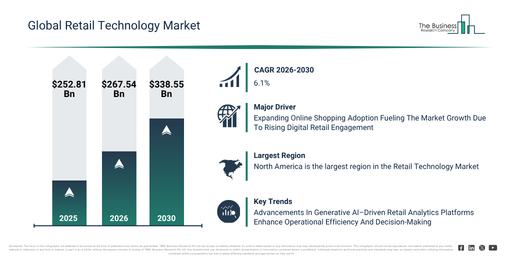
The retail technology market size has experienced substantial growth in recent years. It is projected to expand from $252.81 billion in 2025 to $267.54 billion in 2026, at a compound annual growth rate (CAGR) of 5.8%. The increase observed in the past period is attributable to the growing adoption of digital payment systems, the rise in retail automation, the expansion of e-commerce channels, increasing customer demand for personalized experiences, and the implementation of barcode and RFID inventory systems.
The retail technology market is poised for substantial expansion over the next few years, with projections indicating it will grow to $338.55 billion by 2030, exhibiting a compound annual growth rate (CAGR) of 6.1%. This anticipated growth is driven by factors such as the increasing implementation of AI-driven analytics in retail, the growing adoption of cloud-based and hybrid retail platforms, the expansion of omnichannel customer engagement solutions, a rising focus on mobile commerce and self-service technologies, and the integration of immersive AR/VR experiences within retail. Throughout the forecast period, key trends are expected to include the increasing uptake of mobile and self-service point-of-sale (POS) systems, a heightened demand for automated inventory tracking and optimization, the broadening integration of customer loyalty and engagement platforms, the development of multi-channel e-commerce management solutions, and an elevated emphasis on cloud-based deployment for retail technology.
Get A Free Sample Report With In-Depth Market Insights:
Retail Technology Market Growth Momentum: What Factors Are Shaping Demand?
The expanding reach of e-commerce across the globe is anticipated to fuel the advancement of the retail technology market in the future. E-commerce penetration denotes the rising proportion of consumers who acquire products and services via online channels, including marketplaces, retail company websites, and mobile shopping applications. This surge in e-commerce adoption is primarily fueled by extensive internet availability and a growing consumer inclination towards convenient digital purchasing options in advanced economies. Retail technology aids e-commerce penetration by supplying digital payment methods, software for managing inventory, intelligent point-of-sale systems, and unified omnichannel retail platforms that empower retailers to effectively oversee both their online and physical store operations. For example, in February 2026, Eurostat, a Luxembourg-based European Union statistical office, reported that in 2025, 95% of individuals aged 16–74 in the European Union had accessed the internet in the preceding 12 months, and out of these users, 78% stated they had bought or ordered goods and services online. Consequently, the worldwide increase in e-commerce penetration is propelling the expansion of the retail technology market.
Retail Technology Market Breakdown By Product Type And Application
The retail technology market covered in this report is segmented –
1) By Technology: Point Of Sale Systems, Inventory Management Systems, Customer Relationship Management, Electronic Commerce Platforms
2) By Deployment Type: Cloud-Based, On-Premises, Hybrid
3) By Application: Store Operations, Supply Chain Management, Sales And Marketing, Customer Engagement
4) By End Use: Hypermarkets, Supermarkets, Specialty Stores, Online Retailers
Subsegments:
1) By Point Of Sale Systems: Mobile Point Of Sale Systems, Cloud Based Point Of Sale Systems, Self Service Point Of Sale Systems, Tablet Based Point Of Sale Systems, Integrated Point Of Sale Systems
2) By Inventory Management Systems: Automated Inventory Tracking Systems, Barcode Based Inventory Management Systems, Radio Frequency Identification Inventory Systems, Cloud Based Inventory Management Systems, Demand Forecasting And Inventory Optimization Systems
3) By Customer Relationship Management: Customer Data Management Platforms, Customer Loyalty Program Management Systems, Customer Engagement And Marketing Automation Systems, Sales And Customer Interaction Management Systems, Customer Analytics And Insight Platforms
4) By Electronic Commerce Platforms: Online Storefront Management Platforms, Mobile Commerce Platforms, Multi Channel Commerce Management Platforms, Digital Payment Integration Platforms, Order And Fulfillment Management Platforms
Retail Technology Market Trends Redefining Industry Growth
Leading companies in the retail technology market are prioritizing advancements in artificial intelligence-powered retail analytics, including generative AI retail platforms. These platforms are designed to automate decision-making, generate insights, and optimize operational workflows across logistics, merchandising, and customer engagement, all with the goal of achieving a competitive advantage. Generative AI retail platforms are integrated digital systems that merge artificial intelligence capabilities such as automated content creation, predictive analytics, intelligent search, and workflow automation to enhance retail business processes and improve customer experiences. For example, in September 2024, UST, a US-based digital transformation and technology services firm, introduced the UST Retail GenAI Platform. This solution is a specially developed generative AI tool aimed at improving retail operations. The platform integrates functionalities like AI-driven search, summarization, automation, and content creation, while also allowing retailers to simulate scenarios and align AI strategies with enterprise capabilities for better decision-making. These features enable retailers to test AI-powered innovations and boost operational efficiency, though factors like integration complexity and data governance requirements could impact implementation speed.
Retail Technology Market Key Participants And Competitive Landscape
Major companies operating in the retail technology market are Microsoft Corporation, Oracle Corporation, Salesforce Inc., SAP SE, Toshiba Corporation, NCR Voyix Corporation, Shopify Inc., Stripe Inc., EPAM Systems Inc., Zebra Technologies Corporation, Publicis Groupe S.A., Blue Yonder Group Inc., Adyen N.V., Diebold Nixdorf Incorporated, Lightspeed Commerce Inc., PAX Global Technology Limited, Cegid Group, Ingenico Group S.A., Block Inc., Aptos Inc., GK Software SE, Trax Technology Solutions Pte Ltd, Clover Network LLC.
View The Full Retail Technology Market Report:
Retail Technology Market Geographic Analysis: Where Is Demand Rising Fastest?
North America was the largest region in the retail technology market in 2025. Asia-Pacific is expected to be the fastest-growing region in the forecast period. The regions covered in the retail technology market report are Asia-Pacific, South East Asia, Western Europe, Eastern Europe, North America, South America, Middle East, Africa.
Reach Out To Our Team:
The Business Research Company: https://www.thebusinessresearchcompany.com/
Americas: +1 310-496-7795
Asia: +44 7882 955267 & +91 8897263534
Europe: +44 7882 955267
Email us at: marketing@tbrc.info
Follow us on:
LinkedIn: https://in.linkedin.com/company/the-business-research-company
YouTube: https://www.youtube.com/channel/UC24_fI0rV8cR5DxlCpgmyFQ
Global Market Model: https://www.thebusinessresearchcompany.com/global-market-model

Wasay has over a decade of experience in market research, data modelling, and analytics, with prior experience at GlobalData and Decision Tree Consulting Services. At The Business Research Company , he leads research operations across syndicated studies, customized consulting engagements, and the Global Market Model platform. His professional experience includes supporting organizations such as Boston Consulting Group, KPMG, and Ernst & Young. Wasay holds a degree in Electronics and Communications Engineering, postgraduate management qualifications from International Management Institute Belgium and Indian School of Business and Entrepreneurship, and completed the Integrated Program in Business Analytics from Indian Institute of Management Indore.