
Featuring market attractiveness scoring, total addressable market sizing, company benchmarking matrices, interactive Excel dashboards, deeper supply chain intelligence, emerging startup tracking, and granular product-level insights, The Business Research Company’s 2026 market reports are built to deliver research that is both more actionable and more strategically valuable.
Robotics Carrier Boards Market Value Growth And Long-Term Outlook
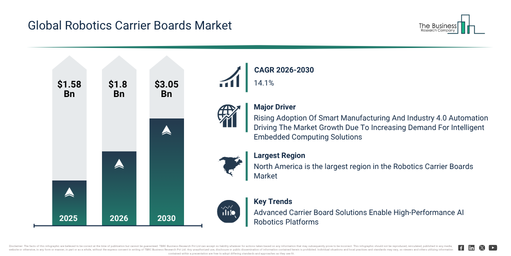
The robotics carrier boards market has seen rapid expansion in recent years. It is anticipated to expand from $1.58 billion in 2025 to $1.8 billion in 2026, registering a compound annual growth rate (CAGR) of 13.8%. The historical growth of this market can be attributed to several factors, including the escalation of industrial automation, the increasing integration of robotics in manufacturing, the proliferation of educational and research robotics programs, a growing demand for service robots, and the broadened application of medical robotics.
The robotics carrier boards market is projected to experience substantial expansion in the coming years. This sector is forecast to achieve a valuation of $3.05 billion by 2030, demonstrating a compound annual growth rate (CAGR) of 14.1%. The anticipated growth throughout this period can be attributed to several factors, including the increasing implementation of AI-driven robotics, the rising adoption of autonomous mobile robots, a growing requirement for high-connectivity carrier boards, the broadening of robotics applications in aerospace and defense, and an increasing emphasis on energy-efficient and scalable board designs. Dominant trends during the forecast timeframe are expected to encompass the growing acceptance of modular and stackable carrier boards, an escalating demand for high-performance computing boards in robotics, the expanding integration of sensor-optimized carrier boards, an increase in custom and ruggedized carrier board solutions, and a heightened focus on boards offering improved power efficiency and connectivity.
Get A Free Sample Report With In-Depth Market Insights:
Robotics Carrier Boards Market Growth Factors: What’s Supporting Expansion?
The increasing integration of smart manufacturing and Industry 4.0 automation is anticipated to fuel the expansion of the robotics carrier boards market in the future. These concepts involve incorporating sophisticated digital technologies into industrial production setups, facilitating real-time oversight, independent decision-making, and improved operational effectiveness. Manufacturers are increasingly adopting smart manufacturing and Industry 4.0 automation primarily due to a rising demand to lessen dependence on human labor and enhance production accuracy. This trend is further propelled by escalating labor scarcities and intense global competition, prompting industries to automate their fundamental processes extensively. Robotics carrier boards play a crucial role in enabling smart manufacturing and Industry 4.0 automation by linking processors, sensors, and actuators. This connectivity facilitates real-time data handling, rapid communication, and the smooth incorporation of robots into interconnected factory systems. For example, data from March 2024, shared by Rockwell Automation Inc., a US-based automation company, indicates that manufacturers view AI as the foremost capability for creating substantial business impact, with 83% expecting to integrate generative AI (GenAI) into their operations. Additionally, 95% of manufacturers are actively using or assessing smart manufacturing technologies, a rise from 84% in 2023. Consequently, the increasing implementation of smart manufacturing and Industry 4.0 automation is propelling the expansion of the robotics carrier boards market.
Robotics Carrier Boards Market Segments: Where Is Growth Concentrated?
The robotics carrier boards market covered in this report is segmented –
1) By Product Type: Single Board, Multi-Board, Custom Carrier Boards
2) By Distribution Channel: Direct Sales, Distributors, Online Retail
3) By Application: Industrial Robotics, Service Robotics, Medical Robotics, Educational Robotics, Other Applications
4) By End-Users: Manufacturing, Healthcare, Automotive, Aerospace And Defense, Research And Academia, Other End-Users
Subsegments:
1) By Single Board: Low Power Computing Boards, High Performance Computing Boards, Compact Form Factor Boards, Industrial Grade Boards, Development And Evaluation Boards
2) By Multi-Board: Modular Expansion Board Systems, Stackable Interface Board Systems, Distributed Processing Board Systems, High Scalability Board Configurations, Redundant Control Board Systems
3) By Custom Carrier Boards: Application Specific Carrier Boards, Ruggedized Environment Carrier Boards, High Connectivity Carrier Boards, Sensor Integrated Carrier Boards, Power Optimized Carrier Boards
Robotics Carrier Boards Market Industry Trends: What’s Reshaping Demand?
Major companies in the robotics carrier boards market are prioritizing the creation of advanced hardware solutions, specifically carrier boards that facilitate next-generation AI computing platforms, to boost processing capability, system integration, and performance in autonomous robotics and edge AI applications. Carrier boards designed to support AI modules allow for the effortless integration of sensors, communication interfaces, and power management systems, enabling robotic developers to implement high-performance embedded computing platforms with efficiency. For instance, in August 2025, Auvidea GmbH, an embedded systems company based in Germany, confirmed its support for the NVIDIA Jetson Thor platform as a carrier board manufacturer. This carrier board solution is engineered to assist developers and robotics manufacturers in incorporating NVIDIA’s high-performance AI computing module into advanced robotic systems, offering high-speed connectivity, broadened I/O interfaces, and enhanced power management for applications in robotics, industrial automation, and edge AI.
Robotics Carrier Boards Market Competitive Overview And Top Companies
Major companies operating in the robotics carrier boards market are NVIDIA Corporation, DENSO Corporation, Mitsubishi Electric Corporation, FANUC Corporation, Yaskawa Electric Corporation, SolidRun Ltd., Advantech Co Ltd, Schunk GmbH & Co KG, Moxa Inc., IEI Integration Corporation, VIA Technologies Inc., SECO S.p.A., Axiomtek Co. Ltd., CompuLab Ltd., Kawasaki Heavy Industries Ltd., Seer Robotics Inc., Seiko Epson Corporation, PHYTEC Messtechnik GmbH, Connect Tech Inc., emtrion GmbH, OMRON Robotics and Safety Technologies Co. Ltd., Auvidea GmbH, Gumstix Inc., Stäubli Robotics AG.
View The Full Robotics Carrier Boards Market Report:
Robotics Carrier Boards Market Leading Geography: Which Region Contributes The Most Revenue?
North America was the largest region in the robotics carrier boards market in 2025. Asia-Pacific is expected to be the fastest-growing region in the forecast period. The regions covered in the robotics carrier boards market report are Asia-Pacific, South East Asia, Western Europe, Eastern Europe, North America, South America, Middle East, Africa.
Reach Out To Our Team:
The Business Research Company: https://www.thebusinessresearchcompany.com/
Americas: +1 310-496-7795
Asia: +44 7882 955267 & +91 8897263534
Europe: +44 7882 955267
Email us at: marketing@tbrc.info
Follow us on:
LinkedIn: https://in.linkedin.com/company/the-business-research-company
YouTube: https://www.youtube.com/channel/UC24_fI0rV8cR5DxlCpgmyFQ
Global Market Model: https://www.thebusinessresearchcompany.com/global-market-model

Wasay has over a decade of experience in market research, data modelling, and analytics, with prior experience at GlobalData and Decision Tree Consulting Services. At The Business Research Company , he leads research operations across syndicated studies, customized consulting engagements, and the Global Market Model platform. His professional experience includes supporting organizations such as Boston Consulting Group, KPMG, and Ernst & Young. Wasay holds a degree in Electronics and Communications Engineering, postgraduate management qualifications from International Management Institute Belgium and Indian School of Business and Entrepreneurship, and completed the Integrated Program in Business Analytics from Indian Institute of Management Indore.