Delivering more actionable and strategically valuable research, The Business Research Company’s 2026 market reports feature market attractiveness analysis, total addressable market evaluation, company benchmarking matrices, interactive Excel dashboards, expanded supply chain intelligence, emerging startup coverage, and detailed product insights.
#Compact Construction Equipment Market Size And Revenue Forecast Through 2030
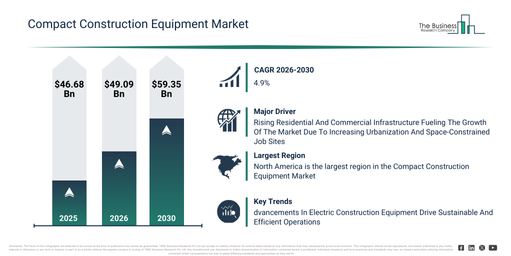
The compact construction equipment market has experienced robust growth in recent years. It is forecast to expand from $46.68 billion in 2025 to $49.09 billion in 2026, achieving a compound annual growth rate (CAGR) of 5.2%. This historical growth can be attributed to factors such as the increasing adoption of compact machinery for urban developments, a rising need for lightweight and maneuverable equipment, reliance on imported hydraulic and engine systems, the expansion of construction activities on small sites, and increasing demand in the equipment rental market.
The market for compact construction equipment is anticipated to experience consistent expansion over the upcoming years. This market is projected to reach $59.35 billion by 2030, demonstrating a compound annual growth rate (CAGR) of 4.9%. This anticipated growth during the forecast period is primarily driven by several factors, including the greater uptake of electric compact machinery, a growing need for autonomous and semi-autonomous devices, the proliferation of smart fleet management technologies, advancements in high-efficiency compact powertrains, and increased capital allocation towards sustainable construction machinery. Key developments expected in this period encompass the incorporation of AI-powered equipment control systems, the proliferation of autonomous compact machinery, progress in automated compact equipment manufacturing, the creation of low-emission compact machinery solutions, and the deployment of IoT-enabled fleet monitoring platforms.
Download A Free Sample Report For Comprehensive Market Insights:
#Compact Construction Equipment Market Demand Drivers Creating New Revenue Opportunities
The anticipated expansion of residential and commercial infrastructure is set to drive the growth of the compact construction equipment market going forward. Residential and commercial infrastructure encompasses the physical structures and facilities, such as buildings, utilities, roads, and services, that are essential for supporting housing and business operations within a community or urban area. This increase in residential and commercial infrastructure is largely attributed to rapid urbanization, as expanding populations in cities heighten the demand for housing, office spaces, and public facilities. Compact construction equipment supports residential and commercial infrastructure by offering space-efficient designs, which makes it ideal for urban and confined job sites. It enhances productivity by performing critical tasks like digging, lifting, and grading with ease, thereby accelerating construction timelines. For instance, in March 2024, according to Atradius, a Netherlands-based insurance company that provides trade credit insurance, surety, and collections services, global construction output is projected to rise by 2.0% in 2024, following a 3.7% increase in 2023. Growth in advanced economies is anticipated to be 1.8%, while in emerging markets, building activity is expected to see a 2.2% increase. Non-residential output and civil engineering are forecast to grow by 2.8% and 4.4%, respectively, this year. In 2025, global construction is predicted to grow by 1.8%. Residential construction output is expected to rebound by 2.4% due to improving economic conditions and the effects of looser monetary policies. Therefore, the rising residential and commercial infrastructure is driving the growth of the compact construction equipment market.
Compact Construction Equipment Market Segments: Where Are The Largest Growth Opportunities?
The compact construction equipment market covered in this report is segmented –
1) By Type: Mini Excavators, Compact Wheel Loaders, Compact Track Loaders, Skid Steer Loaders, Other Types
2) By Application: Loading, Excavation, Material Handling, Lifting And Hoisting, Other Applications
3) By End User: Construction, Agriculture, Mining, Utility works, Other End Users
Subsegments:
1) By Mini Excavators: Electric Mini Excavators, Diesel Mini Excavators, Zero-Tail Swing Mini Excavators, Conventional Tail Swing Mini Excavators
2) By Compact Wheel Loaders: Articulated Compact Wheel Loaders, Rigid Frame Compact Wheel Loaders, Electric Compact Wheel Loaders
3) By Compact Track Loaders: Radial Lift Track Loaders, Vertical Lift Track Loaders, Electric Compact Track Loaders
4) By Skid Steer Loaders: Wheeled Skid Steer Loaders, Tracked Skid Steer Loaders, Stand-On Skid Steer Loaders
5) By Other Types: Compact Backhoe Loaders, Compact Dozers, Compact Telehandlers, Compact Asphalt Pavers, Compact Motor Graders
Compact Construction Equipment Market Trends Driving Strategic Industry Expansion
Leading firms in the compact construction equipment market are prioritizing the creation of sophisticated offerings, including electric mini excavators, aiming to improve energy efficiency, decrease emissions, and address the increasing need for sustainable building practices. These electric mini excavators are defined as compact excavation machinery that utilizes electric batteries in place of conventional diesel engines, engineered to execute digging and earthmoving operations with decreased noise, zero emissions, and lowered operational expenses. An illustration of this is Komatsu, a Japan-based producer of construction and mining equipment, which introduced the PC20E, PC26E, and PC33E in April 2024. These models provide zero emissions and reduced noise, rendering them highly suitable for urban and indoor construction environments subject to strict environmental and noise regulations. Furthermore, they ensure extended operating periods with rapid, adaptable charging solutions, complemented by minimal maintenance costs attributed to a reduced number of mechanical components. Engineered for adaptability and enhanced operator comfort, these specific models contribute to sustainable construction endeavors while consistently delivering efficient and dependable performance throughout the entire workday.
Compact Construction Equipment Market Major Participants And Competitive Dynamics
Major companies operating in the compact construction equipment market are Caterpillar Inc., Deere & Company, Volvo Construction Equipment, Komatsu Ltd., CNH Industrial N.V, Kubota Corporation, Liebherr-International AG, Xuzhou Construction Machinery Group Co. Ltd., Sany Group Co. Ltd., Hitachi Construction Machinery Co. Ltd., J.C. Bamford Excavators Limited, Yanmar Co. Ltd., Doosan Bobcat Inc., Terex Corporation, Manitou BF S.A., Wacker Neuson SE, Sunward Intelligent Equipment Group Co. Ltd., Bell Equipment Limited, Takeuchi Manufacturing Co. Ltd., Mecalac S.A., Hyundai Construction Equipment Co. Ltd., Avant Tecno Oy, WAY INDUSTRY AS, Messersì S.p.A., Multione S.r.l., Schaffer Maschinenfabrik GmbH, Thaler GmbH And Co. KG
Access The Complete Compact Construction Equipment Market Report:
Compact Construction Equipment Market Global Footprint: Which Region Holds Market Leadership?
North America was the largest region in the compact construction equipment market in 2025. Asia-Pacific is expected to be the fastest-growing region in the forecast period. The regions covered in the compact construction equipment market report are Asia-Pacific, South East Asia, Western Europe, Eastern Europe, North America, South America, Middle East, Africa.
Get in touch with us:
The Business Research Company: https://www.thebusinessresearchcompany.com/
Americas: +1 310-496-7795
Asia: +44 7882 955267 & +91 8897263534
Europe: +44 7882 955267
Email us at: marketing@tbrc.info
Follow us on:
LinkedIn: https://in.linkedin.com/company/the-business-research-company
YouTube: https://www.youtube.com/channel/UC24_fI0rV8cR5DxlCpgmyFQ
Global Market Model: https://www.thebusinessresearchcompany.com/global-market-model

Wasay has over a decade of experience in market research, data modelling, and analytics, with prior experience at GlobalData and Decision Tree Consulting Services. At The Business Research Company , he leads research operations across syndicated studies, customized consulting engagements, and the Global Market Model platform. His professional experience includes supporting organizations such as Boston Consulting Group, KPMG, and Ernst & Young. Wasay holds a degree in Electronics and Communications Engineering, postgraduate management qualifications from International Management Institute Belgium and Indian School of Business and Entrepreneurship, and completed the Integrated Program in Business Analytics from Indian Institute of Management Indore.