
Backed by market attractiveness analysis, total addressable market sizing, company benchmarking matrices, interactive Excel dashboards, wider supply chain intelligence, emerging startup coverage, and detailed product-level insights, The Business Research Company’s 2026 market reports are designed to offer research that is more actionable and strategically valuable than ever.
Shrimp Specific Pathogen Free (SPF) Broodstock Market Forecast: What Value Will The Market Reach By 2030?
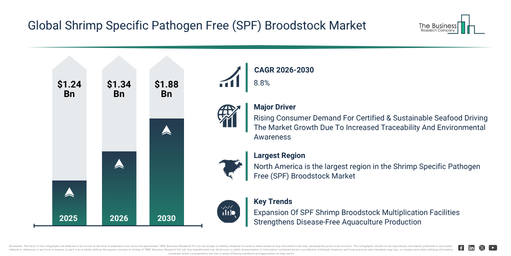
The shrimp specific pathogen free (SPF) broodstock market has seen significant growth in recent years. This market is expected to expand from $1.24 billion in 2025 to $1.34 billion in 2026, exhibiting a compound annual growth rate (CAGR) of 8.5%. The market’s past growth can be linked to several factors, including an increase in shrimp disease outbreaks, the adoption of both wild and domesticated broodstock, the proliferation of shrimp aquaculture farms, a rising demand for high-quality larvae, and the expansion of hatchery infrastructure.
The shrimp specific pathogen free (SPF) broodstock market is anticipated to experience robust expansion in the coming years, projected to reach $1.88 billion by 2030, demonstrating a compound annual growth rate (CAGR) of 8.8%. This growth during the forecast period is fueled by factors such as the increasing uptake of specific pathogen free broodstock, a heightened emphasis on biosecure hatchery practices, the escalating need for selectively bred and highly fecund broodstock, the broadening of online and direct sales avenues, and greater incorporation of research-led breeding initiatives. Key trends expected over the forecast horizon encompass the wider implementation of SPF broodstock in commercial shrimp farming, an intensified focus on disease prevention and biosecurity measures, increasing requirements for broodstock with high fecundity and strong survival rates, the enlargement of direct sales and online distribution networks, and the enhanced integration of research with selective breeding efforts.
Get A Free Sample Report With In-Depth Market Insights:
Shrimp Specific Pathogen Free (SPF) Broodstock Market Growth Factors: What’s Supporting Expansion?
The increasing consumer desire for certified and sustainable seafood is anticipated to boost the expansion of the shrimp-specific pathogen-free (SPF) broodstock market moving forward. This demand signifies a growing preference among purchasers for seafood items validated by recognized third-party standards as responsibly obtained with minimal environmental consequences. This push for certified and sustainable seafood is primarily fueled by greater environmental awareness among consumers in developed markets, where growing concerns about overfishing and ecosystem damage prompt shoppers to actively look for eco-labeled and traceable options. With buyers increasingly prioritizing responsibly sourced shrimp, producers face mounting pressure to employ disease-free, certified broodstock that satisfies traceability needs and guarantees consistent, premium harvests consistent with sustainability benchmarks. For example, a 2024 report from the Marine Stewardship Council, a UK-based non-profit, indicated that from June 2022 to June 2023, UK consumers spent around USD 495 million (£408.5 million) on 61,012 tonnes of tuna products. These expenditures accounted for 10% of the total value and 16% of the total volume of all supermarket seafood purchases across the nation. The MSC anticipates that certified tuna volume will surpass 25,000 tonnes in the 2023/24 financial year. Consequently, the increasing consumer demand for certified and sustainable seafood is propelling the expansion of the shrimp-specific pathogen-free (SPF) broodstock market.
Shrimp Specific Pathogen Free (SPF) Broodstock Market Segment Breakdown: Which Categories Lead On Revenue?
The shrimp specific pathogen free (SPF) broodstock market covered in this report is segmented –
1) By Species: Penaeus Vannamei, Penaeus Monodon, Other Species
2) By Distribution Channel: Direct Sales, Distributors, Online Sales
3) By Application: Aquaculture Farms, Hatcheries, Research Institutes
4) By End User: Commercial, Research
Subsegments:
1) By Penaeus Vannamei: Specific Pathogen Free Broodstock, Specific Pathogen Resistant Broodstock, Wild Caught Broodstock, Domesticated Genetic Line Broodstock, High Fecundity Selected Broodstock
2) By Penaeus Monodon: Specific Pathogen Free Broodstock, Specific Pathogen Resistant Broodstock, Wild Origin Broodstock, Domesticated Selective Line Broodstock, High Survival Rate Broodstock
3) By Other Species: Mixed Species Broodstock, Indigenous Species Broodstock, Exotic Species Broodstock, Selective Bred Species Broodstock, Research Grade Species Broodstock
Shrimp Specific Pathogen Free (SPF) Broodstock Market Industry Trends: What’s Reshaping Demand?
Leading companies in the shrimp SPF broodstock market are actively pursuing strategic partnerships to broaden their global distribution networks and enhance biosecure breeding capabilities. A strategic partnership involves a formal collaboration between two or more entities that combine their resources, expertise, and strengths to achieve shared long-term objectives and create mutual value. As an illustration, in October 2023, Hendrix Genetics, a multi-species breeding company based in the Netherlands, formed a partnership with Sapthagiri Hatcheries, an India-based shrimp hatchery and aquaculture firm. This collaboration resulted in the inauguration of a new Shrimp Breeding Multiplication Center (BMC) in the Srikakulam district, Andhra Pradesh, India. This center possesses a broodstock capacity exceeding 150,000 and yields the same high-quality Specific Pathogen Free (SPF) genetics as its Hawaii breeding nucleus, while integrating advanced biosecurity systems, filtration, quarantine, and sterilization technologies to ensure disease-free production and develop locally adapted shrimp strains.
Shrimp Specific Pathogen Free (SPF) Broodstock Market Top Companies Driving Competitive Growth
Major companies operating in the shrimp specific pathogen free (SPF) broodstock market are Charoen Pokphand Foods Public Company Limited, Hendrix Genetics B V, Unima, Benchmark Genetics Limited, SyAqua Group, Moana Technologies LLC, American Penaeid Inc, Oceanic Institute of Hawai i Pacific University, Shrimp Improvement Systems, Blue Genetics Global, Molokai Broodstock Company, Global Gen, Sea Products Development, MPEDA RGCA Broodstock Multiplication Centre, Kona Bay, Coastal Corporation Limited, Vaishnavi Aquatech, B Tech Hatcheries, Royal Hatcheries, Golden Marine Harvest.
View The Full Shrimp Specific Pathogen Free (SPF) Broodstock Market Report:
Shrimp Specific Pathogen Free (SPF) Broodstock Market Global Footprint: Which Region Leads The Industry?
North America was the largest region in the shrimp-specific pathogen-free (SPF) broodstock market in 2025. Asia-Pacific is expected to be the fastest-growing region in the forecast period. The regions covered in the shrimp specific pathogen free (SPF) broodstock market report are Asia-Pacific, South East Asia, Western Europe, Eastern Europe, North America, South America, Middle East, Africa.
Reach Out To Our Team:
The Business Research Company: https://www.thebusinessresearchcompany.com/
Americas: +1 310-496-7795
Asia: +44 7882 955267 & +91 8897263534
Europe: +44 7882 955267
Email us at: marketing@tbrc.info
Follow us on:
LinkedIn: https://in.linkedin.com/company/the-business-research-company
YouTube: https://www.youtube.com/channel/UC24_fI0rV8cR5DxlCpgmyFQ
Global Market Model: https://www.thebusinessresearchcompany.com/global-market-model

Wasay has over a decade of experience in market research, data modelling, and analytics, with prior experience at GlobalData and Decision Tree Consulting Services. At The Business Research Company , he leads research operations across syndicated studies, customized consulting engagements, and the Global Market Model platform. His professional experience includes supporting organizations such as Boston Consulting Group, KPMG, and Ernst & Young. Wasay holds a degree in Electronics and Communications Engineering, postgraduate management qualifications from International Management Institute Belgium and Indian School of Business and Entrepreneurship, and completed the Integrated Program in Business Analytics from Indian Institute of Management Indore.