
Backed by market attractiveness analysis, total addressable market sizing, company benchmarking matrices, interactive Excel dashboards, wider supply chain intelligence, emerging startup coverage, and detailed product-level insights, The Business Research Company’s 2026 market reports are designed to offer research that is more actionable and strategically valuable than ever.
Agricultural Telehandlers Market Value Analysis: What Growth Lies Ahead Over The Forecast Period?
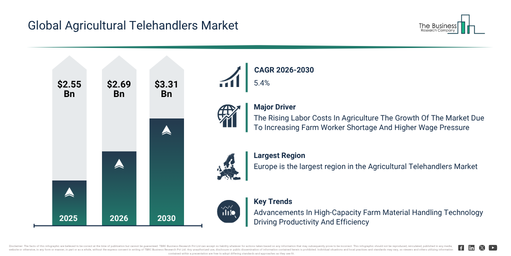
The agricultural telehandlers market has shown substantial growth in recent years. Its size is projected to increase from $2.55 billion in 2025 to $2.69 billion in 2026, achieving a compound annual growth rate (CAGR) of 5.2%. Historically, this growth has been influenced by factors such as the increasing mechanization of farming operations, a heightened demand for efficient material handling equipment, an expansion in agricultural production, the development of large-scale farms, and the integration of diesel-powered farm machinery.
The agricultural telehandlers market is poised for significant expansion in the coming years. It is forecast to reach $3.31 billion by 2030, growing at a compound annual growth rate (CAGR) of 5.4%. This projected growth during the forecast period is driven by factors such as an increasing transition towards electric agricultural machinery, the rising adoption of smart and connected farm equipment, escalating labor shortages in agriculture, the broadening of precision farming practices, and a growing demand for fuel-efficient and low-emission telehandlers. Prominent trends for this period include the increased uptake of electric and hybrid telehandlers in the agricultural sector, a heightened demand for high lift capacity telehandlers for large farms, the expanding use of compact telehandlers for small-scale farming operations, the development of multi-function attachments for versatile farm tasks, and the growing integration of material handling equipment that is compatible with precision farming.
Get A Free Sample Report With In-Depth Market Insights:
Agricultural Telehandlers Market Growth Backed By Core Demand Fundamentals
Increased labor expenses in farming are anticipated to drive the expansion of the agricultural telehandlers market in the future. Agricultural labor costs encompass all expenditures made by farmers or farming enterprises to employ staff for tasks like planting, cultivating, irrigating, harvesting, and other operational duties on the farm. The primary reason for the rise in agricultural labor costs is a scarcity of farm workers, leading to heightened competition for available staff and subsequently higher wages. Agricultural telehandlers assist in lowering these labor expenses by efficiently executing various material handling operations, including lifting, loading, and moving farm supplies and produce, thus decreasing the reliance on manual work and extra equipment. For example, data from November 2023, released by the United States Department of Agriculture (USDA), a US federal government agency, showed that cash labor expenses in US agriculture climbed from $42.57 billion in 2022 to $43.35 billion in 2023, representing an increase of $0.78 billion (1.8%). Consequently, the upward trend in agricultural labor costs is fueling the expansion of the agricultural telehandlers market.
Agricultural Telehandlers Market Segment Trends And Revenue Contributors
The agricultural telehandlers market covered in this report is segmented –
1) By Product Type: Compact Telehandlers, High Lift Telehandlers, Heavy Duty Telehandlers
2) By Power Source: Diesel, Electric, Hybrid
3) By Lift Capacity: Below 3 Tons, 3 To 10 Tons, Above 10 Tons
4) By Application: Material Handling, Lifting And Loading, Landscaping, Other Applications
5) By End User: Farms, Agricultural Contractors, Greenhouses, Other End Users
Subsegments:
1) By Compact Telehandlers: Compact Agricultural Telehandlers, Compact Farm Material Handling Telehandlers, Compact Utility Telehandlers, Compact Livestock Handling Telehandlers
2) By High Lift Telehandlers: High Reach Agricultural Telehandlers, High Lift Crop Handling Telehandlers, High Lift Bale Handling Telehandlers, High Lift Warehouse Farm Telehandlers
3) By Heavy Duty Telehandlers: Heavy Duty Agricultural Telehandlers, Heavy Duty Construction Farm Telehandlers, Heavy Duty Bulk Material Handling Telehandlers, Heavy Duty Silage Handling Telehandlers
Agricultural Telehandlers Market Growth Trends Reshaping The Competitive Landscape
Leading companies within the agricultural telehandlers market are prioritizing innovative solutions, such as high-capacity material handling machines, to boost operational effectiveness, enhance lifting performance, and meet the increasing demand for quicker and more productive farm logistics. High-capacity material handling machines are sophisticated equipment engineered to proficiently lift, move, and transport large volumes or heavy loads of agricultural or industrial materials with superior speed, power, and operational efficiency compared to conventional handling systems. For instance, in February 2025, Manitou Group, a France-based agricultural equipment manufacturing company, launched the all-new MLT 850 agricultural telehandler, which represents a high-capacity material handling machine crafted for demanding farm applications and improved operational efficiency. The MLT 850 features a robust telescopic boom structure, a substantial lifting capacity of around 5 tons, and a maximum lift height of approximately 24 feet 11 inches, facilitating the efficient handling of bales, silage, manure, and bulk materials in diverse farm environments. This machine incorporates advanced hydraulic systems for accelerated cycle times, a continuously variable transmission for smoother power delivery, and an ergonomic low-noise operator cab designed to minimize fatigue during prolonged working hours. Its compatibility with quick-attach systems enables rapid switching between multiple farm implements, thereby improving overall productivity and reducing downtime compared to conventional loaders and skid steers.
Agricultural Telehandlers Market Leading Players And Competitive Positioning
Major companies operating in the agricultural telehandlers market are Deere And Company, Kubota Corporation, Liebherr-International AG, Sany Group Co. Ltd., Terex Corporation, CLAAS KGaA mbH, Manitou Group, Wacker Neuson SE, Haulotte Group, Hidromek Hidrolik ve Mekanik Makina Imalat Sanayi ve Ticaret A.S., Merlo S.p.A., Action Construction Equipment Ltd., Foton Lovol International Heavy Industry Co. Ltd., Zoomlion Heavy Industry Science and Technology Co. Ltd., Dieci S.r.l., Magni Telescopic Handlers S.r.l., Faresin Industries S.p.A., Sunward Intelligent Equipment Co. Ltd., Xuzhou Construction Machinery Group Co. Ltd., Schäffer Maschinenfabrik GmbH.
View The Full Agricultural Telehandlers Market Report:
Agricultural Telehandlers Market Regional Distribution: Which Areas Power Market Growth?
Europe was the largest region in the agricultural telehandlers market in 2025. Asia-Pacific is expected to be the fastest-growing region in the forecast period. The regions covered in the agricultural telehandlers market report are Asia-Pacific, South East Asia, Western Europe, Eastern Europe, North America, South America, Middle East, Africa.
Reach Out To Our Team:
The Business Research Company: https://www.thebusinessresearchcompany.com/
Americas: +1 310-496-7795
Asia: +44 7882 955267 & +91 8897263534
Europe: +44 7882 955267
Email us at: marketing@tbrc.info
Follow us on:
LinkedIn: https://in.linkedin.com/company/the-business-research-company
YouTube: https://www.youtube.com/channel/UC24_fI0rV8cR5DxlCpgmyFQ
Global Market Model: https://www.thebusinessresearchcompany.com/global-market-model

Wasay has over a decade of experience in market research, data modelling, and analytics, with prior experience at GlobalData and Decision Tree Consulting Services. At The Business Research Company , he leads research operations across syndicated studies, customized consulting engagements, and the Global Market Model platform. His professional experience includes supporting organizations such as Boston Consulting Group, KPMG, and Ernst & Young. Wasay holds a degree in Electronics and Communications Engineering, postgraduate management qualifications from International Management Institute Belgium and Indian School of Business and Entrepreneurship, and completed the Integrated Program in Business Analytics from Indian Institute of Management Indore.