
Featuring market attractiveness scoring, total addressable market sizing, company benchmarking matrices, interactive Excel dashboards, deeper supply chain intelligence, emerging startup tracking, and granular product-level insights, The Business Research Company’s 2026 market reports are built to deliver research that is both more actionable and more strategically valuable.
Aquaculture Disinfectants Market Forecast: Value Set To Climb From $1.6 Billion To $2.23 Billion
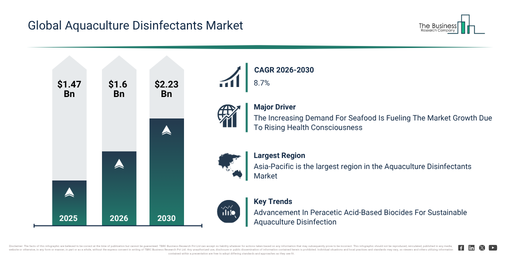
The aquaculture disinfectants market has seen robust growth in recent years. Its value is expected to increase from $1.47 billion in 2025 to $1.6 billion in 2026, achieving a compound annual growth rate (CAGR) of 8.5%. This historical expansion can be attributed to factors such as a greater frequency of aquatic diseases, an uptick in global fish consumption demand, the spread of commercial aquaculture farms, increasing consciousness of water hygiene in fish farming, and a rise in the application of chemical disinfectants in hatcheries.
The aquaculture disinfectants market size is expected to experience significant expansion in the upcoming years. It is projected to reach $2.23 billion by 2030, showing a compound annual growth rate (CAGR) of 8.7%. This growth during the forecast period can be attributed to the increasing adoption of sustainable aquaculture practices, rising global demand for seafood protein, higher investment in aquaculture biosecurity systems, the expansion of intensive farming operations, and growing innovation in low-toxicity disinfectant formulations. Notable trends anticipated in this period include a greater embrace of eco-friendly disinfectant formulations in aquaculture systems, an increase in the use of oxidizing disinfectants for controlling waterborne pathogens, a growing preference for non-toxic and fish-safe chemical solutions, the expansion of disease prevention programs in shrimp and fish farming, and increased implementation of automated dosing systems in aquaculture sanitation.
Get A Free Sample Report With In-Depth Market Insights:
Aquaculture Disinfectants Market Expansion Drivers: What’s Shaping Future Growth?
The rising consumer need for seafood is anticipated to boost the expansion of the aquaculture disinfectants market in the future. Seafood encompasses all edible aquatic flora and fauna consumed by people, providing a significant source of premium protein and essential minerals for human nutrition. This escalating demand for seafood stems from heightened health awareness among consumers, with a growing number of individuals favoring nutritious, protein-dense options that contribute to a balanced and wholesome diet. Aquaculture disinfectants play a crucial role in seafood production by upholding water quality, averting disease epidemics, and diminishing microbial impurities, thereby guaranteeing healthier aquatic life and safer, superior seafood for human intake. An illustrative example demonstrates this: in December 2024, data from the Marine Management Organization, a UK-based executive non-departmental public body, indicated that UK vessels landed 719,000 tones of sea fish in 2023, with an estimated value of $1.47 billion (£1.1 billion). This signifies a 12% increase in volume and a 5% rise in value when contrasted with 2022 figures. Consequently, the expanding need for seafood is a key impetus for the development of the aquaculture disinfectant market.
Aquaculture Disinfectants Market Segment Analysis And Revenue Potential
The aquaculture disinfectants market covered in this report is segmented –
1) By Type: Oxidizing Disinfectants, Non-Oxidizing Disinfectants, Aldehyde Disinfectants, Halogen Disinfectants, Other Types
2) By Form: Liquid, Powder, Granular, Other Forms
3) By Distribution Channel: Direct Sales, Distributors, Online Retail, Other Distribution Channels
4) By Application: Fish Farming, Shrimp Farming, Mollusk Farming, Other Applications
5) By End-Use: Commercial Aquaculture, Household And Small-Scale Aquaculture, Research And Educational Institutes, Other End-Uses
Subsegments:
1) By Oxidizing Disinfectants: Hydrogen Peroxide Based Disinfectants, Peracetic Acid Based Disinfectants, Ozone Based Disinfectants, Potassium Permanganate Based Disinfectants, Chlorine Dioxide Based Disinfectants
2) By Non-Oxidizing Disinfectants: Quaternary Ammonium Compound Based Disinfectants, Biguanide Based Disinfectants, Phenolic Compound Based Disinfectants, Organic Acid Based Disinfectants, Alcohol Based Disinfectants
3) By Aldehyde Disinfectants: Formaldehyde Based Disinfectants, Glutaraldehyde Based Disinfectants, Ortho Phthalaldehyde Based Disinfectants, Glyoxal Based Disinfectants
4) By Halogen Disinfectants: Chlorine Based Disinfectants, Iodine Based Disinfectants, Bromine Based Disinfectants, Hypochlorite Based Disinfectants
5) By Other Types: Enzyme Based Disinfectants, Herbal Extract Based Disinfectants, Silver Based Disinfectants, Copper Based Disinfectants, Combined Formulation Disinfectants
Aquaculture Disinfectants Market Strategic Trends: What Defines The Next Growth Phase?
Major companies in the aquaculture disinfectants market are concentrating on developing innovative products, such as peracetic acid-based biocides, to ensure secure and effective pathogen control while minimizing their environmental footprint. Peracetic acid-based biocides are disinfectants that swiftly eliminate bacteria and viruses in water, subsequently breaking down into harmless byproducts. This process maintains safe aquaculture conditions, supports fish health, and reduces ecological impact. For instance, in May 2023, Evonik Industries AG, a Germany-based specialty chemicals company, launched Vigorox Trident, a peracetic acid biocide formulation designed specifically for use in aquaculture. This product can be directly applied in tanks or ponds without needing to remove fish, thereby maintaining water quality while keeping chemical residues at a minimum. Vigorox Trident is effective in controlling fish pathogens, including bacteria and viruses, and facilitates high-density fish farming within sustainable recirculating systems. Its rapid decomposition into non-toxic components reduces environmental impact and eliminates the need for additional cleaning steps, providing benefits in both operational efficiency and regulatory compliance.
Aquaculture Disinfectants Market Competitive Landscape: Who Leads The Industry?
Major companies operating in the aquaculture disinfectants market are Merck KGaA, Bayer AG, Evonik Industries AG, Ecolab Inc, LANXESS AG, Solvay SA, Stepan Company, Veolia Water Technologies, Kemin Industries Inc, Christeyns NV, Shepard Bros Inc, Biosafe Systems LLC, Aditya Birla Chemicals, Kersia Group, Evans Vanodine International PLC, Virox Technologies Inc, Chemtex Speciality Ltd, Seitz GmbH, Fink Tec GmbH, Sanosil AG, AquaClean Environmental Products, Airedale Chemical Company Ltd.
View The Full Aquaculture Disinfectants Market Report:
Aquaculture Disinfectants Market Geographic Landscape: Which Region Dominates Industry Growth?
Asia-Pacific was the largest region in the aquaculture disinfectants market in 2025. North America is expected to be the fastest-growing region in the forecast period. The regions covered in the aquaculture disinfectants market report are Asia-Pacific, South East Asia, Western Europe, Eastern Europe, North America, South America, Middle East, Africa.
Reach Out To Our Team:
The Business Research Company: https://www.thebusinessresearchcompany.com/
Americas: +1 310-496-7795
Asia: +44 7882 955267 & +91 8897263534
Europe: +44 7882 955267
Email us at: marketing@tbrc.info
Follow us on:
LinkedIn: https://in.linkedin.com/company/the-business-research-company
YouTube: https://www.youtube.com/channel/UC24_fI0rV8cR5DxlCpgmyFQ
Global Market Model: https://www.thebusinessresearchcompany.com/global-market-model

Wasay has over a decade of experience in market research, data modelling, and analytics, with prior experience at GlobalData and Decision Tree Consulting Services. At The Business Research Company , he leads research operations across syndicated studies, customized consulting engagements, and the Global Market Model platform. His professional experience includes supporting organizations such as Boston Consulting Group, KPMG, and Ernst & Young. Wasay holds a degree in Electronics and Communications Engineering, postgraduate management qualifications from International Management Institute Belgium and Indian School of Business and Entrepreneurship, and completed the Integrated Program in Business Analytics from Indian Institute of Management Indore.