
Featuring market attractiveness scoring, total addressable market sizing, company benchmarking matrices, interactive Excel dashboards, deeper supply chain intelligence, emerging startup tracking, and granular product-level insights, The Business Research Company’s 2026 market reports are built to deliver research that is both more actionable and more strategically valuable.
Artificial Intelligence (AI) Semiconductors Market Growth Analysis: How Will Revenue Trend Over The Forecast Period?
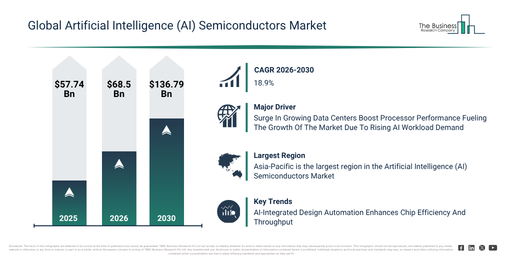
The artificial intelligence (AI) semiconductors market has experienced substantial expansion in recent years. Projections indicate it will expand from $57.74 billion in 2025 to $68.5 billion in 2026, demonstrating a compound annual growth rate (CAGR) of 18.6%. This historical growth can be attributed to several factors, including the increasing development of cloud computing infrastructure, a rising demand for high-performance computing, the expansion of smartphone and consumer electronics markets, the early adoption of GPU-based AI workloads, and growing investment in semiconductor fabrication capacity.
The artificial intelligence (AI) semiconductors market is projected to experience substantial expansion over the coming years. Its size is anticipated to reach $136.79 billion by 2030, demonstrating a compound annual growth rate (CAGR) of 18.9%. This expansion during the forecast period is fueled by several factors, including the swift rise of generative AI applications, the increasing adoption of edge AI computing systems, a heightened need for specialized AI inference chips, increased capital flow into advanced semiconductor manufacturing nodes, and the proliferation of autonomous systems that require AI hardware acceleration. Key trends observed during this period encompass the growing integration of AI accelerators within data centers, a rising preference for energy-efficient semiconductor architectures, the expanding incorporation of edge AI chip solutions into consumer products, the broadening scope of GPU and ASIC-based AI computing platforms, and the increased reliance on heterogeneous computing for managing AI workloads.
Get A Free Sample Report With In-Depth Market Insights:
Artificial Intelligence (AI) Semiconductors Market Growth Factors Behind Sustained Expansion
The growth of the artificial intelligence (AI) semiconductors market is expected to be fueled by the increasing expansion of data centers. As global demand for data storage, cloud computing, and real-time AI processing intensifies, data centers require significantly enhanced computational capacity. AI semiconductors are pivotal in this environment, facilitating faster and more efficient execution of intricate AI workloads, including machine learning and deep learning tasks. These specialized chips offer high throughput and energy efficiency, rendering them essential for contemporary data center operations. For instance, in 2023, U.S. data centers consumed approximately 176 terawatt-hours (TWh) of electricity, representing about 4.4% of total U.S. electricity consumption, according to the U.S. Department of Energy (DOE). This figure marks an increase from previous years and indicates substantial rises in processing activity directly linked to data center growth. Therefore, the continued expansion of data centers is anticipated to contribute significantly to the advancement of the artificial intelligence (AI) semiconductors market.
Artificial Intelligence (AI) Semiconductors Market Segmentation: How Does The Market Break Down By Category?
The artificial intelligence (AI) semiconductors market covered in this report is segmented –
1) By Chip Type: Central Processing Units, Field Programmable Gate Arrays, Application Specific Integrated Circuits, Tensor Processing Units
2) By Processing Precision: 16 Bit, 32 Bit, 64 Bit, Other Processing Precisions
3) By Organization Size: Small And Medium Enterprises, Large Enterprises
4) By Application: Artificial Intelligence Training, Artificial Intelligence Inference, Edge Artificial Intelligence, Cloud Artificial Intelligence, Other Applications
5) By End Use: Healthcare, Automotive, Consumer Electronics, Industrial Automation, Banking And Finance, Other End Users
Subsegments:
1) By Central Processing Units: Server Processors, Desktop Processors, Mobile Processors, Embedded Processors
2) By Field Programmable Gate Arrays: Low Density Field Programmable Gate Arrays, Medium Density Field Programmable Gate Arrays, High Density Field Programmable Gate Arrays, System On Chip Field Programmable Gate Arrays
3) By Application Specific Integrated Circuits: Custom Logic Chips, Digital Signal Processing Chips, Mixed Signal Chips, Memory Interface Chips
4) By Tensor Processing Units: Training Accelerators, Inference Accelerators, Edge Tensor Chips, Cloud Tensor Chips
Artificial Intelligence (AI) Semiconductors Market Industry Trends Fueling Future Revenue Growth
Major companies in artificial intelligence (AI) semiconductors are concentrating on technological improvements to optimize chip design efficiency, particularly through AI-driven electronic design automation (EDA) tools. This strategy aims to gain a competitive edge by automating complex layout, verification, and optimization tasks, thereby reducing manual engineering efforts while simultaneously enhancing power, performance, and area outcomes. AI-driven EDA tools are software systems that utilize machine learning and generative AI to explore design spaces, detect flaws early, and propose optimal configurations, allowing engineers to shorten cycle times and deliver more efficient semiconductor designs tailored for AI workloads. For example, in November 2023, Synopsys, a US-based electronic design automation company, launched Synopsys.ai Copilot, which integrates generative AI capabilities into chip design workflows, supports natural language queries to expedite design decisions, and automates routine tasks such as script generation and verification guidance to boost productivity and design quality.
Artificial Intelligence (AI) Semiconductors Market Industry Leaders And Competitive Landscape
Major companies operating in the artificial intelligence (AI) semiconductors market are Amazon Web Services (AWS), Apple Inc., Google Inc. (Alphabet Inc.), Samsung Electronics Co. Ltd., Huawei Technologies Co. Ltd., Taiwan Semiconductor Manufacturing Company (TSMC), International Business Machines, Nvidia Corporation, Intel Corporation, Qualcomm Incorporated, Advanced Micro Devices, Texas Instruments Incorporated, MediaTek Inc., NXP Semiconductors, Synopsys Inc., Cadence Design Systems Inc., Arm Holdings, Astera Labs Inc., Groq, Tenstorrent, Cerebras Systems, Axelera AI, Rebellions Inc., Graphcore Limited.
View The Full Artificial Intelligence (AI) Semiconductors Market Report:
Artificial Intelligence (AI) Semiconductors Market Regional Analysis And Top Geography
Asia-Pacific was the largest region in the artificial intelligence (AI) semiconductors market in 2025. North America is expected to be the fastest-growing region in the forecast period. The regions covered in the artificial intelligence (AI) semiconductors market report are Asia-Pacific, South East Asia, Western Europe, Eastern Europe, North America, South America, Middle East, Africa.
Reach Out To Our Team:
The Business Research Company: https://www.thebusinessresearchcompany.com/
Americas: +1 310-496-7795
Asia: +44 7882 955267 & +91 8897263534
Europe: +44 7882 955267
Email us at: marketing@tbrc.info
Follow us on:
LinkedIn: https://in.linkedin.com/company/the-business-research-company
YouTube: https://www.youtube.com/channel/UC24_fI0rV8cR5DxlCpgmyFQ
Global Market Model: https://www.thebusinessresearchcompany.com/global-market-model

Wasay has over a decade of experience in market research, data modelling, and analytics, with prior experience at GlobalData and Decision Tree Consulting Services. At The Business Research Company , he leads research operations across syndicated studies, customized consulting engagements, and the Global Market Model platform. His professional experience includes supporting organizations such as Boston Consulting Group, KPMG, and Ernst & Young. Wasay holds a degree in Electronics and Communications Engineering, postgraduate management qualifications from International Management Institute Belgium and Indian School of Business and Entrepreneurship, and completed the Integrated Program in Business Analytics from Indian Institute of Management Indore.