
Backed by market attractiveness analysis, total addressable market sizing, company benchmarking matrices, interactive Excel dashboards, wider supply chain intelligence, emerging startup coverage, and detailed product-level insights, The Business Research Company’s 2026 market reports are designed to offer research that is more actionable and strategically valuable than ever.
Critical Minerals Market Value Growth And Long-Term Outlook
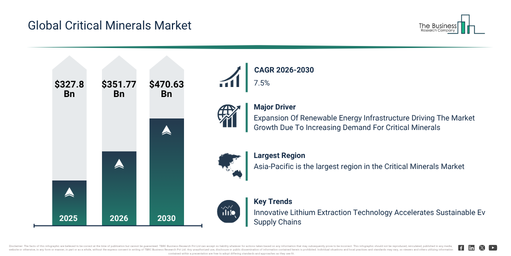
The critical minerals market has witnessed substantial growth over recent years. Its expansion is anticipated to continue, with the market size projected to rise from $327.8 billion in 2025 to $351.77 billion in 2026, achieving a compound annual growth rate (CAGR) of 7.3%. This historical increase is primarily driven by an uptick in industrial manufacturing demand, the enlargement of electronics production, escalating mining ventures in developing nations, a rise in steel and alloy manufacturing, and the initial integration of electric vehicle batteries.
The critical minerals market size is projected for substantial expansion in the coming years. It is anticipated to grow to $470.63 billion by 2030, demonstrating a compound annual growth rate (CAGR) of 7.5%. This growth in the forecast period can be attributed to the increasing electrification of transport systems, a rising demand for battery-grade materials, the expansion of renewable energy storage systems, growing investments in deep-sea and rare earth mining, and an increasing geopolitical focus on supply chain security. Major trends expected during this period include enhanced government-led strategic stockpiling of critical minerals, a rising geographic diversification of mining and sourcing operations, growing long-term offtake agreements between miners and OEMs, an expansion of exploration activities in untapped mineral reserves, and an increase in mergers and acquisitions across mining and resource companies.
Get A Free Sample Report With In-Depth Market Insights:
Critical Minerals Market Growth Factors Behind Sustained Expansion
The growing renewable energy infrastructure is anticipated to drive the critical minerals market’s expansion. This infrastructure encompasses the physical facilities and systems for generating, transmitting, and storing energy from renewable sources like solar panels, wind turbines, hydroelectric plants, and their linked power grids and storage units. The increase in renewable energy infrastructure is driven by government policies and global pledges to lower carbon emissions, promoting significant investments in clean energy technologies. Critical minerals are crucial for renewable energy infrastructure, providing essential raw materials such as lithium, cobalt, and rare earth elements, which are necessary for manufacturing batteries, wind turbines, solar panels, and other components facilitating clean energy generation, storage, and transmission. For example, in August 2025, according to the Atlantic Renewables, a UK-based solar energy company, the UK solar industry observed a substantial 22% increase in home solar panel installations during the first half of 2025 compared to the same period in 2024. Consequently, the expanding renewable energy infrastructure is fueling the critical minerals market’s growth.
Critical Minerals Market Breakdown By Product Type And Application
The critical minerals market covered in this report is segmented –
1) By Mineral Type: Lithium, Cobalt, Rare Earth Elements, Nickel, Graphite, Manganese, Tungsten, Copper, Other Minerals
2) By Supply Chain Stage: Mining And Extraction, Processing And Refining, Manufacturing And Component Production
3) By Application: Agriculture, Electric Vehicles, High-Tech Electronics, Telecommunications, Energy, Other Applications
Subsegments:
1) By Lithium: Lithium Carbonate, Lithium Hydroxide, Lithium Chloride, Lithium Metal, Lithium Concentrate
2) By Cobalt: Cobalt Sulfate, Cobalt Oxide, Cobalt Metal, Cobalt Hydroxide, Cobalt Carbonate
3) By Rare Earth Elements: Neodymium, Praseodymium, Dysprosium, Terbium, Lanthanum
4) By Nickel: Nickel Sulfate, Nickel Pig Iron, Nickel Matte, Nickel Cathode, Nickel Briquettes
5) By Graphite: Natural Flake Graphite, Amorphous Graphite, Vein Graphite, Synthetic Graphite, Expandable Graphite
6) By Manganese: Manganese Sulfate, Manganese Dioxide, High Carbon Ferromanganese, Silicomanganese, Electrolytic Manganese Metal
7) By Tungsten: Ammonium Paratungstate, Tungsten Carbide, Tungsten Oxide, Ferrotungsten, Tungsten Metal
8) By Copper: Copper Cathode, Copper Concentrate, Copper Rod, Copper Wire, Refined Copper
9) By Other Minerals: Vanadium, Gallium, Indium, Tellurium
Critical Minerals Market Industry Trends Fueling Future Revenue Growth
Leading companies in the critical minerals market are concentrating on employing innovative technologies, such as direct lithium extraction (DLE) methods, to speed up lithium production and decrease environmental repercussions. Direct lithium extraction (DLE) technologies are procedures that selectively take lithium from brine or saltwater solutions, aiding in the quick creation of high-purity lithium while consuming less water and land than traditional evaporation techniques. As an illustration, in February 2026, Summit Nanotech, a Canadian clean technology firm, unveiled the RapidValidation DLE Demonstration Plant, an inventive facility designed to mitigate risks for global lithium projects. This plant utilizes proprietary DLE processes to rapidly evaluate lithium recovery efficiency from various brine sources, featuring a compact modular design, quick operational testing, and a minimal environmental footprint. It facilitates accelerated project validation, diminishes operational risk, and boosts lithium yield when compared to conventional methods. Its applications cover lithium mining and processing projects, particularly for electric vehicle (EV) battery supply chains.
Critical Minerals Market Competitive Landscape: Who Leads The Industry?
Major companies operating in the critical minerals market are Glencore International AG, Rio Tinto Group, BHP Group Limited, Vale S.A., Anglo American plc, Freeport-McMoRan Inc., MMC Norilsk Nickel, Albemarle Corporation, Tianqi Lithium Corporation, Ganfeng Lithium Co. Ltd., Pilbara Minerals Limited, NMDC Limited, Livent Corporation, Lynas Rare Earths Limited, MP Materials Corp., Core Lithium Ltd, Sigma Lithium Resources Corporation, Piedmont Lithium Inc., IGO Limited, Arafura Resources Limited, Teck Resources Limited, Graphite One Inc., Lithium Americas Corp.
View The Full Critical Minerals Market Report:
Critical Minerals Market Geographic Landscape: Which Region Dominates Industry Growth?
Asia-Pacific was the largest region in the critical minerals market in 2025. North America is expected to be the fastest-growing region in the forecast period. The regions covered in the critical minerals market report are Asia-Pacific, South East Asia, Western Europe, Eastern Europe, North America, South America, Middle East, Africa.
Reach Out To Our Team:
The Business Research Company: https://www.thebusinessresearchcompany.com/
Americas: +1 310-496-7795
Asia: +44 7882 955267 & +91 8897263534
Europe: +44 7882 955267
Email us at: marketing@tbrc.info
Follow us on:
LinkedIn: https://in.linkedin.com/company/the-business-research-company
YouTube: https://www.youtube.com/channel/UC24_fI0rV8cR5DxlCpgmyFQ
Global Market Model: https://www.thebusinessresearchcompany.com/global-market-model

Wasay has over a decade of experience in market research, data modelling, and analytics, with prior experience at GlobalData and Decision Tree Consulting Services. At The Business Research Company , he leads research operations across syndicated studies, customized consulting engagements, and the Global Market Model platform. His professional experience includes supporting organizations such as Boston Consulting Group, KPMG, and Ernst & Young. Wasay holds a degree in Electronics and Communications Engineering, postgraduate management qualifications from International Management Institute Belgium and Indian School of Business and Entrepreneurship, and completed the Integrated Program in Business Analytics from Indian Institute of Management Indore.