
Built to provide research that’s more actionable and strategically valuable, The Business Research Company’s 2026 market reports include market attractiveness analysis, total addressable market sizing, company benchmarking matrices, interactive Excel dashboards, broader supply chain intelligence, emerging startup tracking, and in-depth product insights.
Thermal System-level Surveillance Camera Market Revenue Growth On Track For A 7.1% CAGR Through 2030
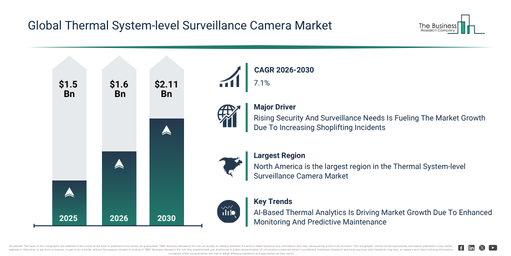
The thermal system-level surveillance camera market has experienced significant expansion over recent years. Its valuation is set to increase from $1.5 billion in 2025 to $1.6 billion in 2026, achieving a compound annual growth rate (CAGR) of 6.8%. The historical rise in market size can be attributed to heightened security and surveillance demands, the adoption of fixed thermal cameras in defense sectors, a growing requirement for monitoring during night-time and in poor light, the proliferation of border and perimeter security endeavors, and expanded funding for military and homeland security.
The thermal system-level surveillance camera market is set for significant growth in the upcoming years, with projections indicating it will achieve a valuation of $2.11 billion by 2030, exhibiting a compound annual growth rate (CAGR) of 7.1%. This expansion during the forecast period is primarily driven by the increasing deployment of portable thermal cameras in field operations, greater integration with AI-based analytics, a rising demand for wearable and helmet-mounted thermal systems, the broader application of counter-UAS technologies, and an intensified focus on networked and system-level surveillance. Concurrently, major trends expected in this period include the growing adoption of portable and handheld thermal cameras, an escalating need for multi-sensor integration to enhance detection, the expanding implementation of PTZ and dome-mounted cameras, advancements in long-range and high-resolution thermal imaging, and a heightened emphasis on counter-unmanned aircraft systems (C-UAS).
Get A Free Sample Report With In-Depth Market Insights:
Thermal System-level Surveillance Camera Market Growth Factors Behind Sustained Expansion
The growing requirements for security and surveillance are anticipated to boost the expansion of the thermal system-level surveillance camera market moving forward. These increasing security and surveillance needs denote the heightened demand for continuous monitoring and threat detection across various public areas, critical infrastructure, and sensitive locations to ensure safety and prevent potential security breaches. This rise in demand is attributed to the escalating frequency of security incidents and the necessity for improved monitoring across urban and industrial environments. Thermal system-level surveillance cameras support these evolving security and surveillance requirements by enabling uninterrupted monitoring and precise threat detection in challenging conditions where conventional cameras might fail, such as in darkness, fog, smoke, or glare. For example, according to data from the Government Of Canada, a Canada-based police-reported crime source, police recorded 182,361 incidents of shoplifting of $5,000 or under (442 incidents per 100,000 population) in 2024, as reported in July 2025, representing a 14% increase from 2023. The rate of shoplifting has consistently risen for four consecutive years, showing a 66% increase during the period from 2014 to 2024. Therefore, the escalating security and surveillance needs are expected to drive the growth of the thermal system-level surveillance camera market.
Thermal System-level Surveillance Camera Market Segment Analysis And Revenue Potential
The thermal system-level surveillance camera market covered in this report is segmented –
1) By Type: Fixed Cameras, Portable And Handheld Cameras
2) By Category: Long Wavelength Infrared, Mid Wavelength Infrared, Short Wavelength Infrared
3) By Technology: Uncooled Thermal Imaging, Cooled Thermal Imaging
4) By Application: Surveillance And Targeting, Counter-Unmanned Aircraft Systems
5) By End-User: Military Or Defense, Homeland Security
Subsegments:
1) By Fixed Cameras: Perimeter Mounted Cameras, Pole Mounted Cameras, Wall Mounted Cameras, Ceiling Mounted Cameras, Pan Tilt Zoom Cameras, Bullet Type Cameras, Dome Type Cameras
2) By Portable And Handheld Cameras: Handheld Monocular Cameras, Handheld Binocular Cameras, Wearable Thermal Cameras, Rugged Field Cameras, Helmet Mounted Cameras, Portable Inspection Cameras, Battery Operated Cameras
Thermal System-level Surveillance Camera Market Industry Trends Fueling Future Revenue Growth
Major companies operating within the thermal system-level surveillance camera market are directing their efforts towards creating artificial intelligence-based thermal analytics, including radiometric thermal data processing. This strategy aims to achieve improved monitoring accuracy, strengthen predictive maintenance capabilities, and gain a competitive edge in critical infrastructure and industrial safety applications. Radiometric thermal data processing involves the analysis and interpretation of thermal imaging data where each pixel provides precise temperature measurements, which facilitates accurate detection, monitoring, and assessment of heat variations in objects or environments. For example, in January 2024, Hanwha Vision, a South Korea-based security solutions company, unveiled New AI-Based Radiometric Thermal Cameras. These new cameras offer advanced monitoring by combining artificial intelligence with precise temperature measurement functionalities. They enable the accurate detection of heat variations across different environments, thereby supporting predictive maintenance and early fault identification. Furthermore, these cameras maintain clear imaging quality even under difficult conditions such as darkness, smoke, and fog.
Thermal System-level Surveillance Camera Market Key Participants And Competitive Landscape
Major companies operating in the thermal system-level surveillance camera market are RTX Corporation, Northrop Grumman Corporation, BAE Systems plc, Safran Electronics and Defense SAS, Thales SA, L3Harris Technologies Inc., Leonardo SpA, Hangzhou Hikvision Digital Technology Co Ltd, Rheinmetall AG, Elbit Systems Ltd., Teledyne FLIR LLC, Zhejiang Dahua Technology Co. Ltd., HENSOLDT AG, Axis Communications AB, Hanwha Vision Co. Ltd., Seek Thermal, Opgal Optronic Industries Ltd, Bosch Sicherheitssysteme GmbH, InfraTec GmbH Infrarotsensorik und Messtechnik, Xenics NV.
View The Full Thermal System-level Surveillance Camera Market Report:
Thermal System-level Surveillance Camera Market Geographic Analysis: Where Is Demand Accelerating Fastest?
North America was the largest region in the thermal system-level surveillance camera market in 2025. Asia-Pacific is expected to be the fastest-growing region in the forecast period. The regions covered in the thermal system-level surveillance camera market report are Asia-Pacific, South East Asia, Western Europe, Eastern Europe, North America, South America, Middle East, Africa.
Reach Out To Our Team:
The Business Research Company: https://www.thebusinessresearchcompany.com/
Americas: +1 310-496-7795
Asia: +44 7882 955267 & +91 8897263534
Europe: +44 7882 955267
Email us at: marketing@tbrc.info
Follow us on:
LinkedIn: https://in.linkedin.com/company/the-business-research-company
YouTube: https://www.youtube.com/channel/UC24_fI0rV8cR5DxlCpgmyFQ
Global Market Model: https://www.thebusinessresearchcompany.com/global-market-model

Wasay has over a decade of experience in market research, data modelling, and analytics, with prior experience at GlobalData and Decision Tree Consulting Services. At The Business Research Company , he leads research operations across syndicated studies, customized consulting engagements, and the Global Market Model platform. His professional experience includes supporting organizations such as Boston Consulting Group, KPMG, and Ernst & Young. Wasay holds a degree in Electronics and Communications Engineering, postgraduate management qualifications from International Management Institute Belgium and Indian School of Business and Entrepreneurship, and completed the Integrated Program in Business Analytics from Indian Institute of Management Indore.