
Built to provide research that’s more actionable and strategically valuable, The Business Research Company’s 2026 market reports include market attractiveness analysis, total addressable market sizing, company benchmarking matrices, interactive Excel dashboards, broader supply chain intelligence, emerging startup tracking, and in-depth product insights.
Work-Integrated Learning Market Value Growth And Long-Term Outlook
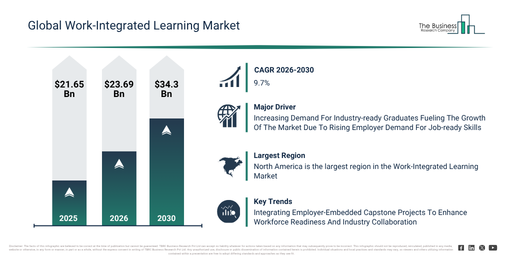
The work-integrated learning market size has demonstrated significant expansion in recent years. It is anticipated to expand from $21.65 billion in 2025 to $23.69 billion in 2026, registering a compound annual growth rate (CAGR) of 9.5%. The market’s past growth can be ascribed to several factors, including the increasing acknowledgement of the benefits of experiential learning, the rise in collaborations between universities and industries, the escalating demand for graduates ready for the workforce, the widespread adoption of structured internship and apprenticeship programs, and the expansion of vocational training initiatives.
The work-integrated learning market is set for significant expansion over the next few years, with its size projected to reach $34.3 billion by 2030, exhibiting a compound annual growth rate (CAGR) of 9.7%. This growth during the forecast period is propelled by the increasing incorporation of AI and digital technologies in WIL, heightened corporate engagement in apprenticeship and mentoring initiatives, an intensified focus on global mobility and international placements, the broader availability of online and virtual work-integrated learning opportunities, and the adoption of competency-based assessment and evaluation frameworks. Noteworthy trends expected in this timeframe include a rise in hybrid WIL delivery models, an escalating demand for corporate training integration, an increased emphasis on international cooperative education programs, the proliferation of virtual and simulation-based clinical placements, and a stronger focus on project-based and capstone industry projects.
Get A Free Sample Report With In-Depth Market Insights:
Work-Integrated Learning Market Growth Catalysts And Demand Drivers
The future expansion of the work-integrated learning market is anticipated due to a growing need for graduates prepared for the industry. Industry-ready graduates are students equipped with practical skills, real-world experience, and job-relevant competencies, enabling a smooth transition into the workforce. This rising demand stems from employers’ increasing emphasis on job-ready abilities, which encourages educational institutions to align their curricula with industry requirements and hands-on training. Work-integrated learning supports the development of industry-ready graduates by providing practical, real-world workplace exposure that builds relevant skills, professional competencies, and applied knowledge. For instance, in October 2023, the Confederation of International Contractors’ Associations, an Australia-based organization, reported that 36% of assessed occupations (332 out of 916) faced national shortages in 2023, an increase of 5 percentage points compared to 2022. Consequently, the increasing demand for industry-ready graduates is driving the growth of the work-integrated learning market.
Work-Integrated Learning Market Segment Breakdown: Which Categories Lead On Revenue?
The work-integrated learning market covered in this report is segmented –
1) By Type: Apprenticeships, Internships, Cooperative Education, Service Learning, Clinical Placements, Other Types
2) By Delivery Mode: Onsite, Online, Hybrid
3) By Application: Higher Education, Vocational Training, Corporate Training, Other Applications
4) By End User: Students, Educational Institutions, Employers
Subsegments:
1) By Apprenticeships: Registered Apprenticeships, Industry Sponsored Apprenticeships, Youth Apprenticeships, Trade Based Apprenticeships, Degree Linked Apprenticeships
2) By Internships: Paid Internships, Unpaid Internships, Full Time Internships, Part Time Internships, Virtual Internships
3) By Cooperative Education: Alternating Term Cooperative Education, Parallel Cooperative Education, Project Based Cooperative Education, Industry Partnership Cooperative Education, International Cooperative Education
4) By Service Learning: Community Based Service Learning, Curriculum Integrated Service Learning, Field Based Service Learning, Civic Engagement Service Learning, Research Oriented Service Learning
5) By Clinical Placements: Hospital Based Clinical Placements, Primary Care Clinical Placements, Specialty Clinical Placements, Simulation Based Clinical Placements, Community Health Clinical Placements
6) By Other Types: Work Based Projects, Industry Mentorship Programs, Professional Practicum Programs, Capstone Industry Projects, Entrepreneurial Work Experience Programs
Work-Integrated Learning Market Trends Shaping Long-Term Demand
Leading entities in the work-integrated learning sector are concentrating on advanced programs, such as employer-integrated capstone projects, to bolster cooperation between educational establishments and businesses, thereby enhancing the readiness of graduates for the workforce. These employer-embedded capstone projects represent academic modules crafted in partnership with industry stakeholders and woven into the curriculum, allowing students to engage with genuine business challenges while acquiring practical skills. For example, in May 2025, Arizona State University, a US-based public research university, introduced the Work-Integrated Learning Accelerator, a nationwide endeavor focused on incorporating hands-on industry experience into academic curricula. This initiative, supported by funding from prominent companies, unites universities, employers, and education technology startups to jointly develop scalable work-integrated learning frameworks. The program prioritizes embedding real-world projects and employer interaction within coursework, consequently boosting student involvement in practical education, fortifying industry ties, and improving employment outcomes after graduation.
Work-Integrated Learning Market Key Participants And Competitive Landscape
Major companies operating in the work-integrated learning market are Accenture plc, International Business Machines Corporation, Cisco Systems Inc., Oracle Corporation, Tata Motors Limited, Morgan Stanley, SAP SE, Tata Consultancy Services Limited, Randstad N.V., Fujitsu Limited, Capgemini SE, Cognizant Technology Solutions Corporation, Infosys Limited, Jio Platforms Limited (Reliance Jio Infocomm Limited), HCL Technologies Limited, Atos SE, Wipro Limited, CGI Inc., Tata Power Company Limited, Tech Mahindra Limited, Bharat Forge Limited, SKF Group (AB SKF).
View The Full Work-Integrated Learning Market Report:
Work-Integrated Learning Market Geographic Analysis: Where Is Demand Rising Fastest?
North America was the largest region in the work-integrated learning platforms market in 2025. Asia-Pacific is expected to be the fastest-growing region in the forecast period. The regions covered in the work-integrated learning market report are Asia-Pacific, South East Asia, Western Europe, Eastern Europe, North America, South America, Middle East, Africa.
Reach Out To Our Team:
The Business Research Company: https://www.thebusinessresearchcompany.com/
Americas: +1 310-496-7795
Asia: +44 7882 955267 & +91 8897263534
Europe: +44 7882 955267
Email us at: marketing@tbrc.info
Follow us on:
LinkedIn: https://in.linkedin.com/company/the-business-research-company
YouTube: https://www.youtube.com/channel/UC24_fI0rV8cR5DxlCpgmyFQ
Global Market Model: https://www.thebusinessresearchcompany.com/global-market-model

Wasay has over a decade of experience in market research, data modelling, and analytics, with prior experience at GlobalData and Decision Tree Consulting Services. At The Business Research Company , he leads research operations across syndicated studies, customized consulting engagements, and the Global Market Model platform. His professional experience includes supporting organizations such as Boston Consulting Group, KPMG, and Ernst & Young. Wasay holds a degree in Electronics and Communications Engineering, postgraduate management qualifications from International Management Institute Belgium and Indian School of Business and Entrepreneurship, and completed the Integrated Program in Business Analytics from Indian Institute of Management Indore.