Backed by market attractiveness analysis, total addressable market sizing, company benchmarking matrices, interactive Excel dashboards, wider supply chain intelligence, emerging startup coverage, and detailed product-level insights, The Business Research Company’s 2026 market reports are designed to offer research that is more actionable and strategically valuable than ever.
Analytics Market Size, Value And Growth Trajectory Through 2030
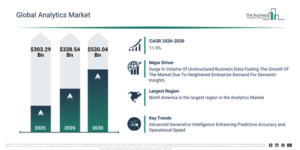
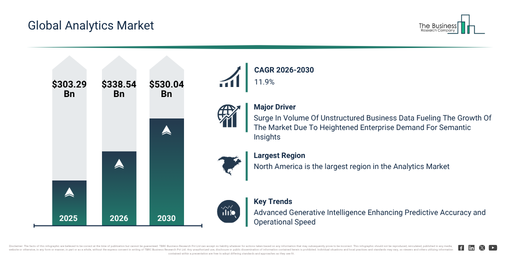
The analytics market has experienced substantial growth in recent times. Its size is forecast to expand from $303.29 billion in 2025 to $338.54 billion in 2026, exhibiting a compound annual growth rate (CAGR) of 11.6%. This historical development can be linked to factors such as the increasing digitization of business operations, the wider embrace of business intelligence reporting tools, a rising need for operational reporting and dashboards, the expansion of systems for collecting structured data, and the greater application of statistical analysis in making decisions.
The analytics market is projected for substantial expansion in the coming years, reaching a valuation of $530.04 billion by 2030, exhibiting a compound annual growth rate (CAGR) of 11.9%. This anticipated growth during the forecast period is fueled by several factors, including the increasing embrace of real-time analytics and streaming data processing, a heightened need for predictive and prescriptive business insights, a greater corporate emphasis on data-driven decision-making, the proliferation of cloud-based analytics solutions, and an escalating requirement for analytics that support regulatory and data privacy adherence. Key developments expected throughout this period encompass the wider acceptance of self-service business intelligence tools, a surge in the demand for data governance and quality management offerings, an escalating utilization of real-time streaming analytics platforms, the broadening application of specialized analytics across various business operations, and the progressive integration of older data warehouses with contemporary analytics systems.
Get A Free Sample Report With In-Depth Market Insights:
Analytics Market Industry Drivers: What’s Behind The Revenue Growth?
The expanding volume of unstructured business data is projected to boost the growth of the analytics market. Unstructured business data refers to information that doesn’t reside in traditional row-column databases and lacks a predefined data model. Its volume is increasing as organizations generate vast quantities of text, video, and social media content through expanding digital touchpoints. Analytics empowers organizations to effectively manage this growing volume of unstructured business data by utilizing machine learning and natural language processing to transform disorganized content into structured, actionable intelligence. For instance, in June 2024, the UK Business Data Survey 2024, published by GOV.UK, a UK-based public information website, revealed that almost all (99%) businesses with at least 10 employees handled digitized data in 2024. Additionally, 14% of businesses managing digitized data shared it outside their organization, indicating increasing data sophistication, while approximately one-fifth (21%) analyzed data to generate new insights and knowledge. Furthermore, 2% of businesses leveraged data for artificial intelligence or automated decision-making purposes, a percentage that rose to 12% among large businesses. Therefore, the growing volume of unstructured business data is expected to drive the growth of the analytics market.
Analytics Market Segmentation And Category Overview
The analytics market covered in this report is segmented –
1) By Type: Predictive Analytics, Prescriptive Analytics, Descriptive Analytics, Diagnostic Analytics
2) By Deployment Mode: On-Premises, Cloud-Based
3) By Data Type: Structured Data Analytics, Unstructured Data Analytics, Semi-Structured Data Analytics
4) By Organization Size: Small And Medium Enterprises, Large Enterprises
5) By Process Stage: Data Collection And Ingestion, Data Processing And Storage, Data Analysis And Modeling, Insight Visualization And Reporting, Action And Decision Automation
Subsegments:
1) By Predictive Analytics: Time Series Forecasting, Regression Analysis Models, Classification Techniques, Demand Forecasting Models, Risk Prediction Models
2) By Prescriptive Analytics: Optimization Models, Simulation Techniques, Decision Analysis Systems, Recommendation Engines, Scenario Planning Tools
3) By Descriptive Analytics: Reporting And Dashboarding, Data Aggregation Techniques, Business Intelligence Reporting, Trend Analysis Methods, Performance Monitoring Tools
4) By Diagnostic Analytics: Root Cause Analysis, Drill Down Analysis, Correlation Analysis Techniques, Variance Analysis Methods, Data Discovery Tools
#Analytics Market Growth Trends: What’s Shaping The Future Outlook?
Prominent companies operating in the analytics market are prioritizing technological advancements in AI-driven analytics, including agentic analytics, to bolster their competitive standing. Agentic analytics describes autonomous systems that utilize large language models and advanced reasoning engines to actively monitor data, detect anomalies, and execute complex workflows with minimal human involvement. For instance, in February 2026, Snowflake Inc., a US-based computer software company, introduced Cortex Code, a data-native AI coding agent designed to automate end-to-end enterprise development by interpreting specific data contexts, enabling autonomous pipeline orchestration, and delivering real-time financial operations insights related to credit consumption. Consequently, these advancements in generative intelligence are enabling organizations to move from passive reporting to proactive, self-optimizing systems within the analytics market.
Analytics Market Competitive Analysis Of Leading Industry Participants
Major companies operating in the analytics market are Amazon Web Services Inc.; Google LLC; Microsoft Corporation; International Business Machines Corporation; Oracle Corporation; Salesforce Inc.; SAP SE; Cloud Software Group Inc.; SAS Institute Inc.; Snowflake Inc.; Databricks Inc.; Palantir Technologies Inc.; Teradata Corporation; Cloudera Inc.; Alteryx Inc.; MicroStrategy Incorporated; QlikTech International AB; Domo Inc.; Sisense Ltd; ThoughtSpot Inc.
View The Full Analytics Market Report:
Analytics Market Geographic Spread And Regional Opportunities
North America was the largest region in the analytics market in 2025. Asia-Pacific is expected to be the fastest-growing region in the forecast period. The regions covered in the analytics market report are Asia-Pacific, South East Asia, Western Europe, Eastern Europe, North America, South America, Middle East, Africa.
Reach Out To Our Team:
The Business Research Company: https://www.thebusinessresearchcompany.com/
Americas: +1 310-496-7795
Asia: +44 7882 955267 & +91 8897263534
Europe: +44 7882 955267
Email us at: marketing@tbrc.info
Follow us on:
LinkedIn: https://in.linkedin.com/company/the-business-research-company
YouTube: https://www.youtube.com/channel/UC24_fI0rV8cR5DxlCpgmyFQ
Global Market Model: https://www.thebusinessresearchcompany.com/global-market-model

Wasay has over a decade of experience in market research, data modelling, and analytics, with prior experience at GlobalData and Decision Tree Consulting Services. At The Business Research Company , he leads research operations across syndicated studies, customized consulting engagements, and the Global Market Model platform. His professional experience includes supporting organizations such as Boston Consulting Group, KPMG, and Ernst & Young. Wasay holds a degree in Electronics and Communications Engineering, postgraduate management qualifications from International Management Institute Belgium and Indian School of Business and Entrepreneurship, and completed the Integrated Program in Business Analytics from Indian Institute of Management Indore.