Backed by market attractiveness analysis, total addressable market sizing, company benchmarking matrices, interactive Excel dashboards, wider supply chain intelligence, emerging startup coverage, and detailed product-level insights, The Business Research Company’s 2026 market reports are designed to offer research that is more actionable and strategically valuable than ever.
Broadcast Equipment Market Revenue Growth On Track For A 7% CAGR Through 2030
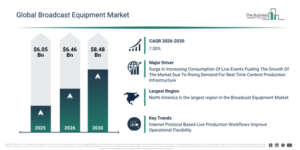
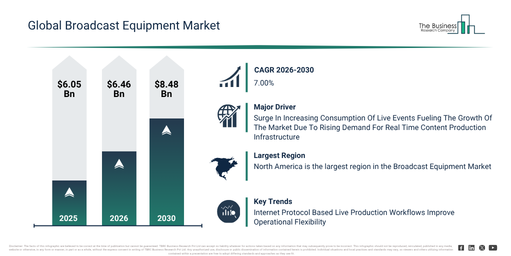
The broadcast equipment market size has experienced robust expansion in recent years. Projected figures indicate its expansion from $6.05 billion in 2025 to $6.46 billion in 2026, exhibiting a compound annual growth rate (CAGR) of 6.8%. Key factors driving this growth historically include the shift from analog to digital broadcasting infrastructure, the global proliferation of television and radio networks, rising consumer demand for superior video content, increased satellite television penetration, and the evolution of high-definition (HD) broadcasting standards.
The broadcast equipment market size is projected to undergo significant expansion in the coming years. It is anticipated to grow to $8.48 billion by 2030, demonstrating a compound annual growth rate (CAGR) of 7.0%. This growth during the forecast period can be primarily attributed to the increasing adoption of ultra high definition (uhd) and 8k broadcasting, the expansion of live streaming and hybrid media platforms, heightened investment in next-generation broadcast transmission infrastructure, the rising demand for remote and automated production facilities, and the evolution of IP convergence in media distribution networks. Noteworthy trends expected in the forecast period include the modernization of IP-based broadcast infrastructure, the growing implementation of software-defined broadcasting systems, an increasing requirement for low-latency live content delivery, the expanded deployment of hybrid satellite and terrestrial broadcast networks, and the proliferation of cloud-based playout and remote production workflows.
Get A Free Sample Report With In-Depth Market Insights:
Broadcast Equipment Market Growth Factors: What’s Supporting Expansion?
The broadcast equipment market is anticipated to expand due to the rising consumption of live events. This refers to the increasing need for real-time coverage of concerts, sports, festivals, and major public gatherings, all of which necessitate specialized systems for capture, production, and transmission. The surge in live event consumption stems from content owners and broadcasters boosting their investments in such coverage, aiming to captivate audiences with instant, premium viewing experiences. Broadcast equipment facilitates this by enabling smooth video capture, signal management, encoding, transmission, and distribution across both television and digital platforms. For example, UK Music, a UK-based collective voice and industry-funded body, reported in July 2024 that over 19.2 million music fans participated in live music events in the UK in 2023. This marks a 33% rise from the 14.4 million music tourists who attended live music events in 2022. Consequently, the expanding consumption of live events is propelling the growth of the broadcast equipment market.
Broadcast Equipment Market Segment Breakdown: Which Categories Lead On Revenue?
The broadcast equipment market covered in this report is segmented –
1) By Product: Dish Antennas, Switches, Video Servers, Encoders, Transmitters And Repeaters, Other Products
2) By Frequency: Low Frequency, Medium Frequency, High Frequency
3) By Technology: Analog Broadcasting, Digital Broadcasting
4) By Application: Radio Broadcasting, Television Broadcasting, Internet Live Streaming, Satellite Broadcasting
5) By End User: Broadcasters, Cable Network Operators, Streaming Service Providers, Production Studios
Subsegments:
1) By Dish Antennas: Parabolic Dish Antennas, Offset Dish Antennas, Prime Focus Dish Antennas, Motorized Dish Antennas, Fixed Dish Antennas, Portable Dish Antennas
2) By Switches: Video Production Switches, Master Control Switches, Routing Switches, Digital Switches, Analog Switches, Hybrid Switches
3) By Video Servers: Broadcast Video Servers, Production Video Servers, Playout Video Servers, Ingest Video Servers, Cloud Based Video Servers, On Premise Video Servers
4) By Encoders: Hardware Encoders, Software Encoders, Real Time Encoders, Batch Encoders, Single Channel Encoders, Multi Channel Encoders
5) By Transmitters And Repeaters: Television Transmitters, Radio Transmitters, Digital Transmitters, Analog Transmitters, Signal Repeaters, Gap Fillers
6) By Other Products: Signal Converters, Modulators, Demodulators, Amplifiers, Distribution Equipment, Monitoring Equipment
Broadcast Equipment Market Industry Trends: What’s Reshaping Demand?
Key players in the broadcast equipment market are prioritizing the development of sophisticated solutions, such as internet protocol-based live production workflows, aiming for a competitive edge. These internet protocol-based live production workflows leverage standard network infrastructure for the movement, switching, monitoring, and control of video and audio signals across various production settings, thereby enhancing scalability, simplifying integration, and facilitating remote and multi-location operations. As an illustration, in April 2024, Blackmagic Design Pty Ltd., an Australian company specializing in digital cinema and broadcast technology, unveiled ATEM Constellation 4K. This live production switcher features up to 20 inputs, 12 auxiliary outputs, 6 digital video effects processors, 8 chroma keyers, and 2 multiview outputs. Such capabilities significantly enhance live switching capacity, improve graphics handling, and boost monitoring efficiency for intricate productions.
Broadcast Equipment Market Competitive Landscape: Who Leads The Industry?
Major companies operating in the broadcast equipment market are Sony Group Corporation, Panasonic Holdings Corporation, Cisco Systems Inc., Canon Inc., Fujifilm Holdings Corporation, Amphenol Corporation, Dolby Laboratories Inc., CommScope Holding Company Inc., Belden Inc., Grass Valley USA LLC, Semtech Corporation, Harmonic Inc., Ceragon Networks Ltd., Evertz Microsystems Ltd., EVS Broadcast Equipment SA, Net Insight AB, ATEME S. A., Blackmagic Design Pty Ltd., Astrodesign Inc., Appear AS
View The Full Broadcast Equipment Market Report:
Broadcast Equipment Market Geographic Landscape: Which Region Leads Industry Growth?
North America was the largest region in the broadcast equipment market in 2025. Asia-Pacific is expected to be the fastest-growing region in the forecast period. The regions covered in the broadcast equipment market report are Asia-Pacific, South East Asia, Western Europe, Eastern Europe, North America, South America, Middle East and Africa.
Reach Out To Our Team:
The Business Research Company: https://www.thebusinessresearchcompany.com/
Americas: +1 310-496-7795
Asia: +44 7882 955267 & +91 8897263534
Europe: +44 7882 955267
Email us at: marketing@tbrc.info
Follow us on:
LinkedIn: https://in.linkedin.com/company/the-business-research-company
YouTube: https://www.youtube.com/channel/UC24_fI0rV8cR5DxlCpgmyFQ
Global Market Model: https://www.thebusinessresearchcompany.com/global-market-model

Wasay has over a decade of experience in market research, data modelling, and analytics, with prior experience at GlobalData and Decision Tree Consulting Services. At The Business Research Company , he leads research operations across syndicated studies, customized consulting engagements, and the Global Market Model platform. His professional experience includes supporting organizations such as Boston Consulting Group, KPMG, and Ernst & Young. Wasay holds a degree in Electronics and Communications Engineering, postgraduate management qualifications from International Management Institute Belgium and Indian School of Business and Entrepreneurship, and completed the Integrated Program in Business Analytics from Indian Institute of Management Indore.