Featuring market attractiveness scoring, total addressable market sizing, company benchmarking matrices, interactive Excel dashboards, deeper supply chain intelligence, emerging startup tracking, and granular product-level insights, The Business Research Company’s 2026 market reports are built to deliver research that is both more actionable and more strategically valuable.
Chilled Processed Food Market Size And Revenue Outlook Through 2030
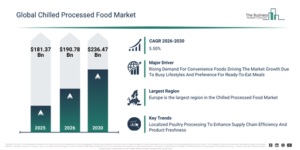
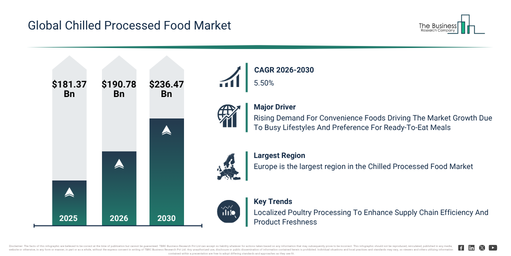
The chilled processed food market has experienced significant growth over recent years. Its valuation is projected to increase from $181.37 billion in 2025 to $190.78 billion in 2026, at a compound annual growth rate (CAGR) of 5.2%. The expansion observed in the past can be attributed to factors such as rising urbanization and busy consumer lifestyles, the expansion of modern retail and supermarkets, growing demand for convenient ready-to-eat foods, development in refrigerated logistics infrastructure, and advancements in cold storage technologies.
The chilled processed food market is anticipated to experience robust expansion over the coming years. Projections indicate it will reach $236.47 billion by 2030, exhibiting a compound annual growth rate (CAGR) of 5.5%. This growth during the forecast period is driven by several factors, including the increasing desire for fresh and minimally processed food items, the expanding reach of online food delivery services, the rise of premium chilled organic food products, the deployment of smart refrigeration and IoT-based cold chain solutions, and a heightened consumer emphasis on food safety and extended shelf life. Key developments expected in this period encompass the development of intelligent cold chain monitoring systems, a greater uptake of modified atmosphere packaging, a surge in demand for ready-to-eat chilled meals, the broadening of online grocery delivery for perishable goods, and the wider application of sophisticated refrigeration and shelf-life extension techniques.
Get A Free Sample Report With In-Depth Market Insights:
Chilled Processed Food Market Development Factors: What’s Supporting Demand?
The increasing consumer preference for convenience foods is anticipated to stimulate the expansion of the chilled processed food market in the future. Convenience foods are typically pre-processed or packaged items designed for minimal preparation, enabling quick and straightforward consumption. The growth in demand for convenience foods stems from busy lifestyles that reduce available cooking time, prompting individuals to seek easy and fast meal alternatives. Chilled processed foods play a crucial role in supporting this trend by providing ready-to-cook or ready-to-eat options that require little effort, while also maintaining freshness through refrigeration. For example, the National Association of Convenience Stores (NACS), a US-based trade association, reported in September 2025 that foodservice sales in 2024, which include prepared food, commissary items, and hot, cold, and frozen dispensed beverages, comprised 27.7% of in-store sales and 38.6% of gross margins at convenience stores. Prepared food was a major contributor, making up 72.6% of foodservice sales and showing consistent growth in its share over the past five years. Thus, the escalating demand for convenience foods is a significant factor driving the growth of the chilled processed food market.
Chilled Processed Food Market Segment Analysis: What Are The Core Market Categories?
The chilled processed food market covered in this report is segmented –
1) By Product Type: Chilled Ready Meals, Chilled Meat And Poultry, Chilled Seafood, Chilled Dairy Products, Chilled Fruits And Vegetables
2) By Packaging: Modified Atmosphere Packaging, Vacuum Packaging, Plastic Tubs And Trays, Flexible Pouches
3) By Distribution Channel: Supermarkets And Hypermarkets, Convenience Stores, Specialty Food Stores, Online Retail, Foodservice Channels, Direct Sales Or Institutional Supply
4) By End User: Household Consumers, Restaurants And Cafes, Hotels, Catering Services, Institutional Buyers
Subsegments:
1) By Chilled Ready Meals: Chilled Pasta Meals, Chilled Rice Based Meals, Chilled Ethnic Cuisine Meals, Chilled Vegetarian Ready Meals, Chilled Non Vegetarian Ready Meals, Chilled Meal Bowls, Chilled Sandwiches And Wraps
2) By Chilled Meat And Poultry: Chilled Fresh Poultry Cuts, Chilled Red Meat Cuts, Chilled Processed Meat Products, Chilled Marinated Meat Products, Chilled Minced Meat Products, Chilled Sausages And Frankfurters, Chilled Deli Meat Slices
3) By Chilled Seafood: Chilled Fish Fillets, Chilled Whole Fish, Chilled Shrimp And Prawns, Chilled Shellfish, Chilled Crab And Lobster Products, Chilled Marinated Seafood, Chilled Ready To Cook Seafood Mixes
4) By Chilled Dairy Products: Chilled Milk And Flavored Milk, Chilled Yogurt Products, Chilled Cheese Products, Chilled Cream Products, Chilled Butter And Spreads, Chilled Dairy Desserts, Chilled Fermented Dairy Products
5) By Chilled Fruits And Vegetables: Pre Cut Fruits, Fresh Cut Vegetable Packs, Ready To Eat Fruit Bowls, Salad Mixes, Washed And Trimmed Vegetables, Fruit Salads, Vegetable Snack Packs
Chilled Processed Food Market Transformation Trends: What Innovations Are Driving Change?
Major companies operating in the chilled processed food market are concentrating on developing innovative solutions, such as localized chilled poultry processing. This approach is designed to enhance supply chain efficiency, maintain product freshness, satisfy regional taste preferences, and reduce cold-chain logistics costs. Localized chilled poultry processing involves the handling and chilling of poultry in close proximity to consumption markets, which helps minimize transit time, sustain quality, and lower distribution expenses. As an illustration, in July 2025, BRF S. A., a food processing company from Brazil, introduced its inaugural chilled chicken product line in Saudi Arabia, featuring items that were locally processed and packaged under its established brands. This launch serves to strengthen BRF’s expansion within the Gulf’s expanding chilled poultry segment and aligns with its strategy of bolstering localized production of chilled and processed foods within the kingdom.
Chilled Processed Food Market Leading Players And Competitive Positioning
Major companies operating in the chilled processed food market are Nestlé S. A., Tyson Foods Inc., The Kraft Heinz Company, Conagra Brands Inc., Unilever PLC, General Mills Inc., JBS S. A., Hormel Foods Corporation, WH Group Limited, Danone S. A., Kerry Group, Maple Leaf Foods Inc., OSI Group LLC, Greencore Group plc, Ajinomoto Co. Inc., Sigma Alimentos S. A. de C. V., Danish Crown A/S, Nippon Ham Co. Ltd., Perdue Farms Inc., 2 Sisters Food Group Limited, Signature International Foods India Private Limited
View The Full Chilled Processed Food Market Report:
Chilled Processed Food Market Regional Split: Which Areas Are Fueling Growth?
Europe was the largest region in the chilled processed food market in 2025. Asia-Pacific is expected to be the fastest-growing region in the forecast period. The regions covered in the chilled processed food market report are Asia-Pacific, South East Asia, Western Europe, Eastern Europe, North America, South America, Middle East and Africa.
Reach Out To Our Team:
The Business Research Company: https://www.thebusinessresearchcompany.com/
Americas: +1 310-496-7795
Asia: +44 7882 955267 & +91 8897263534
Europe: +44 7882 955267
Email us at: marketing@tbrc.info
Follow us on:
LinkedIn: https://in.linkedin.com/company/the-business-research-company
YouTube: https://www.youtube.com/channel/UC24_fI0rV8cR5DxlCpgmyFQ
Global Market Model: https://www.thebusinessresearchcompany.com/global-market-model

Wasay has over a decade of experience in market research, data modelling, and analytics, with prior experience at GlobalData and Decision Tree Consulting Services. At The Business Research Company , he leads research operations across syndicated studies, customized consulting engagements, and the Global Market Model platform. His professional experience includes supporting organizations such as Boston Consulting Group, KPMG, and Ernst & Young. Wasay holds a degree in Electronics and Communications Engineering, postgraduate management qualifications from International Management Institute Belgium and Indian School of Business and Entrepreneurship, and completed the Integrated Program in Business Analytics from Indian Institute of Management Indore.