
Backed by market attractiveness analysis, total addressable market sizing, company benchmarking matrices, interactive Excel dashboards, wider supply chain intelligence, emerging startup coverage, and detailed product-level insights, The Business Research Company’s 2026 market reports are designed to offer research that is more actionable and strategically valuable than ever.
Co-Digestion Facility Market Size, Value And Growth Trajectory Through 2030
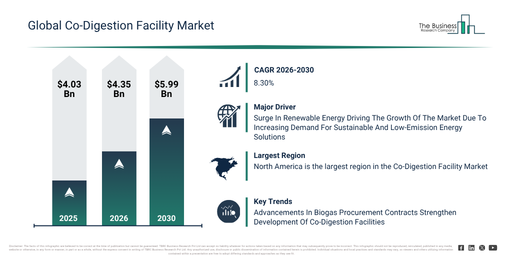
The co-digestion facility market size has shown strong growth in recent years. It is expected to expand from $4.03 billion in 2025 to $4.35 billion in 2026, achieving a compound annual growth rate (CAGR) of 8.1%. This historical growth can be linked to factors such as an increase in municipal waste generation, more stringent landfill diversion regulations, the expansion of renewable energy initiatives, growing awareness of bioenergy benefits, and the early adoption of anaerobic digestion technologies.
The co-digestion facility market size is projected to experience robust expansion over the coming years, reaching $5. 99 billion by 2030 at a compound annual growth rate (CAGR) of 8. 3%. This growth during the forecast period can be attributed to several factors, including stricter global carbon emission reduction objectives, a rising need for renewable biogas energy, the broader implementation of circular economy policies, increased investment in sustainable waste management infrastructure, and the growing embrace of decentralized energy systems. Key trends anticipated within the forecast period encompass the integration of multi-feedstock anaerobic digestion systems to enhance biogas yield, the proliferation of decentralized waste-to-energy co-digestion plants, a greater uptake of advanced pretreatment technologies for optimizing organic waste, the increasing utilization of nutrient recovery systems from digestate for circular agriculture, and the expanding deployment of modular and scalable co-digestion infrastructure within urban waste management.
Get A Free Sample Report With In-Depth Market Insights:
Co-Digestion Facility Market Growth Factors Behind Sustained Expansion
The escalating requirement for renewable energy is anticipated to drive the expansion of the co-digestion facility market in the future. Renewable energy refers to power sourced from naturally regenerating supplies such as sunlight, wind, water, biomass, and geothermal heat, presenting sustainable and eco-friendly alternatives to conventional fuels. This demand is rising due to increasing environmental concerns and the necessity to lower greenhouse gas emissions, thus supporting a move towards cleaner and more sustainable energy frameworks. Co-digestion facilities aid in renewable energy production by processing various organic waste streams into biogas through anaerobic digestion, thereby boosting resource efficiency while generating sustainable power. For example, in June 2025, the Department of Climate Change, Energy, the Environment, and Water, an Australia-based government agency, reported that renewable energy sources generated approximately 102,403 GWh. This constituted 36% of Australia’s total electricity production, representing an increase of one percentage point compared to 2023. Hence, the surging demand for renewable energy is propelling the growth of the co-digestion facility market.
Co-Digestion Facility Market Segment Landscape And Growth Outlook
The co-digestion facility market covered in this report is segmented –
1) By Feedstock Type: Agricultural Waste, Food Waste, Industrial Waste, Municipal Solid Waste, Other Feedstock Types
2) By Technology: Wet Digestion, Dry Digestion, Two-Stage Digestion, Other Technologies
3) By Application: Biogas Production, Waste Management, Energy Generation, Other Applications
4) By End-User: Municipalities, Industrial, Agricultural, Commercial, Other End-Users
Subsegments:
1) By Agricultural Waste: Crop Residue Waste, Animal Manure Waste, Poultry Waste, Dairy Farm Waste, Agro Processing Waste
2) By Food Waste: Household Food Waste, Restaurant Food Waste, Food Processing Waste, Retail Food Waste, Catering Food Waste
3) By Industrial Waste: Food And Beverage Industry Waste, Pulp And Paper Industry Waste, Textile Industry Organic Waste, Pharmaceutical Industry Organic Waste, Chemical Industry Organic Waste
4) By Municipal Solid Waste: Organic Household Waste, Green Waste, Market Waste, Sewage Sludge, Biodegradable Urban Waste
5) By Other Feedstock Types: Garden Waste, Slaughterhouse Waste, Fishery Waste, Dairy Processing Waste, Brewery Waste
Co-Digestion Facility Market Industry Trends Fueling Future Revenue Growth
Major companies active in the co-digestion facility market are concentrating on establishing long-term biogas procurement contracts to boost project viability, ensure steady revenue, and accelerate the implementation of integrated waste-to-energy solutions. Biogas procurement agreements refer to pacts where utility providers or energy companies commit to purchasing renewable natural gas generated from organic waste and wastewater treatment processes, thereby supporting sustainable energy production and waste management. For instance, in March 2026, Anaergia Inc., a renewable energy company based in Canada, secured California’s first biogas procurement contract directly linked to wastewater infrastructure. The project involves upgrading biogas produced from wastewater and organic waste streams into renewable natural gas, which will then be supplied to utility companies, consequently promoting co-digestion practices, lowering greenhouse gas emissions, and aiding the transition towards energy systems based on a circular economy.
Co-Digestion Facility Market Company Landscape And Competitive Strategy
Major companies operating in the co-digestion facility market are Veolia Environnement S. A., Xylem Inc., Kanadevia Inova AG, EnviTec Biogas AG, HoSt B. V., Anaergia Inc., Eggersmann Gruppe GmbH & Co. KG, WELTEC BIOPOWER GmbH, Thöni Industriebetriebe GmbH, DVO Inc., Cambrian Innovation Inc., Paques B. V., BTA International GmbH, BIOFerm Energy Systems Inc., PlanET Biogas Global GmbH, SEaB Energy Limited, Bright Biomethane B. V., Viessmann Group, Naskeo Environnement S. A. S., Fluence Corporation Limited
View The Full Co-Digestion Facility Market Report:
Co-Digestion Facility Market Largest Region: Which Geography Holds The Biggest Share?
North America was the largest region in the co-digestion facility market in 2025. Asia Pacific is expected to be the fastest-growing region in the forecast period. The regions covered in the co-digestion facility market report are Asia-Pacific, South East Asia, Western Europe, Eastern Europe, North America, South America, Middle East and Africa.
Reach Out To Our Team:
The Business Research Company: https://www.thebusinessresearchcompany.com/
Americas: +1 310-496-7795
Asia: +44 7882 955267 & +91 8897263534
Europe: +44 7882 955267
Email us at: marketing@tbrc.info
Follow us on:
LinkedIn: https://in.linkedin.com/company/the-business-research-company
YouTube: https://www.youtube.com/channel/UC24_fI0rV8cR5DxlCpgmyFQ
Global Market Model: https://www.thebusinessresearchcompany.com/global-market-model

Wasay has over a decade of experience in market research, data modelling, and analytics, with prior experience at GlobalData and Decision Tree Consulting Services. At The Business Research Company , he leads research operations across syndicated studies, customized consulting engagements, and the Global Market Model platform. His professional experience includes supporting organizations such as Boston Consulting Group, KPMG, and Ernst & Young. Wasay holds a degree in Electronics and Communications Engineering, postgraduate management qualifications from International Management Institute Belgium and Indian School of Business and Entrepreneurship, and completed the Integrated Program in Business Analytics from Indian Institute of Management Indore.