
Featuring market attractiveness scoring, total addressable market sizing, company benchmarking matrices, interactive Excel dashboards, deeper supply chain intelligence, emerging startup tracking, and granular product-level insights, The Business Research Company’s 2026 market reports are built to deliver research that is both more actionable and more strategically valuable.
Mobile Device Repair Parts Market Size, Value And Growth Trajectory Through 2030
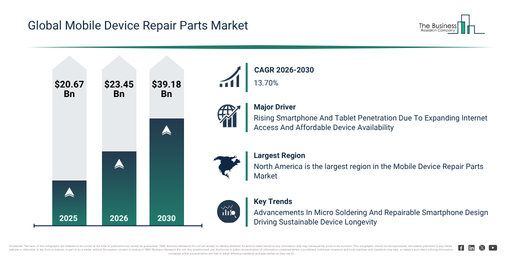
The mobile device repair parts market has seen significant growth in recent times. It is projected to increase from $20.67 billion in 2025 to $23.45 billion in 2026, exhibiting a compound annual growth rate (CAGR) of 13.5%. Historically, this expansion can be attributed to factors such as greater smartphone adoption, higher rates of device damage, the proliferation of independent repair establishments, the broader availability of spare parts through e-commerce, and the restricted repairability of older device models.
The mobile device repair parts market is projected to experience substantial expansion over the coming years, reaching a valuation of $39. 18 billion by 2030, exhibiting a compound annual growth rate (CAGR) of 13. 7%. This anticipated growth is driven by several factors, including the expansion of right to repair legislation, a rising demand for sustainable electronics lifecycle solutions, the increasing integration of modular smartphone components, advancements in AI-powered diagnostic repair tools, and the broadening of localized repair and parts distribution networks. Key trends during this projection period encompass the broadening of right to repair regulations, the expansion of the independent mobile repair ecosystem, an increase in the availability of certified aftermarket spare parts, the development of rapid supply chains and same-day parts distribution, and a growing need for systems that grade and authenticate device repair quality.
Get A Free Sample Report With In-Depth Market Insights:
Mobile Device Repair Parts Market Demand Drivers: What’s Powering Industry Growth?
The expanding presence of smartphones and tablets is projected to fuel the growth of the mobile device repair parts market in the future. Smartphone and tablet penetration refers to the proportion of people in a population who possess or actively utilize these devices. The increase in smartphone and tablet penetration indicates a growing number of individuals adopting these devices, attributed to better affordability, enhanced internet infrastructure, and a wider range of digital services. Mobile device repair parts support this by making device upkeep and fixes more economical, enabling users to extend their devices’ operational life. For instance, in March 2026, according to a report from Demandsage, a US-based SaaS company, around 5.78 billion people worldwide use smartphones, demonstrating their widespread acceptance, while the total number of smartphones in use has exceeded 7.58 billion, showing that many individuals own multiple devices. Hence, the increasing smartphone penetration is a significant driver for the growth of the mobile device repair parts market.
Mobile Device Repair Parts Market Segment Performance And Emerging Opportunities
The mobile device repair parts market covered in this report is segmented –
1) By Product Type: Display Screens, Batteries, Camera Modules, Connectors, Buttons, Speakers, Other Product Types
2) By Device Type: Smartphones, Tablets, Wearables, Other Device Types
3) By Distribution Channel: Online Stores, Offline Retailers, Service Centers, Other Distribution Channels
4) By End User: Individual Consumers, Repair Shops, Enterprises, Other End Users
Subsegments:
1) By Display Screens: Liquid Crystal Display Screens, Organic Light Emitting Diode Screens, Touchscreen Digitizer Screens, In Cell Display Screens, Edge To Edge Display Screens
2) By Batteries: Lithium Ion Batteries, Lithium Polymer Batteries, High Capacity Replacement Batteries, Fast Charging Compatible Batteries, Standard Capacity Batteries
3) By Camera Modules: Rear Camera Modules, Front Camera Modules, Wide Angle Camera Modules, Telephoto Camera Modules, Depth Sensing Camera Modules
4) By Connectors: Charging Port Connectors, Audio Jack Connectors, Flexible Printed Circuit Connectors, Board To Board Connectors, Universal Serial Bus Connectors
5) By Buttons: Power Buttons, Volume Control Buttons, Home Buttons, Side Control Buttons, Fingerprint Sensor Buttons
6) By Speakers: Loudspeaker Modules, Earpiece Speakers, Stereo Speaker Units, Miniature Speaker Components, Replacement Speaker Units
7) By Other Product Types: Microphone Components, Vibration Motor Components, Sensor Modules, Protective Housing Components, Internal Circuit Components
Mobile Device Repair Parts Market Innovation Trends: What Developments Are Reshaping The Industry?
Major companies operating in the mobile device repair parts market are directing their efforts towards developing sophisticated solutions, including micro soldering repair systems, to improve repair precision, enhance component-level restoration, extend the useful life of electronic devices, and reduce replacement costs. Micro soldering repair systems are defined as precise repair technologies that enable technicians to fix damaged circuit components at a microscopic level, thereby improving the accuracy of repairs and diminishing the need for a full component replacement. For example, in February 2023, HMD Global, a consumer electronics company based in Finland, unveiled the Nokia G22 smartphone, designed to offer superior repairability and sustainability by allowing users to easily replace key components such as the display, battery, and charging port. HMD Global introduced the Nokia G22 with a user-friendly repairable design that permits simple replacement of essential components like the battery, display, and charging port using basic tools and step-by-step instructions. It also features a collaboration with iFixit for affordable spare parts, alongside a sustainable construction made from 100% recycled plastic, thus boosting device longevity and eco-friendliness.
Mobile Device Repair Parts Market Top Companies Driving Competitive Growth
Major companies operating in the mobile device repair parts market are Apple Inc., Hon Hai Precision Industry Co. Ltd., Samsung Electronics Co. Ltd., Huawei Technologies Co. Ltd., Sony Group Corporation, BYD Electronic (International) Company Limited, LG Electronics Inc., Lenovo Group Limited, Xiaomi Corporation, Luxshare Precision Industry Co. Ltd., Vivo Communication Technology Co. Ltd., TCL Technology Group Corporation, Nokia Corporation, ZTE Corporation, ASUSTeK Computer Inc., OPPO Electronics Corp., Sunwoda Electronic Co. Ltd., HTC Corporation, OnePlus Technology (Shenzhen) Co. Ltd., Motorola Mobility LLC
View The Full Mobile Device Repair Parts Market Report:
Mobile Device Repair Parts Market Global Footprint: Which Region Leads The Market?
North America was the largest region in the mobile device repair parts market in 2025. Asia Pacific is expected to be the fastest-growing region in the forecast period. The regions covered in the mobile device repair parts market report are Asia-Pacific, South East Asia, Western Europe, Eastern Europe, North America, South America, Middle East and Africa.
Reach Out To Our Team:
The Business Research Company: https://www.thebusinessresearchcompany.com/
Americas: +1 310-496-7795
Asia: +44 7882 955267 & +91 8897263534
Europe: +44 7882 955267
Email us at: marketing@tbrc.info
Follow us on:
LinkedIn: https://in.linkedin.com/company/the-business-research-company
YouTube: https://www.youtube.com/channel/UC24_fI0rV8cR5DxlCpgmyFQ
Global Market Model: https://www.thebusinessresearchcompany.com/global-market-model

Wasay has over a decade of experience in market research, data modelling, and analytics, with prior experience at GlobalData and Decision Tree Consulting Services. At The Business Research Company , he leads research operations across syndicated studies, customized consulting engagements, and the Global Market Model platform. His professional experience includes supporting organizations such as Boston Consulting Group, KPMG, and Ernst & Young. Wasay holds a degree in Electronics and Communications Engineering, postgraduate management qualifications from International Management Institute Belgium and Indian School of Business and Entrepreneurship, and completed the Integrated Program in Business Analytics from Indian Institute of Management Indore.

