Built to provide research that’s more actionable and strategically valuable, The Business Research Company’s 2026 market reports include market attractiveness analysis, total addressable market sizing, company benchmarking matrices, interactive Excel dashboards, broader supply chain intelligence, emerging startup tracking, and in-depth product insights.
Monolithic Refractories Market Growth Potential: How Will Market Size Shift Through 2030?
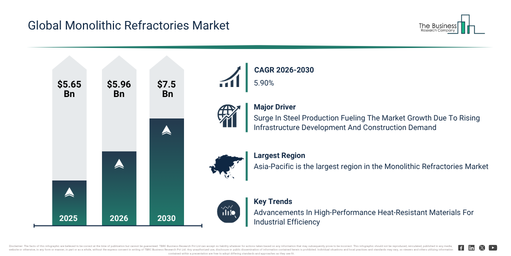
The market for monolithic refractories has demonstrated robust expansion recently. Projections indicate its value will increase from $5.65 billion in 2025 to $5.96 billion by 2026, exhibiting a compound annual growth rate (CAGR) of 5.6%. Historically, this growth has been driven by factors such as the expanding production capabilities of steel and cement, a heightened need for high-temperature industrial furnaces, the increased utilization of basic refractory materials within metallurgy, the development of petrochemical processing infrastructure, and initial efforts in modernizing industrial kiln lining systems.
The monolithic refractories market is projected to experience substantial expansion over the upcoming years, reaching $7.5 billion by 2030 at a compound annual growth rate (CAGR) of 5.9%. This anticipated growth is driven by factors such as a growing need for energy-efficient industrial heating systems, the increasing uptake of sustainable, extended-lifecycle refractory solutions, advancements in automated industrial maintenance and repair systems, the expanding non-ferrous metal processing sectors, and more stringent environmental regulations promoting the use of advanced refractories. Key trends influencing the market during this period encompass sophisticated monolithic refractory formulations offering improved thermal shock resistance, the wider implementation of low cement and ultra low cement castables for efficient furnace linings, the growing utilization of gunning and shotcrete methods for swift industrial upkeep, the creation of corrosion-resistant refractory materials for challenging metallurgical settings, and the incorporation of automated refractory installation and monitoring systems within high-temperature industries.
Get A Free Sample Report With In-Depth Market Insights:
Monolithic Refractories Market Growth Catalysts And Demand Drivers
The expanding production of steel is anticipated to significantly advance the growth of the monolithic refractories market. Steel production is defined as the industrial method of manufacturing steel from fundamental materials such as iron ore, scrap metal, and alloying components using various techniques. This increase in steel production is attributed to rising demand, driven by rapid infrastructure expansion and large-scale construction initiatives, as growing urbanization and industrialization necessitate substantial quantities of steel for building structures, transportation networks, and energy infrastructure. Monolithic refractories play a vital role in supporting steel production by offering superior high-temperature resistance, thermal stability, and durability in critical equipment like furnaces and ladles, which enables efficient heat containment, reduces downtime, and ensures continuous, cost-effective steel manufacturing operations. For instance, in April 2026, the American Iron and Steel Institute (AISI), a US-based organization, reported that raw steel production for the week ending April 4, 2026, increased by 1.6% relative to the preceding week ending March 28, 2026, when output reached 1,803,000 net tons with a capability utilization rate of 77.9%. Thus, the growth in steel production is indeed a key driver for the monolithic refractories market.
Monolithic Refractories Market Segment Landscape: Which Areas Lead Development?
The monolithic refractories market covered in this report is segmented –
1) By Product Type: Castables, Plastic Refractories, Ramming Mixes, Gunning Mixes, Coating Refractories, Other Product Types
2) By Material: Alumina, Magnesite, Silica, Chromite, Zirconia, Other Materials
3) By Form: Dry, Wet
4) By Application: Iron And Steel, Cement, Glass, Power Generation, Non-Ferrous Metals, Petrochemicals, Other Applications
5) By End-User Industry: Metallurgy, Energy, Chemical, Other End-User Industries
Subsegments:
1) By Castables: Low Cement Castables (LCC), Ultra-Low Cement Castables (ULCC), No Cement Castables (NCC), Conventional Castables, Insulating Castables, Self-Flowing Castables, Shotcrete Castables
2) By Plastic Refractories: Phosphate-Bonded Plastics, Clay-Bonded Plastics, High Alumina Plastic Refractories, Insulating Plastic Refractories
3) By Ramming Mixes: Acidic Ramming Mixes, Basic Ramming Mixes, Neutral Ramming Mixes, Silica Ramming Mixes, Magnesite Ramming Mixes
4) By Gunning Mixes: Dry Gunning Mixes, Wet Gunning Mixes, Shotcrete Gunning Materials, High Alumina Gunning Mixes, Insulating Gunning Mixes
5) By Coating Refractories: Protective Coatings, Anti-Corrosion Coatings, Wear-Resistant Coatings, Insulating Coatings, Slag-Resistant Coatings
6) By Other Product Types: Mortars, Refractory Cements, Tundish Sprays, Tap Hole Clays, Refractory Patching Compounds
Monolithic Refractories Market Trends Shaping Long-Term Demand
Leading companies active in the monolithic refractories market are prioritizing the development of innovative offerings, specifically high-alumina castable refractories, to improve thermal efficiency and extend the operational lifespan of equipment in demanding high-temperature industrial applications. High-alumina castable refractories are unshaped refractory compositions predominantly made of high-purity alumina and bonding agents, designed to be cast into position, thereby contributing to enhanced thermal resistance, mechanical strength, and durability, while also decreasing maintenance needs and downtime in high-temperature industrial operations. For example, in November 2024, Vesuvius plc, a refractory solutions provider from the UK, launched new manufacturing plants for alumina-silica and monolithic products in Visakhapatnam, India, thereby reinforcing its capacity to produce advanced refractory materials. The recently launched monolithic solutions are formulated with high-purity alumina and silica blends, engineered to withstand extreme temperatures and corrosive chemical environments, ensuring a longer service life and reduced periods of inactivity. These materials offer improved flow properties for easier installation, superior resistance to thermal shock, and optimized performance in areas such as continuous casting and furnace linings. Additionally, these solutions promote sustainability by lowering energy consumption during their application and operation, while simultaneously serving the expanding infrastructure and steel production demands within the region.
Monolithic Refractories Market Competitive Landscape: Who Leads The Industry?
Major companies operating in the monolithic refractories market are Compagnie de Saint-Gobain S. A., Imerys S. A., RHI Magnesita N. V., Vesuvius plc, Shinagawa Refractories Co. Ltd., Puyang Refractories Group Co. Ltd., Carborundum Universal Ltd., Refratechnik Holding GmbH, Henan Refractory Group, Höganäs Borgestad Group, Alsey Refractories Co., Mahakoshal Refractories Pvt. Ltd., Zhengzhou Rongsheng Refractory Co. Ltd., Zhengzhou Huaxu Refractory Co. Ltd., Gita Refractories Pvt. Ltd., Satabdi Monolithics Industries Pvt. Ltd., Shri Balaji Refractories, Qingdao Laurent New Materials Co. Ltd., Magnezit Group, Yingkou Jinlong Refractories Group Co. Ltd., Shandong Minye Refractory Fibre Co. Ltd.
View The Full Monolithic Refractories Market Report:
Monolithic Refractories Market Geographic Landscape: Which Region Leads Industry Growth?
Asia-Pacific was the largest region in the monolithic refractories market in 2025. Asia Pacific is expected to be the fastest-growing region in the forecast period. The regions covered in the monolithic refractories market report are Asia-Pacific, South East Asia, Western Europe, Eastern Europe, North America, South America, Middle East and Africa.
Reach Out To Our Team:
The Business Research Company: https://www.thebusinessresearchcompany.com/
Americas: +1 310-496-7795
Asia: +44 7882 955267 & +91 8897263534
Europe: +44 7882 955267
Email us at: marketing@tbrc.info
Follow us on:
LinkedIn: https://in.linkedin.com/company/the-business-research-company
YouTube: https://www.youtube.com/channel/UC24_fI0rV8cR5DxlCpgmyFQ
Global Market Model: https://www.thebusinessresearchcompany.com/global-market-model

Wasay has over a decade of experience in market research, data modelling, and analytics, with prior experience at GlobalData and Decision Tree Consulting Services. At The Business Research Company , he leads research operations across syndicated studies, customized consulting engagements, and the Global Market Model platform. His professional experience includes supporting organizations such as Boston Consulting Group, KPMG, and Ernst & Young. Wasay holds a degree in Electronics and Communications Engineering, postgraduate management qualifications from International Management Institute Belgium and Indian School of Business and Entrepreneurship, and completed the Integrated Program in Business Analytics from Indian Institute of Management Indore.