Backed by market attractiveness analysis, total addressable market sizing, company benchmarking matrices, interactive Excel dashboards, wider supply chain intelligence, emerging startup coverage, and detailed product-level insights, The Business Research Company’s 2026 market reports are designed to offer research that is more actionable and strategically valuable than ever.
Hydrogen Internal Combustion Engine (ICE) Conversion Kit Market Value Growth And Long-Term Outlook
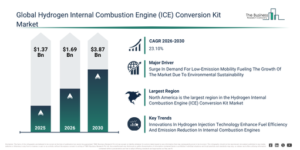
The market size for hydrogen internal combustion engine (ICE) conversion kits has experienced significant growth in recent years. It is anticipated to increase from $1. 37 billion in 2025 to $1. 69 billion in 2026, at a compound annual growth rate (CAGR) of 22. 9%. This historical growth can be attributed to escalating fuel price volatility, which fuels interest in alternative fuels, mounting regulatory pressure on vehicle emissions, the early implementation of hydrogen pilot projects in the automotive sector, an expanding base of internal combustion engine vehicles, and rising investments in alternative fuel research programs.
The market for hydrogen internal combustion engine (ICE) conversion kits is projected to experience substantial growth over the coming years. This market is anticipated to reach a valuation of $3.87 billion by 2030, exhibiting a compound annual growth rate (CAGR) of 23.1%. This expansion during the projection period stems from factors such as stricter worldwide emission standards for transportation, accelerated development of hydrogen fuel infrastructure, an uptick in fleet electrification and hybrid transitions, a greater need for low-carbon retrofit options, and broader government support for adopting hydrogen mobility. Key trends foreseen include the growing uptake of hydrogen ICE retrofit kits for commercial fleets, an increased requirement for dual-fuel hydrogen conversion systems to lower emissions, heightened interest in aftermarket engine retrofitting for older vehicles, the expansion of hydrogen fuel infrastructure that supports combustion engine uses, and an intensifying R&D effort on secure hydrogen injection and combustion optimization technologies.
Get A Free Sample Report With In-Depth Market Insights:
Hydrogen Internal Combustion Engine (ICE) Conversion Kit Market Growth Drivers: What’s Behind The Acceleration?
The rising need for low-emission mobility is anticipated to drive the expansion of the hydrogen internal combustion engine (ICE) conversion kit market in the future. Low-emission mobility denotes transport systems and vehicles that generate substantially lower greenhouse gas and pollutant emissions than traditional fossil-fuel-dependent transportation. This growing demand for low-emission mobility stems from environmental sustainability efforts, as it contributes to decreasing greenhouse gas emissions and air pollution when contrasted with conventional fossil-fuel-based transport. A hydrogen internal combustion engine (ICE) conversion kit supports low-emission mobility by allowing existing standard engines to operate on hydrogen fuel, consequently lowering carbon emissions and air pollutants compared to fossil-fuel combustion. For example, in April 2024, data from the International Energy Agency, a France-based energy organization, showed that the proportion of low-emission vehicles grew from 14% in 2022 to 18% in 2023 and is projected to exceed 20% in 2024. Consequently, the escalating demand for low-emission mobility is fueling the expansion of the hydrogen internal combustion engine (ICE) conversion kit market.
Hydrogen Internal Combustion Engine (ICE) Conversion Kit Market Segment Analysis: What Are The Core Market Categories?
The hydrogen internal combustion engine (ice) conversion kit market covered in this report is segmented –
1) By Kit Type: Partial Conversion Kits, Full Conversion Kits
2) By Fuel Type: Hydrogen-Diesel Dual Fuel, Hydrogen-Gasoline Dual Fuel, Pure Hydrogen
3) By Vehicle Type: Passenger Vehicles, Light Commercial Vehicles, Heavy Duty Trucks, Buses, Off Road And Industrial Vehicles
4) By Sales Channel: Original Equipment Retrofit Providers, Aftermarket Distributors, Online Retailers, Direct Sales By Manufacturers
5) By End-User: Original Equipment Manufacturers, Aftermarket, Fleet Operators, Individual Consumers
Subsegments:
1) By Partial Conversion Kits: Fuel Injection Conversion Kits, Ignition System Conversion Kits, Engine Control Unit Conversion Kits, Hydrogen Fuel Delivery Conversion Kits, Retrofitting And Calibration Kits
2) By Full Conversion Kits: Complete Engine Conversion Kits, Integrated Hydrogen Fuel System Kits, Full Powertrain Replacement Kits, Exhaust And Emission System Conversion Kits, Advanced Engine Management Kits
Hydrogen Internal Combustion Engine (ICE) Conversion Kit Market Trends: What’s Defining The Industry’s Next Phase?
Leading companies in the hydrogen internal combustion engine (ICE) conversion kit market are concentrating on advancing solutions, such as hydrogen injection systems, with the aim of boosting fuel efficiency, cutting operational expenses, and decreasing carbon emissions from conventional engines. Hydrogen injection technology refers to setups that introduce hydrogen gas into the air-fuel mixture of internal combustion engines, leading to more complete combustion and cleaner exhaust output. For example, in October 2023, United H2 Limited, an Australia-based clean energy technology company, unveiled Alpha H2. This hydrogen injection subsidiary focuses on lowering fuel consumption and emissions across all categories of internal combustion engines. The system is engineered to retrofit current engines, thereby improving combustion efficiency and contributing to the shift towards cleaner and more sustainable mobility solutions.
Hydrogen Internal Combustion Engine (ICE) Conversion Kit Market Competitive Analysis Of Leading Industry Participants
Major companies operating in the hydrogen internal combustion engine (ice) conversion kit market are Toyota Motor Corporation, Hyundai Motor Company, Robert Bosch GmbH, Caterpillar Inc., Daimler Truck AG, Tata Motors Limited, Cummins Inc., Eaton Corporation plc, MAN Truck & Bus SE, AVL List GmbH, DEUTZ AG, FEV Group GmbH, Ricardo plc, Westport Fuel Systems Inc., Quantron AG, H2X Global Pty Ltd, Landi Renzo S. p. A., KEYOU GmbH, ULEMCo Limited, GCK Mobility SAS, DeCarice Pty Ltd.
View The Full Hydrogen Internal Combustion Engine (ICE) Conversion Kit Market Report:
Hydrogen Internal Combustion Engine (ICE) Conversion Kit Market Geographic Distribution And Regional Opportunities
North America was the largest region in the hydrogen internal combustion engine (ICE) conversion kit market in 2025. Asia-Pacific is expected to be the fastest-growing region in the forecast period. The regions covered in the hydrogen internal combustion engine (ICE) conversion kit market report are Asia-Pacific, South East Asia, Western Europe, Eastern Europe, North America, South America, Middle East and Africa.
Reach Out To Our Team:
The Business Research Company: https://www.thebusinessresearchcompany.com/
Americas: +1 310-496-7795
Asia: +44 7882 955267 & +91 8897263534
Europe: +44 7882 955267
Email us at: marketing@tbrc.info
Follow us on:
LinkedIn: https://in.linkedin.com/company/the-business-research-company
YouTube: https://www.youtube.com/channel/UC24_fI0rV8cR5DxlCpgmyFQ
Global Market Model: https://www.thebusinessresearchcompany.com/global-market-model

Wasay has over a decade of experience in market research, data modelling, and analytics, with prior experience at GlobalData and Decision Tree Consulting Services. At The Business Research Company , he leads research operations across syndicated studies, customized consulting engagements, and the Global Market Model platform. His professional experience includes supporting organizations such as Boston Consulting Group, KPMG, and Ernst & Young. Wasay holds a degree in Electronics and Communications Engineering, postgraduate management qualifications from International Management Institute Belgium and Indian School of Business and Entrepreneurship, and completed the Integrated Program in Business Analytics from Indian Institute of Management Indore.