Built to provide research that’s more actionable and strategically valuable, The Business Research Company’s 2026 market reports include market attractiveness analysis, total addressable market sizing, company benchmarking matrices, interactive Excel dashboards, broader supply chain intelligence, emerging startup tracking, and in-depth product insights.
Home Networking Market Revenue Outlook: What CAGR Lies Ahead Through 2030?
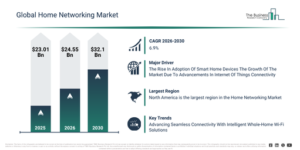
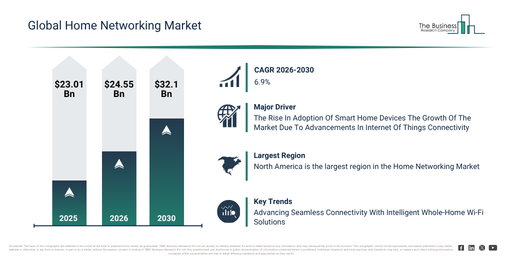
The home networking market has experienced robust expansion in recent years. This market is anticipated to expand from $23.01 billion in 2025 to $24.55 billion in 2026, demonstrating a compound annual growth rate (CAGR) of 6.7%. Historically, this expansion was driven by factors such as the increasing penetration of broadband internet in households, the growing adoption of wireless routers and modems, an increase in digital entertainment consumption, the proliferation of home computing devices, and the heightened demand for multi-device connectivity within residences.
The home networking market is projected to experience substantial expansion in the coming years. It will grow to $32.1 billion by 2030 at a compound annual growth rate (CAGR) of 6.9%. This anticipated growth during the forecast period can be linked to several factors, including the increasing need for high-speed home internet, the wider embrace of smart home systems, the expanding reach of fiber-based broadband, the proliferation of remote work environments, and the greater incorporation of sophisticated home networking hardware and software. Key trends observed within this period involve the swift uptake of mesh Wi-Fi networking systems, the growing implementation of Wi-Fi 6 and Wi-Fi 7 routers, a heightened requirement for high-bandwidth streaming connectivity, the spread of fiber-to-the-home (ftth) broadband connections, and the increasing appeal of user-friendly plug-and-play home networking kits.
Get A Free Sample Report With In-Depth Market Insights:
Home Networking Market Development Factors: What’s Supporting Demand?
The growth of the home networking market is projected to be propelled by the increasing adoption of smart home devices. These devices refer to electronic appliances and systems linked to a network, which users can remotely control, automate, or monitor to enhance convenience, efficiency, and security within a home. The rising uptake of smart home devices is attributed to advancements in Internet of Things connectivity, enabling seamless device communication, remote control via smartphones, and improved automation of daily household tasks. Home networking facilitates this seamless communication between smart home devices by providing a reliable, connected infrastructure that allows them to share data and be managed efficiently from a single system. For instance, in October 2024, according to the Central Statistics Office, an Ireland-based government agency, the percentage of internet users utilizing smart home security solutions such as internet-connected alarm systems, smoke detectors, security cameras, and smart doorbells increased from 17% in 2022 to 30% in 2024. Therefore, the expanding adoption of smart home devices is driving the growth of the home networking market.
Home Networking Market Segment Analysis And Revenue Potential
The home networking market covered in this report is segmented –
1) By Component: Hardware, Software, Services
2) By Connectivity Type: Wired, Wireless
3) By Sales Channel: Online Retailers, Offline Retailers, Direct Sales, Other Sales Channels
4) By Application: Smart Home Entertainment, Remote Working, Gaming, Video Conferencing, Other Applications
5) By End User: Residential Users, Home Offices
Subsegments:
1) By Hardware: Routers, Modems, Network Switches, Wireless Access Points, Network Attached Storage Devices
2) By Software: Network Management Software, Network Security Software, Bandwidth Monitoring Software, Parental Control Software, Device Configuration Software
3) By Services: Installation And Setup Services, Maintenance And Support Services, Network Security Services, Managed Networking Services, Consulting And Optimization Services
Home Networking Market Transformation Trends: What Innovations Are Driving Change?
Leading companies in the home networking market are concentrating on developing innovative platforms, such as managed whole-home Wi-Fi solutions, to improve seamless connectivity, optimize network performance, and support the growing demand for smart home ecosystems and high-speed broadband services. These whole-home Wi-Fi platforms are networking systems that utilize multiple connected devices, like mesh routers and extenders, to provide consistent, uninterrupted wireless internet coverage throughout an entire home without dead zones. For example, in January 2023, CommScope Holding Company Inc., a U.S.-based telecommunications equipment company, introduced HomeVantage home networking solutions at CES 2023. This comprehensive suite integrates advanced Wi-Fi technologies, cloud-based management software, and intelligent analytics to optimize home network performance. It enables service providers to remotely monitor, configure, and troubleshoot customer networks, thereby enhancing reliability and reducing service downtime. The platform also supports effortless connectivity for numerous smart home devices, offers improved cybersecurity features, and includes parental control capabilities, ensuring secure and efficient network usage. Additionally, it is designed to deliver scalable and future-ready connectivity while simultaneously lowering operational costs for service providers and boosting customer satisfaction.
Home Networking Market Competitive Landscape: Who Leads The Industry?
Major companies operating in the home networking market are Alphabet Inc; Huawei Technologies Co Ltd.; Xiaomi Corporation; Nokia Corporation; ZTE Corporation; ASUSTeK Computer Inc.; Sagemcom Broadband SAS; Sercomm Corporation; Ubiquiti Inc.; Arcadyan Technology Corporation; TP-Link Technologies Co Ltd.; ADTRAN Holdings Inc.; Netgear Inc.; MitraStar Technology Corp.; D-Link Corporation; MikroTik SIA; Actiontec Electronics Inc.; EnGenius Technologies Inc.; TRENDnet Inc.; Peplink International Ltd.
View The Full Home Networking Market Report:
Home Networking Market Geographic Landscape: Which Region Leads Industry Growth?
North America was the largest region in the home networking market in 2025. Asia-Pacific is expected to be the fastest-growing region in the forecast period. The regions covered in the home networking market report are Asia-Pacific, South East Asia, Western Europe, Eastern Europe, North America, South America, Middle East, Africa.
Reach Out To Our Team:
The Business Research Company: https://www.thebusinessresearchcompany.com/
Americas: +1 310-496-7795
Asia: +44 7882 955267 & +91 8897263534
Europe: +44 7882 955267
Email us at: marketing@tbrc.info
Follow us on:
LinkedIn: https://in.linkedin.com/company/the-business-research-company
YouTube: https://www.youtube.com/channel/UC24_fI0rV8cR5DxlCpgmyFQ
Global Market Model: https://www.thebusinessresearchcompany.com/global-market-model

Wasay has over a decade of experience in market research, data modelling, and analytics, with prior experience at GlobalData and Decision Tree Consulting Services. At The Business Research Company , he leads research operations across syndicated studies, customized consulting engagements, and the Global Market Model platform. His professional experience includes supporting organizations such as Boston Consulting Group, KPMG, and Ernst & Young. Wasay holds a degree in Electronics and Communications Engineering, postgraduate management qualifications from International Management Institute Belgium and Indian School of Business and Entrepreneurship, and completed the Integrated Program in Business Analytics from Indian Institute of Management Indore.